
AI Coding Agents vs. AI Software Engineers: What’s Changing in Modern Software Development?
Ai agents
Artificial intelligence is transforming software development faster than ever before.
Not long ago, AI tools simply suggested the next line of code. Today, they can understand an entire repository, generate new features, write tests, fix bugs, create documentation, and even submit pull requests with minimal human intervention.
This evolution isn’t just changing how developers write code; it’s reshaping the entire software development lifecycle. According to the Stack Overflow Developer Survey 2025, 84% of developers already use or plan to use AI tools in their workflow, while more than half use AI coding tools daily. Meanwhile, GitHub Copilot has surpassed 20 million users, and 90% of Fortune 100 companies have adopted it, signaling that AI-assisted development has become a mainstream enterprise capability rather than an emerging trend.
The conversation has also shifted. Businesses are no longer asking whether AI can generate code. They’re asking how autonomous AI systems can accelerate product delivery, improve software quality, and reduce engineering overhead without compromising security or maintainability.
Terms like AI Coding Agent, Agentic AI, and AI Software Engineer are appearing everywhere. While they sound similar, they represent different stages in the evolution of AI-powered software development.
The bigger question isn’t whether AI will replace developers.
It’s how developers will collaborate with increasingly autonomous AI systems to build better software, faster.
In this guide, you’ll learn:
- What AI coding agents actually are
- How they differ from AI software engineers
- Why enterprises are investing in them
- Which developer skills are becoming more valuable
- What the future of software engineering could look like
The Evolution of AI in Software Development
AI has evolved from a productivity tool into an active engineering partner. Its role in software development can be understood in three distinct phases.
Phase 1: AI-Powered Code Completion
The first generation of AI coding tools focused on one goal: to help developers write code faster.
These assistants acted like intelligent autocomplete, suggesting:
- Functions
- Variables
- Loops
- Boilerplate code
- Syntax corrections
Although relatively simple, they eliminated repetitive typing and reduced common coding errors, allowing developers to focus on logic instead of syntax.
Phase 2: AI Pair Programming
The next wave introduced conversational AI into development workflows.
Instead of simply predicting code, developers could interact with AI to:
- Explain unfamiliar code
- Generate APIs
- Write SQL queries
- Produce documentation
- Suggest code optimizations
- Debug existing applications
AI evolved into a collaborative programming partner capable of solving technical problems rather than merely completing lines of code.
This shift significantly improved developer productivity. According to JetBrains’ 2025 Developer Ecosystem Survey, 85% of developers now use AI tools for coding, and nearly 9 in 10 developers say AI saves them at least one hour every week. For many engineering teams, AI has become a standard part of the development workflow rather than an optional productivity tool.
Phase 3: AI Coding Agents
Today’s AI coding agents represent the next major leap.
Unlike earlier assistants that waited for individual prompts, coding agents can understand a broader objective, create a plan, execute multiple connected tasks, validate the results, and iterate when necessary.
For example, instead of asking AI to write a single authentication function, a developer can provide a high-level goal such as
Build a secure OAuth authentication system, update the database schema, generate unit tests, resolve existing authentication bugs, document the implementation, and prepare a pull request.
Rather than stopping after generating code, an AI coding agent works through the entire workflow from understanding the project to delivering a completed implementation.
This is a fundamental shift in how software is built.
Enterprise adoption reflects this momentum. GitHub reports that developers using Copilot complete common coding tasks up to 55% faster, enabling teams to spend more time on architecture, reviews, and solving complex business problems instead of repetitive implementation.
What Is an AI Coding Agent?
An AI coding agent is an autonomous software system designed to complete software development tasks with limited human intervention.
Unlike traditional AI assistants that respond to one prompt at a time, coding agents are capable of reasoning through an objective, breaking it into smaller tasks, and executing those tasks independently.
Modern AI coding agents can:
- Analyze an entire codebase
- Understand project architecture and dependencies
- Generate production-ready code
- Write unit and integration tests
- Debug applications
- Refactor legacy systems
- Review pull requests
- Update technical documentation
- Execute terminal commands
- Manage Git workflows
Think of an AI coding agent as a highly productive engineering teammate that can handle repetitive development work while developers focus on solving more strategic problems.
However, these agents still operate within defined boundaries. They rely on human engineers to set objectives, review outputs, validate business logic, and make architectural decisions.
How AI Coding Agents Work
Although different AI coding platforms use different architectures, most follow a similar workflow.
1. Understanding the Objective
The process begins by interpreting the developer’s request.
Rather than generating code immediately, the AI identifies the desired outcome and determines the scope of work.
2. Exploring the Codebase
The agent scans the project to understand:
- Repository structure
- Dependencies
- APIs
- Documentation
- Existing code
- Configuration files
This context enables it to generate changes that align with the existing application instead of producing isolated snippets.
3. Creating an Execution Plan
Instead of working randomly, the agent decomposes the objective into logical tasks.
For example, implementing a new feature may require:
- Creating database migrations
- Building backend APIs
- Updating frontend components
- Writing automated tests
- Modifying documentation
- Updating configuration files
This planning stage allows the AI to manage complex engineering workflows more effectively.
4. Executing Development Tasks
Once the plan is complete, the AI begins implementation.
Depending on the platform, it may:
- Create or modify source code
- Generate tests
- Execute terminal commands
- Install dependencies
- Refactor existing modules
- Fix detected issues
Unlike earlier AI assistants, coding agents continuously evaluate their progress rather than waiting for additional prompts.
5. Validating the Output
One of the biggest advantages of AI coding agents is their ability to verify their own work.
Many modern platforms automatically:
- Run unit tests
- Identify compilation errors
- Resolve failed builds
- Detect missing dependencies
- Improve generated code before presenting it to developers
This reduces manual effort while improving the overall quality of generated code.
6. Delivering Production-Ready Changes
The final step is preparing the completed work for review.
Some AI coding agents can:
- Create Git commits
- Generate pull requests
- Summarize code changes
- Update documentation
- Recommend reviewers
Instead of producing isolated snippets, they complete an end-to-end engineering workflow that integrates seamlessly into modern development pipelines.
What Is an AI Software Engineer?
AI coding agents are transforming how software is built, but they represent only one part of a broader shift toward autonomous software engineering.
An AI software engineer goes beyond executing coding tasks. It is designed to contribute across the entire software development lifecycle, from understanding business requirements and designing system architecture to supporting deployment, monitoring, and maintenance.
Depending on the platform, an AI software engineer can assist with:
- Understanding business requirements
- Recommending technology stacks
- Designing system architecture
- Creating implementation plans
- Writing and reviewing code
- Running automated tests
- Performing security checks
- Supporting deployments
- Monitoring production systems
- Suggesting performance improvements
Unlike coding agents, which primarily focus on task execution, AI software engineers are evolving into broader engineering collaborators. However, they still rely on human expertise for strategic decisions, architectural trade-offs, and product direction.
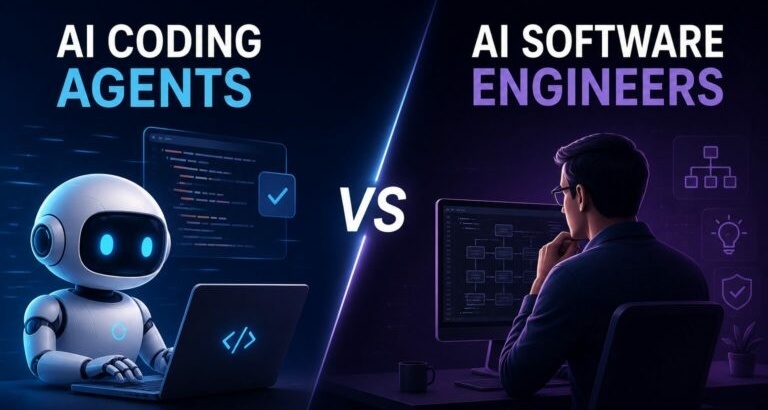
AI Coding Agents vs. AI Software Engineers
Although these terms are often used interchangeably, they represent different levels of AI capability.
| AI Coding Agent | AI Software Engineer |
|---|---|
| Executes coding tasks | Supports the full software lifecycle |
| Builds requested features | Helps define technical solutions |
| Generates code and tests | Contributes to planning, design, development, and maintenance |
| Focuses on implementation | Focuses on engineering outcomes |
| Requires human supervision | Operates with greater autonomy but still needs oversight |
| Optimizes developer productivity | Optimizes the entire engineering process |
A simple way to think about it:
- AI coding agents are execution specialists.
- AI software engineers are intelligent engineering collaborators capable of supporting the entire software lifecycle.
Why Enterprises Are Investing in AI Coding Agents
Organizations aren’t adopting AI coding agents simply because they’re the latest technology trend.
They’re investing because software demand continues to outpace engineering capacity.
Businesses are expected to deliver new digital products faster while maintaining quality, security, and scalability. AI coding agents help engineering teams meet these expectations by automating repetitive work and accelerating delivery.
Organizations are using AI coding agents to:
- Ship features faster
- Improve developer productivity
- Reduce repetitive coding
- Accelerate testing cycles
- Detect bugs earlier
- Generate technical documentation automatically
- Modernize legacy applications
- Simplify onboarding for new developers
The business impact is becoming increasingly measurable. According to GitHub, developers using GitHub Copilot completed coding tasks up to 55% faster in controlled studies, allowing teams to dedicate more time to architecture, innovation, and solving complex business challenges.
But coding is only one area where enterprise AI is creating value.
This broader enterprise shift is one of the key reasons AI coding agents are rapidly becoming part of modern software engineering teams.
How Developer Roles Are Changing
The rise of AI doesn’t reduce the importance of developers.
It changes where they create the most value.
Less Manual Coding
Many repetitive development tasks are now automated.
Today’s AI tools can generate:
- CRUD operations
- REST APIs
- GraphQL endpoints
- Unit tests
- Integration tests
- Configuration files
- Technical documentation
Rather than spending hours building repetitive components, developers can focus on solving higher-value engineering problems.
More Code Review
As AI generates more code, reviewing that code becomes increasingly important.
Developers now spend more time validating:
- Security
- Performance
- Maintainability
- Business logic
- Compliance with engineering standards
Despite rapid AI adoption, developers remain cautious. According to the Stack Overflow Developer Survey 2025, only 29% of developers fully trust AI-generated code, while many report that AI often produces code that appears correct but still requires careful validation.
This reinforces an important reality:
AI can accelerate software development, but human expertise remains essential for delivering reliable, secure, and maintainable software.
Architecture Becomes More Valuable
As implementation becomes easier, architecture becomes a greater competitive advantage.
Developers increasingly focus on questions like
- Should we use microservices or a modular monolith?
- Which database best fits our workload?
- How should services communicate?
- Where should caching be implemented?
- How can the system remain scalable over the next five years?
These decisions require technical judgment, business understanding, and long-term thinking—areas where experienced engineers continue to lead.
Developers Become AI Orchestrators
Modern engineering teams are beginning to coordinate multiple AI systems simultaneously.
One AI agent may:
- Generate backend APIs
Another may:
- Create automated tests
Another could:
- Review security vulnerabilities
Another might:
- Prepare deployment pipelines
Instead of manually completing every task, developers increasingly orchestrate specialized AI agents to build complete applications more efficiently.
This shift reflects a larger industry transformation. As highlighted in AI Beyond the Hype, enterprise AI is evolving from isolated tools into connected systems that collaborate across multiple business functions. Software engineering is becoming one of the first industries to fully embrace this agentic AI model.
Where AI Still Falls Short
Despite remarkable progress, AI still has limitations.
Business Understanding
AI can analyze code.
It cannot fully understand customers, market dynamics, or changing business priorities.
Successful software development requires context that extends far beyond a code repository.
Architecture Trade-Offs
Choosing between serverless, Kubernetes, microservices, or a modular monolith isn’t simply a technical decision.
It requires balancing:
- Cost
- Scalability
- Team expertise
- Operational complexity
- Long-term maintenance
These strategic trade-offs continue to rely heavily on experienced software architects.
Security
Security remains one of AI’s biggest challenges.
AI-generated code can occasionally introduce:
- Authentication vulnerabilities
- Insecure dependencies
- Sensitive data exposure
- API security flaws
- Weak access controls
Independent research has shown that AI-assisted code can introduce more security vulnerabilities than carefully reviewed human-written code.
Interestingly, AI security is also emerging as one of the biggest priorities for enterprises adopting autonomous AI systems. As explored in AI Beyond the Hype, organizations are investing heavily in governance, observability, and secure AI infrastructure to ensure intelligent systems remain reliable, transparent, and compliant.
Whether organizations are deploying AI coding agents or enterprise AI platforms, security must remain a foundational requirement—not an afterthought.
Innovation
AI excels at recognizing patterns.
Creating entirely new software architectures, solving novel engineering challenges, and designing disruptive products still depend on human creativity, critical thinking, and domain expertise.
Innovation remains a uniquely human capability.
The Skills Developers Should Build
As AI automates implementation, the most valuable developers won’t simply be the fastest coders.
They’ll be the strongest problem solvers.
Future-ready developers should strengthen skills such as:
- System architecture
- Software design
- Cloud engineering
- DevOps
- Cybersecurity
- Performance optimization
- Testing strategies
- AI prompt engineering
- Product thinking
- Business communication
These capabilities complement AI rather than compete with it.
Developers who combine technical expertise with strategic thinking will remain indispensable in AI-assisted engineering environments.
The Future of AI Software Engineering
AI coding agents are only the beginning.
Over the next few years, AI systems are expected to support increasingly complex engineering workflows, including:
- Planning software projects
- Estimating timelines
- Coordinating multiple AI agents
- Performing automated security reviews
- Monitoring production systems
- Detecting performance bottlenecks
- Suggesting architectural improvements
- Continuously optimizing applications
This evolution aligns with a broader trend across enterprise AI. As discussed in AI Tech Update’s article, Manufacturing AI: How Smart Factories Are Using AI for Predictive Operations, businesses are moving toward AI-native operations, where intelligent systems don’t simply assist employees; they collaborate across departments, automate end-to-end workflows, and continuously improve business processes.
Software engineering is becoming one of the earliest examples of this transformation.
Final Thoughts
AI coding agents represent one of the biggest shifts in software development since the rise of cloud computing and DevOps.
Today, AI is no longer limited to generating code snippets. It can understand repositories, execute development workflows, automate testing, review pull requests, and accelerate software delivery at scale. With 84% of developers already using or planning to use AI coding tools, AI-assisted development is quickly becoming the industry standard.
However, software engineering has never been just about writing code.
It requires strategic thinking, architecture, security, collaboration, and a deep understanding of business objectives—areas where human expertise remains indispensable.
At the same time, AI coding agents are only one chapter in a much larger enterprise AI story. Organizations are also embracing AI agents, intelligent SaaS platforms, secure AI infrastructure, and governance-first AI strategies to transform how they operate.
Want to explore where enterprise AI is headed beyond software development? Read our related AI Tech Update article: AI Beyond the Hype: 5 Enterprise Trends That Will Define the Next Phase of Artificial Intelligence. It examines how AI agents, enterprise security, intelligent SaaS, and modern AI infrastructure are reshaping businesses across every industry.
The future of software development isn’t about AI replacing developers.
It’s about developers, AI coding agents, and enterprise AI systems working together to build smarter, more secure, and more innovative software than ever before.