
Edge AI
TL;DR
• Edge AI processes data locally without the cloud.
• Local inference reduces latency and improves privacy.
• Smaller AI models run on low-power devices.
• Edge AI supports offline operation and saves bandwidth.
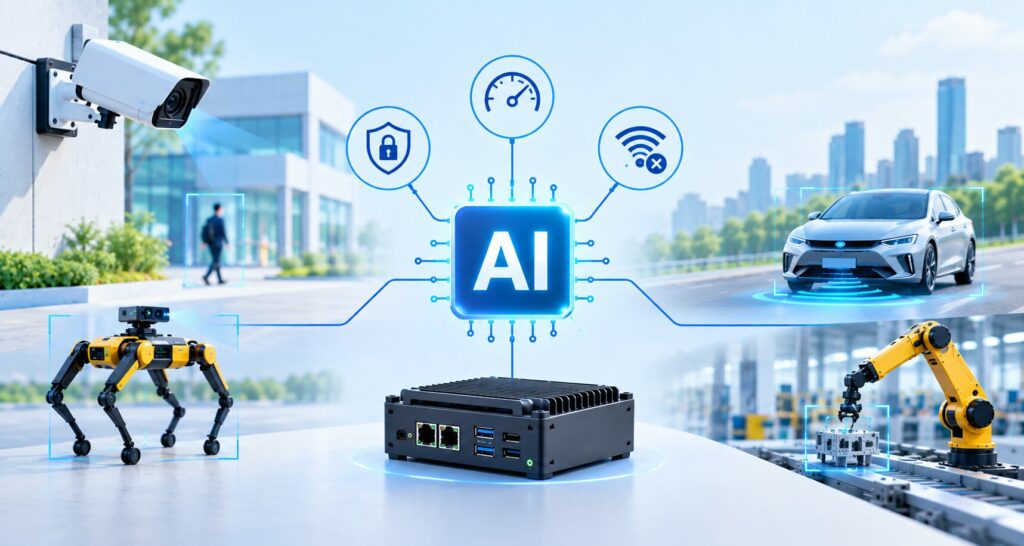
• Key uses include cameras, robots, vehicles, and factories.
• New hardware is making physical AI more accessible.
Artificial intelligence has traditionally depended on powerful cloud infrastructure. Data is collected by a device, sent to a remote server, processed by an AI model , and then returned as a result. That approach works well for many applications, but it is not ideal when a machine needs to make decisions instantly, operate with limited connectivity, or keep sensitive data close to its source.This is where edge AI is changing the equation.
Instead of sending every piece of data to the cloud, edge AI allows AI models to run directly on devices or on nearby computing hardware. Cameras, robots, vehicles, industrial machines, sensors, and other connected systems can analyze information locally and respond in real time.
Recent advances in compact AI hardware are accelerating this shift. NVIDIA’s Jetson Orin Nano Super Developer Kit, for example, can deliver up to 67 INT8 TOPS of AI performance while operating in a 7W–25W power range. NVIDIA positions it for workloads including generative AI, robotics, vision AI, vision-language models, and other edge applications.
The result is a fundamental change in how intelligent systems are designed: AI does not always need to live in the cloud. Increasingly, intelligence can live inside the device itself.
What Is Edge AI?
Edge AI combines artificial intelligence with edge computing. Instead of relying entirely on centralized cloud servers, an AI model runs on a device or computing system located close to where data is generated.
For example, consider an industrial camera monitoring a production line.
In a cloud-based architecture, the camera may continuously send video to a remote server. The server analyzes the video and sends instructions or alerts back to the factory.
With edge AI, the camera system or an attached edge computer can analyze the video locally. It can detect a damaged product, identify an unsafe condition, or recognize an object without sending the entire video stream to the cloud.
This reduces the amount of information that must travel across the network and allows the system to respond much faster. Red Hat describes edge AI as processing AI workloads at or near the physical location where data is generated, enabling responses within milliseconds and allowing systems to work with or without an internet connection.
This concept is becoming increasingly important as the number of connected devices continues to grow.
Local Inference: The Key to Smarter Devices
One of the most important concepts behind edge AI is local inference.
Inference is the stage where a trained AI model receives new data and produces a prediction, classification, recommendation, or other result. Instead of performing this process on a remote cloud server, local inference runs the model directly on an edge device.
Imagine a smart security camera that needs to detect whether someone has entered a restricted area.
The camera captures an image.
The local AI model analyzes the image.
The system identifies a person.
An alert is generated.
All of this can happen locally.
The camera does not necessarily need to upload the entire video stream before making a decision.
This architecture is particularly valuable for applications where milliseconds matter. In robotics, industrial automation, autonomous systems, and safety monitoring, waiting for a cloud response can introduce unnecessary delays.
Red Hat notes that larger and more complex AI models can increase inference demands because they require more computation and memory. This makes the combination of optimized models and appropriate hardware increasingly important for efficient inference.
For companies developing intelligent products, this creates an opportunity to combine AI software development with specialized edge hardware rather than treating cloud AI as the only option.
Why Smaller AI Models Matter
Running AI on a small device creates an obvious challenge: the hardware has significantly fewer resources than a large cloud data center.
A cloud server can use large amounts of memory, powerful GPUs, and extensive computing infrastructure. A camera, robot, vehicle controller, or industrial sensor cannot.
This is why smaller AI models are becoming increasingly important.
Developers can optimize models through techniques such as:
- Quantization
- Pruning
- Knowledge distillation
- Model compression
- Hardware-specific optimization
- Efficient neural network architectures
The goal is not necessarily to create the biggest possible model. Instead, the goal is to create a model that is accurate enough for a specific task while being small and efficient enough to run locally.
For example, an industrial vibration sensor does not need a massive general-purpose AI model to determine whether a motor is developing an abnormal vibration pattern. A lightweight model trained specifically for that task may be more practical.
The same principle can apply to cameras, microphones, smart appliances, wearables, and other embedded devices.
Express Computer highlights this distinction between conventional edge AI and tiny AI, where resource-constrained devices use lightweight models for targeted inference tasks.
Lower Latency Means Faster Decisions
Latency is another major reason businesses are moving AI closer to devices.
When data travels from a device to the cloud and back, the process introduces network delays. These delays may be insignificant for some applications but critical for others.
Consider an autonomous robot operating inside a warehouse.
If the robot detects an obstacle, it cannot afford to wait for a distant cloud server to process the camera feed and return a movement decision.
The system needs to:
- Capture sensor information.
- Analyze the information.
- Identify the obstacle.
- Decide what to do.
- Adjust its movement.
The closer these operations happen to the robot, the faster the response can be.
Edge AI therefore makes particular sense for real-time AI applications where rapid decisions are essential.
The same principle applies to autonomous vehicles, industrial machinery, security cameras, drones, smart infrastructure, and other systems interacting with the physical world.
Privacy: Keeping Sensitive Data on the Device
Privacy is another major advantage of edge AI.
Many intelligent systems process highly sensitive information, including video, audio, location information, customer behavior, industrial data, and biometric information.
Sending all of this raw data to a centralized cloud environment can increase exposure and create additional data-management requirements.
With local inference, a device can process sensitive information locally and send only the required result.
For example, instead of continuously uploading video from a security camera, an edge system could send a simple event such as:
“Person detected in restricted area.”
The raw video can remain on the local system, depending on the application’s architecture and retention requirements.
Red Hat identifies privacy, reduced bandwidth usage, security, and lower latency among the key benefits of edge AI.
However, edge AI should not automatically be considered secure. Devices still require secure boot processes, encrypted communications, access controls, software updates, model protection, and appropriate monitoring.
The advantage is that the architecture can reduce unnecessary movement of sensitive data.
Offline AI: Intelligence Without the Internet
One of the most useful capabilities of edge AI is offline operation.
Not every environment has reliable internet connectivity.
Factories may have network interruptions. Vehicles constantly move between connectivity zones. Agricultural equipment may operate in remote locations. Mining sites can be far from reliable infrastructure. Emergency systems may need to continue functioning during network failures.
An AI system that depends entirely on the cloud may lose important functionality when connectivity disappears.
An edge AI system can continue making decisions locally.
This does not mean the cloud becomes unnecessary. In many architectures, the cloud remains important for:
- Model training
- Centralized analytics
- Fleet management
- Software updates
- Data storage
- Monitoring
- Model improvement
The difference is that the device does not have to depend on the cloud for every individual decision.
Red Hat describes this model as a combination in which cloud infrastructure can support model training and management while optimized models are deployed to resource-constrained edge devices for local processing.
AI-Powered Cameras
Cameras are among the clearest examples of edge AI.
Traditional cameras primarily capture and transmit images. Edge AI cameras can understand what they see.
They can detect:
- People
- Vehicles
- Objects
- Unsafe behavior
- Defects
- Crowded areas
- Intrusions
- Equipment conditions
- Traffic events
A manufacturing facility, for example, can use computer vision to inspect products moving along a production line.
Instead of recording everything and analyzing it later, an edge AI system can identify defects immediately.
This can help manufacturers reduce response times and potentially reduce the volume of video that needs to be stored or transmitted.
NVIDIA also highlights vision AI applications such as factory inspection, smart-city traffic, inventory management, and other IoT scenarios for its Jetson platform.
Smarter Robots
Robotics is another area where edge AI is becoming increasingly important.
A robot must constantly understand its environment. It may need to process camera images, depth information, audio, force measurements, and other sensor data.
Cloud-based processing can support some robotic workloads, but core functions often benefit from local intelligence.
Edge AI can help robots with:
- Object recognition
- Navigation
- Obstacle avoidance
- Visual inspection
- Object manipulation
- Human detection
- Predictive maintenance
- Autonomous decision-making
NVIDIA specifically positions the Jetson Orin Nano Super for robotics workloads including mobility, grasping, vision, and deployment across industries such as manufacturing, agriculture, logistics, healthcare, and retail.
This is part of a broader movement toward physical AI, where AI systems interact directly with the physical environment rather than operating only inside software applications.
AI Inside Vehicles
Vehicles are becoming increasingly dependent on intelligent computing.
Modern vehicles generate enormous amounts of information through cameras, radar, lidar, GPS, microphones, and other sensors.
Edge AI can process this information locally to support applications such as:
- Driver monitoring
- Object detection
- Lane detection
- Traffic-sign recognition
- Parking assistance
- Predictive maintenance
- Cabin monitoring
- Autonomous driving functions
A vehicle cannot rely entirely on a distant cloud service when making safety-critical decisions.
Local processing provides the responsiveness required for real-time interaction with the surrounding environment.
The cloud can still support fleet-level analytics, model training, software updates, and long-term data analysis, creating a hybrid architecture rather than a complete replacement for cloud computing.
Industrial Systems Become More Intelligent
Industrial environments may be one of the biggest beneficiaries of edge AI.
Factories contain thousands of sensors and machines that continuously generate information.
Sending every measurement to a central cloud system can consume bandwidth and increase processing costs.
Edge AI allows machines to analyze data where it is produced.
For example, an AI-enabled industrial system can monitor:
- Temperature
- Vibration
- Pressure
- Electrical current
- Machine sounds
- Production quality
- Equipment performance
The system can recognize abnormal patterns and trigger an alert before a machine fails.
Express Computer highlights applications such as faster fault detection and predictive maintenance using edge AI-enabled industrial sensors.
This changes maintenance from a reactive process into a more predictive one.
Why NVIDIA Jetson Orin Nano Super Matters
Compact AI hardware is making sophisticated inference more practical for developers.
The NVIDIA Jetson Orin Nano Super Developer Kit is a useful example. NVIDIA states that it provides up to 67 INT8 TOPS of AI performance, 102 GB/s memory bandwidth, and configurable power from 7W to 25W. It supports workloads including large language models, vision-language models, vision transformers, robotics, and vision AI.
Importantly, NVIDIA’s documentation describes the Super improvement as a software-enabled performance boost for the existing Jetson Orin Nano Developer Kit rather than an entirely new physical hardware package.
This illustrates a broader trend: edge devices are gaining enough computing capability to perform tasks that previously required much larger systems.
For developers, that opens the door to building smaller and more intelligent products.
Edge AI Does Not Mean the Cloud Is Going Away
It would be a mistake to view edge AI as a complete replacement for cloud AI.
The two technologies are becoming complementary.
A typical architecture may look like this:
Cloud → Training and management
Edge → Inference and real-time decisions
The cloud can provide massive computing resources for training large models. Once a model is optimized, a smaller version can be deployed to edge devices.
The devices perform local inference and periodically send selected data, events, metrics, or model feedback back to centralized infrastructure.
This hybrid architecture can provide the advantages of both approaches.
Cloud computing offers scale.
Edge computing offers speed.
AI connects the two.
Challenges of Edge AI
Despite its advantages, edge AI introduces several challenges.
Limited Computing Resources
Edge devices have less memory and processing power than cloud servers. Developers must carefully select and optimize models.
Hardware Diversity
Different devices may use different processors, GPUs, NPUs, and accelerators. Applications need to be optimized for their target hardware.
Model Updates
AI models evolve. Organizations need reliable mechanisms to update models across potentially thousands of deployed devices.
Security
Edge devices can operate in physically exposed environments. Protecting hardware, software, credentials, data, and AI models is essential.
Accuracy vs. Efficiency
Smaller models can be faster and more efficient, but excessive compression may reduce accuracy. Developers need to find the right balance for each use case.
Fleet Management
Managing a handful of edge devices is relatively simple. Managing thousands or millions requires centralized monitoring, deployment, observability, and security infrastructure.
These challenges mean successful edge AI requires more than simply placing an AI model on a small computer.
What Edge AI Means for Businesses
For businesses, edge AI creates opportunities to build products that are faster, more private, more resilient, and less dependent on continuous cloud connectivity.
Companies can use it to develop:
- Intelligent cameras
- AI-powered mobile and embedded devices
- Smart industrial equipment
- Autonomous robots
- Connected vehicles
- Predictive maintenance systems
- Smart retail infrastructure
- Intelligent IoT products
Organizations planning these solutions may need expertise across AI, software, cloud, embedded systems, computer vision, IoT, and application development.
This makes AI development services, custom AI solutions, and enterprise AI solutions increasingly relevant when moving AI from experimentation into physical products.
The Future: Intelligence Everywhere
The biggest change brought by edge AI may not be a single breakthrough model or processor.
It is the idea that intelligence can become part of almost every physical device.
A camera can understand what it sees.
A robot can understand its surroundings.
A vehicle can interpret sensor data.
A factory machine can recognize signs of failure.
A wearable can process information locally.
A remote device can continue operating even when the network is unavailable.
As AI models become smaller and hardware becomes more capable, more intelligence will move closer to the physical world.
The future of AI will therefore not be limited to massive data centers. It will also exist in cameras, robots, vehicles, sensors, machines, and everyday devices.
Conclusion
Edge AI is changing how intelligent systems process information by bringing AI capabilities closer to where data is created. Local inference helps devices respond faster, reduce cloud dependency, improve privacy, and continue working when internet connectivity is limited. Smaller, optimized AI models also make advanced intelligence practical for cameras, robots, vehicles, industrial machines, and IoT devices. New edge hardware, such as the NVIDIA Jetson Orin Nano Super, is further expanding what compact devices can accomplish. However, edge AI does not replace cloud computing. Instead, both can work together, with the cloud handling training, analytics, storage, and management while edge devices handle real-time decisions. As hardware and AI models continue to improve, edge AI will play an increasingly important role in creating smarter, faster, and more efficient connected systems.
Frequently Asked Questions
What is edge AI?
Edge AI is the use of artificial intelligence directly on or near the device where data is generated. Instead of sending every request to the cloud, the device can process information locally and produce a result.
Why is local inference important?
Local inference reduces the need to send data to remote servers. This can lower latency, reduce bandwidth usage, support offline operation, and help keep sensitive information closer to its source.
Can AI work on devices without the internet?
Yes. If the required AI model and supporting software are deployed locally, many inference tasks can operate without an active internet connection.
What devices can use edge AI?
Edge AI can be used in cameras, robots, vehicles, industrial machines, IoT sensors, smartphones, drones, wearables, smart appliances, and other connected devices.
Is edge AI replacing cloud AI?
No. In most enterprise architectures, edge and cloud AI complement each other. Cloud infrastructure can handle training, storage, analytics, and management, while edge devices handle time-sensitive local inference.