
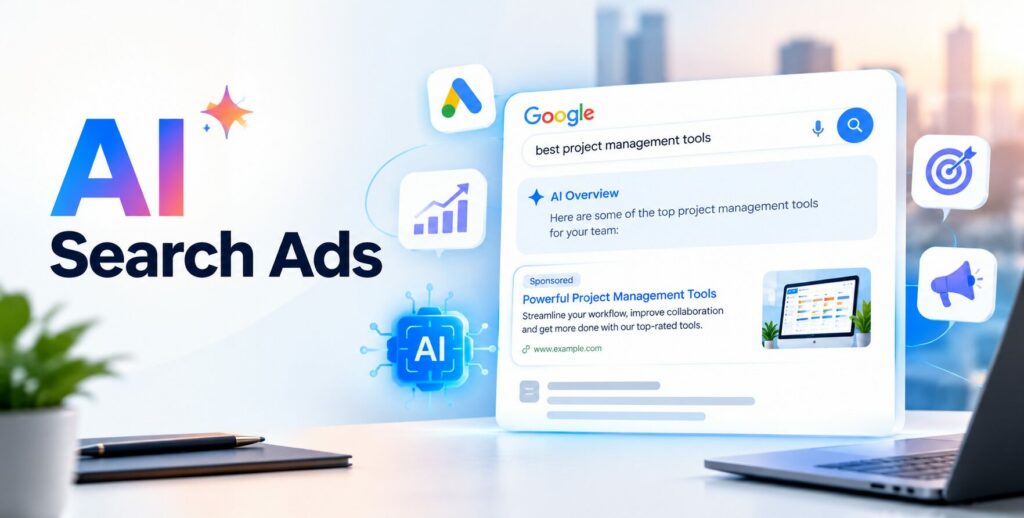
AI Search Ads
TL;DR
• Google expands AI search ads to 10 new markets, including India.
• AI Mode creates new advertising opportunities.
• Multiturn ads reach users during follow-up searches.
• Relevant content improves customer engagement.
• SEO and paid ads support digital growth.
Google is changing how businesses reach customers online as artificial intelligence reshapes search behavior and digital advertising. On October 28, 2026, Google announced the international expansion of advertisements in AI Mode, creating new opportunities for advertisers in markets including India, Australia, Canada, and Singapore. This marks an important development in AI search ads, where sponsored recommendations can appear within AI-powered search experiences rather than only in conventional search results. Businesses adapting to this shift can also explore digital solutions and software development services to strengthen their online presence and customer experiences.
For marketers, this development raises important questions about search engine marketing, paid advertising strategies, campaign performance, and customer discovery. Businesses must now consider how to make their products and services visible when customers use conversational AI to research options, compare solutions, and make purchasing decisions.
What Are AI Search Ads?
AI search ads are paid advertisements displayed within or alongside artificial intelligence-powered search experiences. Instead of relying exclusively on traditional search result pages, these advertisements can appear when users explore topics through AI-generated summaries, conversational answers, and follow-up questions.
For example, a user looking for a software development company might begin with a broad question about building a mobile application. They could then ask about development costs, essential features, security requirements, and suitable technology platforms. In AI-powered search, advertisements may become relevant at different stages of this research process.
Google’s AI Mode is designed to support more detailed, conversational searches. Its advertising expansion creates additional opportunities for businesses to connect with potential customers while they explore products and services.
Unlike conventional search advertising, where marketers often focus on specific keywords and individual queries, AI-driven search advertising must account for broader context, evolving intent, and more detailed user questions.
Google’s Global Expansion of AI Search Advertising
Google’s October 2026 announcement marks an important step in the international expansion of advertising within AI Mode.
The company announced that ads in AI Mode would expand to 10 additional markets:
- Australia
- Canada
- India
- Kenya
- Malaysia
- New Zealand
- Nigeria
- Pakistan
- The Philippines
- Singapore
Google also indicated plans to expand into additional markets, including Brazil, Mexico, and the United Kingdom, during the fourth quarter of 2026.
Another significant development is the introduction of multiturn ads in AI Mode in the United States. These advertisements can appear during follow-up queries within an ongoing AI conversation, creating opportunities to reach users as their requirements become more specific.
Google stated that click-through rates for sponsored and organic product listings in AI Mode were already similar in its internal US data for the period from August 20 to September 3, 2026. These early findings suggest that advertising can attract engagement in conversational search, although results may vary by industry, campaign, and market.
Businesses can follow the official Google announcement about ads in AI Mode to understand the announced rollout and its implications for advertisers.
Why AI Search Ads Matter for Digital Marketing in 2026
The expansion of AI-powered search advertising reflects a broader shift in how consumers discover information online.
Traditional search often begins with a short phrase, such as “best CRM software” or “app development company.” AI-powered search encourages users to ask longer questions that include their objectives, preferences, budgets, and practical constraints.
This creates new opportunities for digital marketers to connect advertisements with more detailed customer needs.
1. Search Intent Is Becoming More Conversational
Search intent describes what a user wants to accomplish through a search query. Understanding this intent is essential for successful search engine marketing.
AI-powered search allows users to express complex requirements in natural language. Someone searching for an enterprise application might ask which platform offers secure integrations, supports business growth, and fits a particular budget.
Advertisers need to consider these detailed requirements when developing campaign messages, landing pages, and conversion strategies.
Rather than targeting only broad terms, marketers should build campaigns around the problems their products solve and the questions potential customers are likely to ask.
2. Advertisements Can Reach Customers During Research
The customer journey rarely follows a straight line. A potential buyer might discover a product, investigate alternatives, compare prices, and revisit a decision several times before making a purchase.
Multiturn advertising creates opportunities to reach users during follow-up questions instead of relying exclusively on the initial search.
For example, a person researching project management software might later ask about collaboration features, integrations, or subscription costs. Contextually relevant advertising could help a provider reach that customer while they evaluate different solutions.
However, advertisers should not assume that every follow-up question will trigger an ad. Placement depends on Google’s advertising systems, campaign eligibility, query relevance, and other factors.
3. Landing Page Quality Remains Essential
AI search ads may change where advertisements appear, but the importance of a useful landing page remains unchanged.
A relevant advertisement should direct users to a page that clearly explains the product or service, its benefits, pricing where appropriate, and the next step.
Businesses investing in digital marketing should maintain fast-loading websites, mobile-friendly layouts, clear navigation, and informative service pages. Accurate information helps potential customers evaluate their options and improves the overall experience after clicking an advertisement.
Companies developing new digital platforms can also explore AI-powered software development solutions to support modern web experiences, business applications, and customer-facing digital products.
How Businesses Can Prepare for AI Search Ads
Companies do not necessarily need to build an entirely separate advertising strategy for Google’s AI-powered search experiences. Google’s current advertising guidance explains that eligible Search, Shopping, and Performance Max campaigns can participate automatically when relevant.
Advertisers should therefore focus on strengthening existing campaigns while adapting their content and measurement practices to changing search behavior.
1. Build Campaigns Around Customer Problems
Keyword research remains important, but successful campaigns should also reflect the problems customers are trying to solve.
For instance, a software company could target searches related to application development, business process automation, system integration, and digital transformation.
Marketers should organize keywords and campaign assets around clear themes. They can then develop advertising messages that explain how their offerings address specific customer needs.
Longer, conversational queries can also help marketers identify new content opportunities and improve their understanding of audience intent.
2. Improve Website Content for AI-Powered Discovery
A website should answer the questions that potential customers commonly ask before making a decision.
Service pages can explain features, benefits, implementation processes, pricing factors, security practices, and common use cases. Supporting articles and FAQs can address more detailed questions that arise during customer research.
For businesses seeking visibility through organic search and paid advertising, useful content remains an important foundation.
A strong search strategy should combine technical SEO, relevant content, clear page structure, and conversion-focused website design. Businesses should also keep product information and service descriptions accurate and consistent across their digital properties.
3. Use First-Party Data and Accurate Conversion Tracking
Advertising performance cannot be evaluated through clicks alone. Businesses need to understand whether campaigns generate meaningful actions, such as qualified enquiries, purchases, demo requests, or application downloads.
Marketers should verify their conversion tracking, analytics configuration, and reporting processes before expanding campaign budgets.
Where appropriate, first-party data can help businesses understand customer behavior while respecting applicable privacy requirements. Teams should also review lead quality and sales outcomes rather than relying exclusively on surface-level engagement metrics.
Google provides additional guidance on advertising in AI-powered Search experiences, including campaign eligibility, ad placement, and optimization practices.
4. Test Campaign Performance Before Increasing Budgets
The arrival of new AI advertising placements does not guarantee lower acquisition costs or higher conversion rates for every advertiser.
Businesses should establish a baseline for existing campaign performance and monitor changes in cost per click, conversion rate, cost per acquisition, and return on advertising spend.
Testing should focus on measurable business outcomes. If a campaign receives more clicks but generates fewer qualified leads, marketers may need to review targeting, landing page relevance, or the quality of their offers.
Budget changes should be based on reliable performance data rather than assumptions about the effectiveness of AI-powered placements.
AI Search Ads and the Future of SEO
The growth of AI search advertising does not make search engine optimization obsolete. Instead, it increases the importance of coordinating paid and organic search strategies.
Paid advertisements can help businesses reach potential customers through eligible sponsored placements. Organic SEO helps websites attract relevant visitors by providing useful information, satisfying search intent, and maintaining technically sound pages.
Businesses should understand the difference between advertising visibility and organic visibility. Paying for advertisements does not automatically improve a website’s organic ranking or guarantee that an AI-generated response will mention the business.
A balanced strategy includes:
- Publishing original, useful, and accurate content.
- Building clear website structures and descriptive service pages.
- Improving page speed and mobile usability.
- Answering customer questions with relevant information.
- Monitoring organic traffic, conversions, and paid campaign performance separately.
- Reviewing search trends to identify emerging customer needs.
For additional perspectives on artificial intelligence, digital marketing, and emerging technology developments, readers can explore AI Tech Updates.
Challenges Businesses Should Consider
Although AI search ads offer new opportunities, marketers should approach the transition with realistic expectations.
Limited control over placements: Advertisers may not have complete control over whether or exactly where eligible campaigns appear within AI-powered search experiences.
Changing user behavior: Conversational search can make customer journeys more complex, requiring marketers to reconsider how they interpret queries and attribute conversions.
Competition and advertising costs: As more businesses adapt to AI-driven advertising, competition for valuable commercial queries may remain strong. Actual costs will depend on auction conditions, targeting, and campaign performance.
Measurement challenges: A customer may interact with several ads, organic pages, and AI-generated answers before converting. Marketers need reliable reporting to understand how these interactions contribute to business outcomes.
Content quality and trust: Misleading claims, outdated landing pages, or unclear service information can undermine customer confidence, regardless of where an advertisement appears.
Addressing these challenges requires continuous testing, clear reporting, useful content, and a willingness to adapt campaigns as Google’s advertising products evolve.
What Google’s Expansion Means for Businesses in India
India’s inclusion in the latest expansion is particularly relevant for businesses targeting customers in a large and competitive digital market.
Companies in software development, ecommerce, education, professional services, travel, and other sectors can monitor how AI-powered search changes the way potential customers research products and services.
For business-to-business companies, conversational search may help users investigate complex services before contacting a provider. For ecommerce brands, contextual advertising may create additional opportunities to connect with shoppers comparing products and features.
However, advertisers should not assume that every industry will benefit equally. The impact will depend on search demand, audience behavior, campaign eligibility, competition, and the relevance of available advertising placements.
Businesses should review their existing Google Ads campaigns, ensure that landing pages answer customer questions, and establish reliable conversion tracking. These steps can help organizations prepare for changes without making unnecessary investments in unproven tactics.
Conclusion
Google’s global expansion of AI search ads marks an important development in digital marketing in 2026. By bringing advertising into more AI Mode markets and introducing multiturn ads in the United States, Google is creating additional opportunities for businesses to reach customers during conversational research and product discovery.
For marketers, the priority should be to combine strong keyword research with relevant campaign assets, useful website content, accurate measurement, and consistent testing. AI-powered advertising can create new opportunities, but sustainable results still depend on understanding customer needs and delivering genuine value.
Businesses that adapt their paid search strategies while maintaining strong SEO fundamentals will be better positioned to respond as search experiences continue to evolve. Rather than treating AI search ads as a replacement for traditional marketing, companies should view them as an emerging part of a broader digital customer acquisition strategy.
Frequently Asked Questions
What are AI search ads?
AI search ads are paid advertisements displayed within or alongside AI-powered search experiences.
What is Google AI Mode?
Google AI Mode is an AI-powered search experience that helps users explore questions and get conversational answers.
Which countries are included in Google's AI search ads expansion?
Google announced expansion into 10 additional markets, including India, Australia, Canada, Singapore, and New Zealand.
How will AI search ads affect digital marketing?
AI search ads may help businesses reach customers as they research products, compare services, and ask follow-up questions.
How can businesses optimize for AI search ads?
Businesses should improve campaign relevance, create useful landing pages, track conversions, and understand customer search intent.
Will AI search ads replace traditional SEO?
No. AI search ads complement SEO. Businesses still need useful content, technical optimization, and a strong website to support organic visibility.