
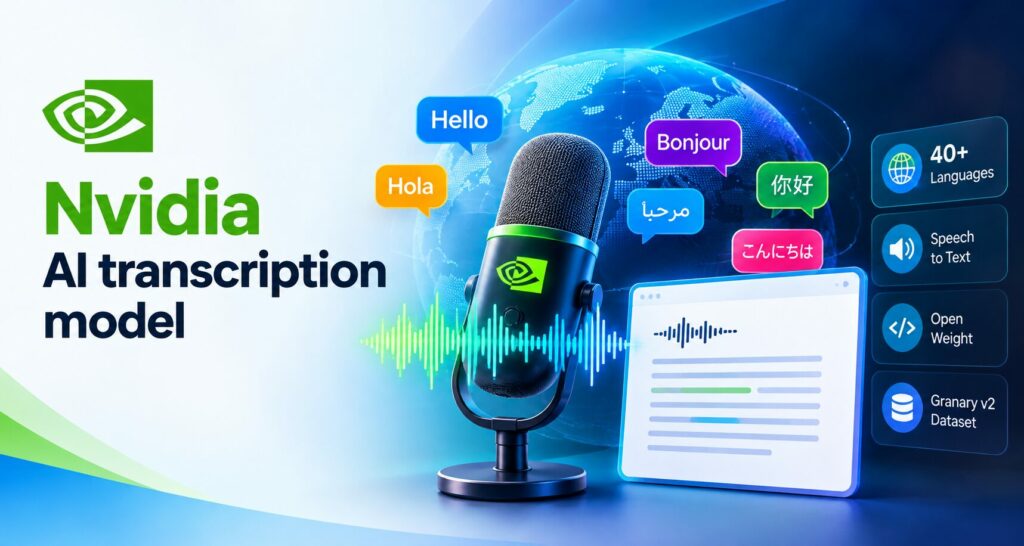
Nvidia AI transcription model
TL;DR
• Nvidia launched an AI transcription model supporting 40 languages.
• Nemotron 3.5 Transcribe converts speech into text.
• Granary v2 provides speech data across 48 languages.
• Uses include meetings, healthcare, customer support, and media.
• Developers should check accuracy, privacy, licensing, and costs.
• The model is designed for recorded audio, not real-time streaming.
Artificial intelligence is changing the way people communicate with technology, and voice is becoming one of the most important parts of this transformation. From virtual assistants and customer support systems to meeting transcription tools and multilingual applications, businesses are increasingly relying on AI to understand spoken language. In a significant development for voice technology, Nvidia has introduced Nemotron 3.5 Transcribe, an open-weight AI transcription model designed to process speech across as many as 40 languages.
The launch reflects a growing demand for accessible, flexible, and scalable speech recognition technology. As organizations look for better ways to convert audio into useful information, open-weight models could make it easier for developers to build customized voice applications without depending entirely on closed, proprietary platforms.
Alongside the transcription model, Nvidia has also introduced the second version of its Granary open-source speech dataset. Together, these developments highlight the growing importance of speech data, multilingual AI, and developer-friendly tools in the expanding voice AI ecosystem.
What Is Nvidia Nemotron 3.5 Transcribe?
Nemotron 3.5 Transcribe is an AI-powered speech-to-text model developed to convert spoken audio into written text. It is designed for applications that need to recognize speech, process audio information, and support communication across different languages.
Traditional transcription systems can struggle with challenging audio conditions, including background noise, different accents, fast speech, and conversations involving multiple speakers. Modern AI transcription models aim to improve speech recognition by learning patterns in human language and audio signals.
Nvidia’s open-weight approach is particularly relevant for developers and businesses that want greater control over how AI models are deployed and integrated into their software systems.
Instead of relying exclusively on an external transcription service, organizations may be able to evaluate and adapt an available model to suit their technical requirements, infrastructure, and application workflows, subject to its license and deployment conditions.
The model’s reported support for up to 40 languages also makes multilingual speech recognition an important part of its value proposition. This capability could be useful for global businesses, international customer service teams, content creators, and software companies developing products for users in different regions.
Why Open-Weight AI Models Matter
The AI industry has traditionally offered businesses a choice between using hosted AI services and deploying models within their own technical environments. Open-weight models provide another option by making model parameters available for eligible users to download, run, and potentially adapt under the applicable license.
This flexibility can be valuable for organizations with specialized requirements.
For example, a company building a voice-enabled healthcare administration platform may need to process recordings within a controlled environment. A global customer support provider may want to integrate transcription into its existing ticketing system. A media company may need to convert large volumes of audio into searchable text.
An open-weight transcription model could help these teams explore solutions that fit their workflows rather than building every speech recognition component from scratch.
However, open weights do not automatically mean unrestricted commercial use, complete transparency into training data, or guaranteed privacy. Organizations still need to review licensing terms, infrastructure requirements, security practices, and applicable data protection obligations before deployment.
For developers, the main advantage is flexibility. For businesses, the potential benefits include greater control over integration, deployment choices, and operational costs.
How 40-Language Speech Recognition Could Change Voice AI
Language diversity remains a major challenge for AI adoption. Many businesses serve customers who communicate in different languages, while their internal systems may be designed primarily around a single language.
Supporting multiple languages can help reduce this gap.
An AI transcription model capable of processing audio in up to 40 languages could support several practical applications:
- Multilingual customer support: Businesses could explore ways to transcribe customer conversations and make them easier to review.
- Meeting transcription: International teams could turn recorded discussions into searchable text for documentation and collaboration.
- Media and content production: Publishers and creators could accelerate the conversion of interviews, podcasts, and recordings into written drafts.
- Voice-enabled applications: Developers could introduce speech input into mobile applications, web platforms, and enterprise software.
- Research and education: Audio recordings of lectures, interviews, and discussions could become easier to organize and analyze.
- Business intelligence: Transcribed conversations could help teams identify recurring customer concerns, product feedback, and service trends.
The actual results will depend on language-specific accuracy, audio quality, accents, speaking speed, and the conditions under which the model is used. Supporting a language does not necessarily mean that performance will be equally strong across all languages and dialects.
Nevertheless, broader language coverage can give developers a stronger starting point for creating more inclusive voice-driven experiences.
Granary Version 2: Building a Stronger Foundation for Speech AI
Alongside Nemotron 3.5 Transcribe, Nvidia has introduced Granary version 2, an updated open speech dataset and data-curation system designed to support the development of speech-language models.
High-quality training data is essential for building reliable AI systems. Speech models must learn to recognize different accents, pronunciation patterns, sentence structures, and variations in spoken language. They also need examples that reflect how people actually speak, including pauses, repeated words, incomplete sentences, and conversations in which speakers switch between languages.
Granary v2 expands language coverage from 25 to 48 languages and provides approximately 843,600 hours of processed audio data. Its approach includes multiple forms of transcription, translated content, and other training targets that help models respond to different speech-related instructions.
This is important because transcription is not always a simple word-for-word process. A business might need a verbatim transcript for legal documentation, a polished version for meeting notes, or a translated transcript for an international audience.
By supporting different output styles, the dataset helps provide a foundation for speech AI systems that can respond to the specific needs of a task.
The broader lesson is that improvements in artificial intelligence depend on more than model size alone. Data quality, training methods, evaluation, and the ability to adapt models to real-world applications are equally important.
Practical Applications for Businesses and Developers
The release of an open-weight transcription model creates opportunities across several industries. However, the value of the technology depends on how effectively it is integrated into existing business processes.
1. AI-Powered Meeting and Productivity Tools
Businesses conduct meetings across departments, time zones, and languages. Manually preparing transcripts and action items can consume valuable employee time.
An AI meeting transcription solution can convert recorded discussions into searchable text, making it easier to review decisions, locate important information, and prepare documentation.
Developers can build additional features around transcription, such as meeting summaries, task extraction, and searchable knowledge bases. Speaker-attributed transcripts can also help teams understand who contributed particular information during a discussion.
These capabilities could become useful components of enterprise software development projects focused on employee productivity and collaboration.
2. Customer Service and Contact Center Analytics
Customer service teams handle large volumes of conversations every day. Analyzing these interactions manually can make it difficult to identify recurring complaints, product issues, and customer expectations.
Speech-to-text AI can transform recorded calls into structured text that businesses can analyze using natural language processing and other AI techniques.
For example, a company could combine transcription with sentiment analysis, topic classification, and automated reporting. Managers could then investigate common support issues or identify opportunities to improve customer experience.
Such systems require careful testing, particularly when conversations contain personal information, sensitive business details, or industry-specific terminology.
3. Healthcare Documentation
Healthcare professionals often spend considerable time preparing clinical notes and documenting consultations. AI medical transcription tools can help convert recorded dictation into text for review.
A multilingual speech recognition model may also support organizations serving patients who communicate in different languages.
However, medical applications require additional safeguards. Transcripts must be reviewed by qualified professionals, and systems must be tested for errors involving medication names, clinical terminology, dosages, and patient details.
AI transcription should support professional workflows rather than replace clinical judgment or necessary documentation checks.
4. Media, Podcasts, and Digital Publishing
Content creators can use AI transcription to turn recorded interviews, podcasts, webinars, and presentations into written material.
A single recording may generate several useful content formats, including transcripts, article drafts, social media captions, searchable archives, and video subtitles.
For publishers and digital marketing teams, this can reduce repetitive work and make existing content more accessible to different audiences.
For example, a technology podcast could be transcribed and converted into a blog post, with a human editor checking factual accuracy, improving readability, and adding relevant context before publication.
5. Voice-Enabled Web and Mobile Applications
Voice interaction is becoming an increasingly useful feature in digital products. Users may prefer speaking rather than typing when searching for information, recording notes, entering data, or interacting with an application while their hands are occupied.
Developers can explore AI transcription as part of mobile apps, enterprise platforms, accessibility features, and voice-driven interfaces.
A well-designed application might combine speech recognition with an AI assistant, a backend processing system, and a secure database. This would allow users to communicate naturally while the software converts their requests into actionable information.
One important limitation should be considered: Nemotron 3.5 Transcribe is designed for recorded audio rather than real-time streaming. Applications requiring continuous, low-latency voice interaction may need a different model or an additional speech-processing component.
Opportunities for AI Software Development Companies
The growing availability of open-weight AI models is changing how software development teams approach intelligent applications.
Previously, building a speech-enabled product could require significant investment in data collection, model development, infrastructure, and machine learning expertise. Open-weight models can provide a starting point, allowing developers to focus more of their effort on application design, integration, customization, and user experience.
For an AI software development company, this creates opportunities to build solutions tailored to specific industries and business requirements.
Potential projects include:
- AI-powered transcription and documentation platforms.
- Multilingual customer support software.
- Enterprise knowledge management systems.
- Intelligent document and audio processing workflows.
- Speech-enabled mobile applications.
- Automated meeting analysis and reporting tools.
- Industry-specific voice assistants.
However, using an existing model does not eliminate the engineering work involved in developing a production-ready product. Teams still need to consider model hosting, inference performance, access controls, data storage, monitoring, and ongoing maintenance.
They must also decide whether to process audio locally, deploy the model on private infrastructure, or use an appropriate hosted service. Each option involves different costs, performance characteristics, and security considerations.
Companies that combine AI expertise with strong software engineering practices will be better positioned to turn these capabilities into practical products.
What Developers Should Consider Before Adopting the Model
Although open-weight speech recognition is promising, businesses should evaluate a model against their actual requirements before making it part of a production system.
Accuracy Across Languages and Accents
A model supporting 40 languages may perform differently depending on the language, accent, recording environment, and subject matter.
Developers should test representative audio samples from their intended users rather than relying exclusively on general benchmark scores.
Hardware and Deployment Costs
Open-weight models can provide flexibility, but running them still requires suitable computing resources. Infrastructure costs depend on model precision, hardware availability, audio volume, processing speed, and deployment architecture.
Organizations should estimate the cost of processing their expected workload and compare it with available alternatives.
Privacy and Security
Audio recordings may contain personal details, confidential conversations, or commercially sensitive information.
Businesses should establish clear policies for recording consent, access permissions, encryption, retention, and deletion. They should also assess whether local or private deployment is appropriate for their requirements.
Customization and Industry Vocabulary
Transcription errors involving names, technical terminology, product codes, and specialized language can reduce the usefulness of automated systems.
Contextual prompts and domain-specific adaptation may improve results, but teams must validate those improvements using real-world examples.
Integration With Existing Software
The model becomes more valuable when it works seamlessly with business applications. Integration may involve APIs, databases, authentication systems, reporting dashboards, content management platforms, and other software components.
A successful deployment therefore requires both machine learning expertise and dependable software architecture.
The Future of Open-Weight Voice AI
Nvidia’s Nemotron 3.5 Transcribe launch highlights a broader shift in artificial intelligence: models are increasingly being developed as building blocks that software teams can adapt to different tasks.
Voice AI is moving beyond basic dictation toward more flexible systems that can interpret instructions, distinguish speakers, work with contextual information, and support multilingual communication.
As these capabilities improve, developers may find new ways to connect spoken information with business applications, digital assistants, analytics platforms, and enterprise knowledge systems.
At the same time, adoption will depend on measurable performance. Accuracy, latency, operating costs, accessibility, and privacy will remain important factors when businesses choose between open-weight models and commercial speech recognition services.
Another area to watch is the relationship between transcription and generative AI. Once audio has been converted into text, large language models can help summarize conversations, identify themes, extract action items, and organize information. Combining these technologies could create more efficient workflows across customer support, education, healthcare administration, and corporate operations.
For technology companies, the opportunity is not simply to add AI features. It is to solve specific problems, deliver dependable user experiences, and ensure that automation produces useful results.
Conclusion
Nvidia’s Nemotron 3.5 Transcribe represents an important development in open-weight speech AI, bringing multilingual transcription capabilities to developers building the next generation of intelligent applications. Its support for up to 40 languages, combined with the Granary v2 speech dataset, provides a foundation for exploring new voice-enabled products and business workflows.
From automated meeting documentation and customer service analytics to multilingual applications and specialized transcription systems, the technology offers several potential use cases. Its practical value, however, will depend on the accuracy achieved in real-world environments, the resources required for deployment, and the safeguards used to protect sensitive information.
As open-weight AI continues to evolve, businesses will have more options for developing customized solutions rather than relying solely on conventional software or external AI services.
For organizations exploring these opportunities, the next step is to identify a specific business problem, evaluate suitable models, and build a solution that combines AI capabilities with reliable software engineering.
The future of voice AI will be shaped not only by more capable models, but also by how effectively developers turn them into secure, accessible, and genuinely useful digital experiences.
Frequently Asked Questions
What is Nvidia Nemotron 3.5 Transcribe?
Nvidia Nemotron 3.5 Transcribe is an open-weight AI speech-to-text model designed to convert spoken audio into written text. It supports up to 40 languages and can be used to develop multilingual transcription applications.
How many languages does Nemotron 3.5 Transcribe support?
The model is reported to support up to 40 languages. However, transcription accuracy may vary depending on the language, accent, audio quality, and speaking conditions.
What is Granary v2?
Granary v2 is an updated open speech dataset and data-curation system introduced alongside Nemotron 3.5 Transcribe. It covers 48 languages and provides approximately 843,600 hours of processed audio data.
What are the main applications of AI transcription models?
AI transcription models can support meeting documentation, customer service analytics, healthcare documentation, podcast transcription, video subtitles, research, and voice-enabled web and mobile applications.
What should developers consider before using an open-weight AI transcription model?
Developers should evaluate transcription accuracy, hardware requirements, licensing terms, data privacy, security, operating costs, and integration with existing software. Testing with real-world audio is important before production deployment.