
TL;DR
• AI text watermarking embeds detectable patterns in AI-generated text.
• It helps identify content from compatible AI models.
• Editing and short text can weaken detection.
• Watermarking differs from AI content detection.
• No watermark does not prove human authorship.
• Human review remains essential for reliable verification.
Artificial intelligence is changing how people write, communicate, and create digital content. From blog posts and business reports to academic assignments and marketing materials, AI writing tools can generate human-like text in seconds. While this technology improves productivity, it also raises an important question: How can we identify AI-generated content, and is it possible to determine whether a piece of text was written by a human or an AI system?
One emerging approach is AI Text Watermarking, a technique designed to help identify text produced by artificial intelligence. Unlike traditional watermarks placed on images or documents, text watermarks can work through subtle patterns in the words or tokens generated by a language model.
AI text watermarking could help improve content transparency, support responsible AI adoption, and make it easier to understand the origins of digital information. However, the technology also has limitations, and it does not guarantee that every AI-generated sentence can be identified accurately.
In this article, we explore how AI text watermarking works, its potential applications, its limitations, and what it means for the future of AI-generated content.
What Is AI Text Watermarking?
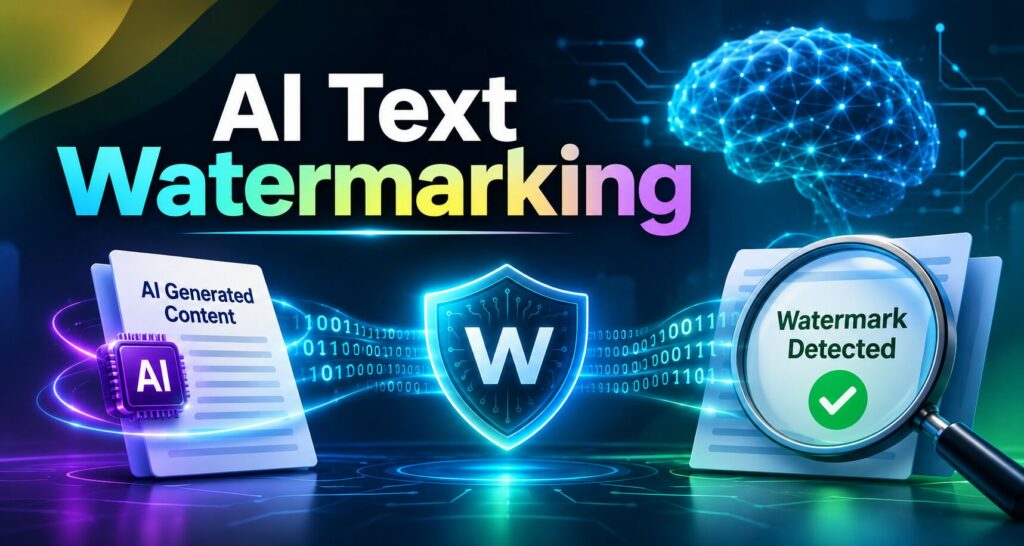
AI Text Watermarking is a technique that embeds a detectable signal into text generated by an artificial intelligence system. The signal is designed to remain largely invisible to ordinary readers while allowing a compatible detection method to assess whether the text may have been generated by a particular AI model.
Traditional watermarks are often visible logos, signatures, or patterns added to images and documents to indicate ownership. Text watermarking works differently because written language does not offer the same obvious space for inserting a visual mark.
Instead, some approaches influence the statistical patterns of word or token selection during text generation. A detection system can then analyze the resulting text to look for evidence of that pattern.
For example, an AI model might subtly favor certain groups of tokens over others according to a predefined mathematical rule. The text can still appear natural to a reader, but a detector with the appropriate method or key may be able to identify a statistical signal.
The exact technique depends on how the watermarking system is designed.
It is important to understand that AI text watermarking is not the same as an AI text detector. A watermarking system attempts to introduce a signal during generation, while a conventional AI detector examines text for characteristics associated with machine-generated writing. These methods can produce different results and have different limitations.
How Does AI Text Watermarking Work?
AI text watermarking generally involves three stages: watermark creation, text generation, and watermark detection.
1. Establishing a Watermark Pattern
The process begins with a watermarking method that defines a pattern or rule for influencing text generation. Some approaches use a secret key or a mathematical procedure to determine which tokens should receive a subtle preference.
The goal is to create a detectable statistical pattern without significantly affecting the text’s meaning, readability, or usefulness.
The pattern should be difficult for an ordinary reader to notice. At the same time, it should be sufficiently consistent for an appropriate detection method to recognize.
2. Generating Watermarked Text
When a compatible language model generates text, the watermarking mechanism can influence its token-selection process.
Language models typically calculate probabilities for possible next tokens and select one according to their generation strategy. A watermarking technique may adjust those probabilities slightly to favor selected tokens under a predefined rule.
Over a sufficiently long passage, these small adjustments may create a statistical signal that can be detected later.
However, this does not mean that every AI-generated response automatically contains a watermark. The model and generation system must support the relevant technique, and the signal must be preserved well enough to remain detectable.
3. Detecting the Watermark
A compatible detector analyzes the text and checks whether the expected watermark pattern appears more strongly than would be expected by chance.
Depending on the method, the detector may calculate a statistical score or evaluate the evidence supporting the presence of a watermark.
The result could indicate that the text contains evidence of a particular watermarking process. It does not necessarily establish who generated the content, which tool was used, or whether every sentence was produced by AI.
A detector also needs to account for uncertainty. Short passages may not contain enough information to provide a reliable result, and edited text may no longer preserve the original signal.
Why Is AI Text Watermarking Important?
The growing use of AI writing tools has created demand for better ways to understand how digital content is produced. AI text watermarking offers one possible approach to improving transparency.
1. Improving Content Transparency
Readers may want to know whether content was generated by AI, written by a person, or created through a combination of both.
A reliable watermark could provide an additional signal about the origin of text, helping organizations establish clearer content disclosure practices.
This could be particularly useful when AI-generated material is published at scale.
2. Supporting Academic Integrity
Educational institutions are exploring how AI tools should be used in assignments, research, and assessments.
AI text watermarking could potentially help educators investigate whether certain text was generated by a compatible AI system. However, it should not be treated as definitive proof of academic misconduct.
Students may use AI for brainstorming, language improvement, or permitted research assistance. Institutions need clear policies and fair assessment procedures rather than relying on a single detection result.
3. Helping Publishers and Content Teams
Publishers, editors, and content managers increasingly work with material created using different combinations of human expertise and AI assistance.
Watermarking could become one component of a broader content verification process. It might help teams identify certain AI-generated passages and apply their own disclosure, review, or editorial standards.
For organizations producing large volumes of content, this could support more consistent documentation of content origins.
4. Encouraging Responsible AI Development
AI developers and businesses need ways to make AI-generated content easier to understand and evaluate.
Watermarking may support responsible AI practices by providing an additional layer of transparency. When combined with clear policies, human oversight, and appropriate documentation, it could help organizations manage the risks associated with AI-generated text.
Nevertheless, watermarking is only one part of responsible AI development. It cannot replace fact-checking, privacy safeguards, security controls, or human judgment.
Can We Identify AI-Generated Content Using Watermarking?
Yes, AI text watermarking can help identify text generated by a compatible AI system, but it cannot identify every piece of AI-generated content.
Its effectiveness depends on several factors, including the watermarking technique, the length of the text, the language used, and how much the content has been edited.
For example, a long article generated by a model that uses watermarking may contain enough statistical evidence for a compatible detector to recognize the signal. However, a short answer generated by the same model may not contain sufficient evidence.
There are also important differences between detecting a watermark and determining whether content was written entirely by AI.
Consider three situations:
- Watermark detected: The text contains evidence consistent with a particular watermarking system.
- Watermark not detected: The system cannot find sufficient evidence of that watermark. This does not prove that a human wrote the text.
- Inconclusive result: The available text is insufficient to support a confident conclusion.
Therefore, AI text watermarking should be viewed as a method for gathering evidence about content origins rather than a universal solution for identifying AI writing.
AI Text Watermarking vs. AI Content Detection
AI text watermarking and AI content detection are related technologies, but they work differently.
An AI watermark is designed to introduce a detectable signal during text generation. An AI content detector typically analyzes existing text and estimates whether it resembles machine-generated writing.
Understanding this distinction is important for businesses, educators, publishers, and content creators.
| Feature | AI Text Watermarking | AI Content Detection |
| Primary purpose | Identify a specific watermark signal | Estimate whether text was AI-generated |
| How it works | Introduces a statistical pattern during generation | Analyzes linguistic and statistical characteristics |
| When it operates | Usually during text generation | Usually after text has been written |
| Compatibility | Requires a compatible watermarking method | Depends on the detector and its capabilities |
| Reliability | Depends on signal strength and available text | Depends on the model, text type, language, and testing conditions |
| Main limitation | May fail when the signal is weak or absent | May misclassify human-written or AI-generated text |
Neither approach is perfect.
A watermark detector may be effective when the relevant signal is present, but it cannot automatically identify text generated by every AI model. Similarly, a conventional AI detector may flag human-written content or fail to recognize AI-generated text.
For the most reliable assessment, organizations should consider multiple sources of evidence instead of relying exclusively on automated detection.
What Are the Limitations of AI Text Watermarking?
Although AI text watermarking offers promising possibilities, several technical and practical challenges affect its reliability.
1. Short Text Is Difficult to Analyze
A watermark relies on patterns that accumulate across multiple token choices. Short passages provide fewer opportunities for these patterns to develop.
A brief social media caption, a one-sentence answer, or a short product description may not provide enough evidence for reliable detection.
Longer passages can offer more information, although length alone does not guarantee a successful result.
2. Editing Can Weaken the Signal
AI-generated content is frequently edited before publication. Writers may replace words, reorganize paragraphs, simplify sentences, or combine several drafts.
These changes can alter the statistical pattern used by a watermarking system. Extensive rewriting may weaken the signal enough to make detection less reliable.
However, the effect depends on the watermarking technique and the type and extent of editing. Ordinary copying and pasting does not necessarily remove a statistical watermark because the signal is not simply a hidden character stored in the document.
3. Different AI Models Use Different Methods
Not every AI writing tool uses the same watermarking technique. Some models may use a watermark, while others may not.
Even when two systems support text watermarking, their methods may be incompatible.
A detector designed for one watermarking system generally cannot be assumed to recognize every other system’s signal.
This creates a challenge for organizations that work with content generated by multiple AI platforms.
4. Language and Writing Style Matter
Watermarking effectiveness can vary across languages and types of content.
Some languages may offer different token-selection patterns, while specialized writing may provide fewer opportunities to introduce a detectable signal without affecting accuracy.
Technical documentation, mathematical explanations, code, and highly structured text can be especially challenging because the correct wording may be relatively constrained.
5. False Conclusions Can Cause Problems
A watermark detection result does not establish that every word was generated by AI.
A person may have written most of an article and used an AI tool to improve a few sentences. Depending on the system and the amount of generated text, a watermark may provide evidence of AI involvement without measuring the extent of that involvement.
Similarly, an absent watermark does not prove human authorship.
Organizations should avoid using watermarking results as the sole basis for academic penalties, employment decisions, publishing restrictions, or accusations of misconduct.
Where Can AI Text Watermarking Be Used?
AI text watermarking has potential applications across several industries. Its practical value will depend on detection accuracy, availability, and the policies governing how results are interpreted.
Education and Research
Schools, universities, and research institutions may use watermarking as one component of an academic integrity process.
It could support investigations into the use of AI-generated assignments or research material. However, institutions should distinguish between prohibited AI use and permitted assistance, such as grammar correction or brainstorming.
Clear guidelines and human review remain essential.
Digital Publishing and Journalism
Publishers and news organizations need reliable processes for reviewing the origin and accuracy of content.
Watermarking could provide an additional signal when evaluating material produced by AI-assisted editorial workflows.
Nevertheless, a watermark does not verify whether an article is accurate, original, or properly sourced. Editorial review and fact-checking remain necessary.
Business Content Creation
Businesses use AI to prepare product descriptions, marketing copy, reports, customer communications, and internal documentation.
AI text watermarking could help content teams understand whether certain material was produced using compatible AI systems.
When combined with appropriate documentation and review procedures, it may contribute to more transparent content management.
AI Software Development
Organizations building AI-powered applications may explore watermarking as part of a broader AI transparency strategy.
For example, an AI writing application could generate content through a compatible watermarking mechanism and provide appropriate information about its limitations.
Companies developing such solutions need to consider model compatibility, performance, data privacy, and the reliability of detection results.
For organizations exploring these capabilities, AI development services, AI software development, and custom AI solutions are useful areas to investigate when evaluating the technical requirements of an AI-powered product.
How Businesses Can Prepare for AI Text Watermarking
Businesses do not need to wait for watermarking technology to mature before improving their AI content practices.
A practical approach combines technology with clear policies and human oversight.
1. Establish an AI Content Policy
Define how employees can use AI writing tools and which types of content require disclosure or additional review.
The policy should explain acceptable AI assistance, verification requirements, and responsibilities for published material.
2. Keep Track of Content Sources
Where appropriate, maintain records of the tools and workflows used to create important content.
Content provenance records can help teams understand how material was produced, especially when multiple employees and AI systems contribute to the same document.
3. Use Detection Tools Carefully
AI watermark detectors and conventional AI content detectors can provide useful information, but their results should be interpreted cautiously.
Before adopting a tool, evaluate its supported models, languages, text lengths, false-positive rates, and limitations.
Avoid treating a single automated score as definitive evidence.
4. Maintain Human Oversight
Human review remains essential for checking factual accuracy, context, originality, and compliance with organizational policies.
AI-generated content should be reviewed according to its intended purpose and potential consequences.
5. Monitor Developments in AI Technology
AI watermarking is part of a wider shift toward content provenance, responsible AI, and transparent digital systems.
Businesses should regularly review developments in these areas and assess whether emerging technologies can improve their existing workflows.
What Is the Future of AI Text Watermarking?
The future of AI text watermarking will depend on whether developers can balance reliable detection with high-quality text generation.
One important area of development is improving watermark robustness. Researchers are exploring ways to preserve detectable signals even when text undergoes ordinary editing or other transformations.
Another priority is reducing false positives while maintaining useful detection rates. A watermark that frequently produces misleading results would have limited value in sensitive environments.
Interoperability is also important. As organizations adopt multiple AI models, compatible approaches and clearer standards could make it easier to interpret provenance information across different systems.
Watermarking may also become part of broader content provenance frameworks that combine machine-readable signals, document metadata, digital signatures, and records of content creation.
However, these technologies serve different purposes. A watermark may provide evidence associated with an AI generation process, while metadata or signed records may provide additional information about a document’s history. None automatically guarantees that the content is accurate or trustworthy.
Ultimately, AI text watermarking is likely to be most useful as one layer in a larger approach to content transparency.
Conclusion
AI Text Watermarking offers a promising way to identify statistical signals associated with text generated by compatible AI systems. By influencing token selection during generation, watermarking techniques can make certain AI-generated passages easier to recognize without necessarily changing how the text appears to readers.
However, the technology has important limitations. Short passages, constrained writing, language differences, and extensive editing can affect detection. A missing watermark does not prove human authorship, and a detected watermark does not establish that an entire document was written by AI.
For businesses, publishers, educators, and developers, the most effective approach is to combine watermarking with responsible AI policies, content verification, appropriate documentation, and human judgment.
As AI-generated content becomes more common, understanding how AI text watermarking works will help organizations make informed decisions about transparency, trust, and the responsible use of artificial intelligence.
The central question is no longer simply whether AI can write human-like text. It is how we can understand where that text came from, evaluate its reliability, and use it responsibly.
Frequently Asked Questions
What is AI text watermarking?
AI text watermarking embeds a detectable statistical pattern in AI-generated text to help identify its origin.
Can AI text watermarking detect all AI-generated content?
No. It works only when compatible watermarking methods are used and the signal remains detectable.
How does AI text watermarking work?
It subtly influences token selection during text generation, creating a pattern that a compatible detector can analyze.
What is the difference between AI watermarking and AI detection?
Watermarking introduces a signal during generation, while AI detection analyzes existing text for characteristics associated with AI writing.
Can editing remove an AI text watermark?
Extensive editing or rewriting may weaken a watermark, making detection less reliable. The effect depends on the watermarking method.