
TL;DR
• AI memory helps assistants remember context and deliver more personalized responses.
• Enterprise memory connects documents, data, and business knowledge in one place.
• Context engineering improves AI accuracy by providing the right information at the right time.
• AI-powered applications use memory to automate tasks and support smarter decisions.
• AI memory is becoming a core technology for the next generation of intelligent systems.
The AI industry has spent the last few years chasing one goal: building bigger and smarter models.
Every major announcement has focused on larger context windows, more parameters, faster inference, and billions of dollars invested in GPUs and AI infrastructure. Companies are competing to create models that can write code, generate videos, reason through complex problems, and automate business operations.
But while everyone is watching the race for better models, another opportunity is quietly emerging.
The next generation of artificial intelligence will not be defined only by intelligence; it will be defined by memory.
Imagine an AI assistant that remembers your writing style, your ongoing projects, your team’s structure, your preferred workflows, and every important conversation you’ve had over the last two years. Instead of repeating instructions every day, the AI simply understands your context and becomes more useful over time.
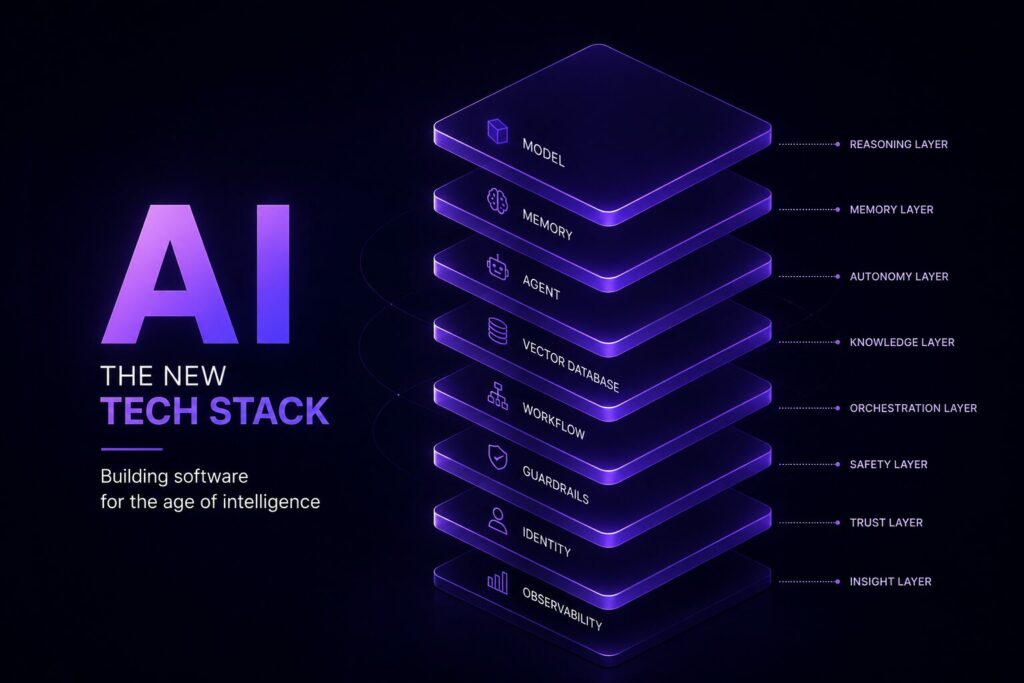
This shift is creating an entirely new technology layer centered around persistent memory, enterprise knowledge systems, context engineering, and knowledge graphs.
These technologies don’t work in isolation. Modern enterprises rely on orchestration layers that connect models, memory, APIs, and business workflows into a single intelligent system.
It may also become one of the biggest billion-dollar opportunities in artificial intelligence.
Why AI Needs Memory
Today’s AI models are incredibly capable, but they still have a fundamental limitation.
They are excellent at generating answers but surprisingly poor at remembering users over long periods.
Most AI systems forget.
- Previous conversations
- Personal preferences
- Business goals
- Team structures
- Customer relationships
- Long-term projects
As a result, users repeatedly explain the same information, wasting time and reducing productivity.
This isn’t simply a user experience problem.
For enterprises deploying AI across thousands of employees, forgetting context increases costs, slows workflows, and limits automation.
Persistent memory solves this challenge by allowing AI to continuously store, organize, retrieve, and update relevant information instead of restarting every conversation from zero.
Organizations investing in long-term AI capabilities are increasingly adopting custom-built AI platforms designed to integrate memory, automation, and business intelligence into a unified ecosystem.
Instead of acting like a search engine, AI begins behaving like an experienced colleague who remembers every meeting and every decision.
The Market Is Already Sending a Signal
The financial markets are already recognizing that memory is becoming one of AI’s most valuable resources.
According to market analysis, the S&P 500 gained nearly 16% during April and May 2026, making it one of the strongest two-month rallies in decades, with AI infrastructure and semiconductor companies leading much of the momentum.
The demand for AI hardware is no longer limited to GPUs.
Memory technologies are becoming equally important because every advanced AI system depends on storing and retrieving enormous amounts of contextual information.
Industry analysts also expect High-Bandwidth Memory (HBM) to account for approximately 34% of leading-edge memory production by 2028, compared to just 6% in 2023, highlighting how quickly AI workloads are reshaping the semiconductor industry.
This isn’t simply another technology trend.
It represents the emergence of a completely new infrastructure market.
Persistent Memory Is Creating Truly Personal AI
For years, technology companies promised personal digital assistants that would understand users naturally.
The missing ingredient was memory.
A modern AI assistant should remember the following:
- Your preferred writing style
- Favorite productivity tools
- Calendar habits
- Travel preferences
- Shopping history
- Business priorities
- Long-term objectives
Every conversation adds another layer of understanding.
Instead of writing long prompts every day, users simply continue the conversation while AI builds a richer understanding of their preferences.
The result is an assistant that becomes more valuable over time instead of remaining a generic chatbot.
This represents a broader shift from one-time prompts to continuously learning AI ecosystems that improve with every interaction.
This evolution transforms AI from a tool into a personalized digital companion capable of supporting users across work and everyday life.
Enterprise Memory Could Become an Even Bigger Opportunity
Consumer AI receives most of the media attention, but enterprise memory may become the larger market.
Every organization produces enormous amounts of information every day through:
- Emails
- Slack messages
- CRM systems
- Customer support tickets
- Internal documentation
- Meeting transcripts
- Product roadmaps
- Sales conversations
Unfortunately, much of this knowledge remains scattered across disconnected platforms.
Employees spend countless hours searching for information that already exists.
Enterprise memory introduces a unified knowledge layer that connects these systems and allows AI agents to retrieve information instantly.
Modern enterprises are combining AI with custom software platforms to create connected ecosystems where knowledge, workflows, and automation work seamlessly together.
As organizations embrace persistent memory, intelligent software is evolving beyond chat interfaces into autonomous systems capable of planning, reasoning, and executing complex business tasks.
Instead of searching multiple applications, employees simply ask AI.
The assistant already understands company history, policies, previous decisions, customer relationships, and project timelines.
This dramatically improves productivity while preserving institutional knowledge that would otherwise disappear when employees leave the organization.
Context Engineering Is Replacing Prompt Engineering
For the last two years, prompt engineering has dominated conversations around AI.
The idea was simple: write better prompts to get better responses.
But developers are increasingly focusing on something much more important context engineering.
Instead of optimizing a single prompt, context engineering ensures AI receives the right information before generating an answer.
Modern AI applications combine multiple layers of context, including:
- User preferences
- Previous conversations
- Retrieved documents
- Company policies
- External APIs
- Real-time business data
- Long-term memory
Together, these layers produce responses that are significantly more accurate and personalized.
As AI agents become more autonomous, context engineering is expected to become one of the most valuable skills in AI development.
Knowledge Graphs Are Giving AI Structured Memory
Memory alone is not enough.
AI also needs to understand relationships between information.
Knowledge graphs solve this challenge by connecting data rather than simply storing it.
Instead of remembering:
Sarah works at Company X.
A knowledge graph understands that:
- Sarah manages Product Alpha
- Product Alpha integrates with Platform Beta
- Platform Beta serves Client Gamma
- Client Gamma renewed its contract last month
- The renewal affects quarterly revenue projections
This interconnected structure enables AI to reason through relationships instead of retrieving isolated facts.
Many enterprise AI platforms are now combining:
- Large Language Models
- Retrieval-Augmented Generation (RAG)
- Persistent Memory
- Vector Databases
- Knowledge Graphs
to create more reliable and intelligent systems.
Why Investors Are Paying Attention
Every major AI trend increases the value of memory infrastructure.
More AI agents generate more conversations.
More conversations create more context.
More context produces more knowledge.
And more knowledge makes AI significantly more valuable.
The demand for AI memory has become so significant that leading cloud providers are securing long-term supply agreements to guarantee future capacity.
Meanwhile, memory manufacturers have become some of the strongest-performing technology companies, driven by explosive demand for AI infrastructure.
Industry projections also suggest that future shortages in DRAM supply could impact both PCs and smartphones as AI applications require increasingly memory-intensive hardware.
The message is becoming increasingly clear:
AI memory is no longer a supporting technology.
It is becoming a strategic asset.
The Hidden Competitive Advantage
For years, the AI race has been measured by model size and benchmark scores.
But those metrics tell only part of the story.
A smaller model that remembers years of customer interactions, understands organizational processes, and continuously updates its knowledge can outperform a much larger model that starts every conversation from scratch.
Memory creates continuity.
Continuity creates personalization.
Personalization builds trust.
And trust determines whether AI becomes an occasional productivity tool or an indispensable business partner.
This is why many technology leaders believe the next wave of AI innovation will happen outside the model itself—in the systems responsible for managing memory, context, and organizational knowledge.
The Future: AI That Never Starts Over
Today’s AI systems answer questions.
Tomorrow’s AI systems will build relationships.
They will remember previous projects, understand evolving priorities, learn organizational structures, and improve continuously through experience.
Persistent memory will enable AI assistants that genuinely know their users.
Enterprise memory will transform scattered information into searchable intelligence.
Context engineering will replace static prompting with dynamic understanding.
Knowledge graphs will help AI reason through complex relationships instead of isolated facts.
Together, these technologies are creating the foundation for a new generation of intelligent systems.
Final Thoughts
The conversation around artificial intelligence has been dominated by foundation models, GPUs, and billion-parameter benchmarks.
But the next major breakthrough may not come from making AI bigger.
It may come from making AI remember.
Persistent memory is transforming personal assistants into long-term companions.
Enterprise memory is turning organizational knowledge into a competitive advantage.
Context engineering is enabling AI to make smarter decisions.
Knowledge graphs are giving machines the ability to understand relationships instead of isolated information.
While the world continues to focus on model wars, a quieter revolution is taking shape beneath the surface.
The companies building AI memory infrastructure today could become the cloud providers, database giants, and enterprise software leaders of the next decade.
The next billion-dollar AI market isn’t just about creating smarter models. It’s about creating AI that never forgets.
Frequently Asked Questions
What is AI memory, and why is it important?
AI memory allows systems to retain context, user preferences, and past interactions, enabling more personalized, accurate, and intelligent responses instead of treating every conversation as a new one.
How is AI memory different from traditional databases?
Traditional databases store structured information, while AI memory stores contextual knowledge, semantic relationships, and conversation history, helping AI understand and retrieve relevant information more effectively.
What role do knowledge graphs and context engineering play in AI memory?
Knowledge graphs connect related information, while context engineering ensures AI receives the right data at the right time. Together, they improve reasoning, reduce hallucinations, and enhance response quality.
Why are enterprises investing heavily in AI memory infrastructure?
As AI agents become part of daily business operations, enterprises need persistent memory to unify documents, workflows, customer interactions, and organizational knowledge, creating more reliable and efficient AI systems.
Is AI memory the next big technology market?
Yes. With growing investments in AI chips, enterprise AI platforms, and autonomous agents, industry experts see AI memory as a foundational technology that will power the next generation of intelligent applications and digital experiences.