
TL;DR
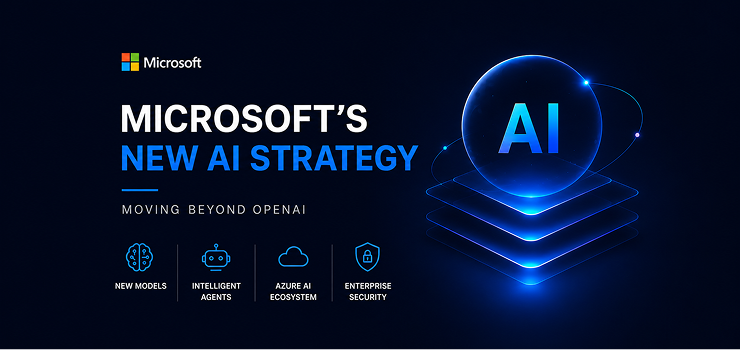
• Microsoft is expanding beyond OpenAI with proprietary AI models and enterprise-focused AI solutions.
• Its Frontier Transformation strategy shifts AI from experimentation to real business value.
• A multi-model approach helps businesses reduce AI costs while improving performance and scalability.
• Azure AI is becoming the foundation for deploying intelligent agents, AI models, and enterprise workflows.
• The next wave of enterprise AI will be powered by integrated ecosystems, not a single AI model.
Artificial intelligence is rapidly becoming a core business technology rather than an experimental innovation. According to Microsoft’s Global AI Adoption 2025 report, 16.3% of the world’s population now actively uses generative AI, meaning nearly one in six people worldwide rely on AI for work, learning, or everyday tasks. This rapid growth highlights how quickly AI is becoming part of mainstream digital experiences.
As AI adoption accelerates, businesses are shifting their focus from deploying chatbots to building intelligent systems that automate workflows and deliver measurable business value. This evolution aligns with a broader industry trend where success is increasingly determined by infrastructure and ecosystem strategy rather than a single AI model. As explored in Why The Real AI Race Is No Longer About Models: It’s About Compute Power, modern AI leaders are investing in scalable platforms and computing infrastructure to support the next generation of enterprise applications.
Microsoft’s latest AI strategy reflects this transformation. While continuing its partnership with OpenAI, the company is expanding investments in proprietary AI models, Azure AI services, and enterprise infrastructure to provide businesses with greater flexibility, lower operating costs, and scalable AI solutions. Rather than relying on one frontier model, Microsoft is building an integrated AI ecosystem designed for the next generation of enterprise computing.
Microsoft AI Enters Its Second Phase
Microsoft describes the next evolution of artificial intelligence as Frontier Transformation, a stage where organizations move beyond AI experimentation and begin redesigning business operations around intelligent systems.
During the first wave of generative AI adoption, companies primarily focused on deploying chatbots, content assistants, and productivity tools. These implementations delivered immediate benefits but often remained isolated from core business processes.
The second phase is fundamentally different.
Instead of asking how AI can save employees time, organizations are beginning to ask how AI can reshape customer experiences, improve operational efficiency, accelerate innovation, and generate measurable business value.
This philosophy has become central to Microsoft’s enterprise AI strategy.
Rather than promoting AI as a standalone application, Microsoft is embedding intelligence across Microsoft 365, Dynamics, GitHub, Fabric, Power Platform, and Azure. The goal is to create an interconnected ecosystem where AI works alongside employees, business applications, and enterprise data.
This approach reflects a broader industry transition from productivity enhancement to organizational transformation.
Companies that successfully integrate AI into everyday decision-making will likely gain significant competitive advantages over businesses that treat AI as a separate technology initiative.
Why Microsoft Is Moving Beyond OpenAI
Microsoft’s partnership with OpenAI remains one of the most influential collaborations in the technology industry. GPT models continue to power many Microsoft products and services, providing advanced reasoning, content generation, and conversational capabilities.
Yet enterprise AI requirements have evolved rapidly.
Organizations now demand solutions that offer:
- Lower inference costs
- Greater model flexibility
- Stronger security controls
- Better regulatory compliance
- Industry-specific customization
- Reduced dependency on a single AI provider
- Faster deployment across existing business systems
A single frontier model cannot efficiently address every enterprise workload.
For example, generating software code, summarizing meeting notes, classifying documents, analyzing financial reports, and automating customer service all require different levels of intelligence, speed, and computational resources.
Recognizing this reality, Microsoft is expanding its AI portfolio to include multiple model types and intelligent services rather than relying exclusively on OpenAI.
This strategy allows enterprises to select the most appropriate AI solution for each business scenario while maintaining consistent governance and infrastructure through Azure.
The result is a flexible ecosystem that prioritizes business outcomes instead of promoting one universal model.
From AI Access to AI Outcomes
One of the most significant shifts in Microsoft’s AI vision is its movement from providing AI access to delivering AI outcomes.
During the initial surge of generative AI adoption, many organizations viewed success simply as deploying AI assistants across their workforce.
Today, expectations are much higher.
Business leaders expect AI investments to improve revenue, streamline operations, reduce costs, strengthen customer relationships, and accelerate innovation.
Microsoft is responding by positioning AI as an operational layer that connects data, applications, workflows, and decision-making.
Instead of implementing isolated AI tools, enterprises can create intelligent systems that automate complex business processes across departments.
Consider a modern customer support operation.
Rather than using AI only to answer questions, an integrated Microsoft AI environment can:
- Retrieve customer history from enterprise databases
- Generate personalized responses
- Analyze previous interactions
- Recommend solutions
- Create follow-up tasks
- Update CRM records automatically
- Notify relevant internal teams
This workflow transforms AI from an assistant into an active participant within business operations.
The same concept applies to finance, healthcare, manufacturing, retail, and software development.
Organizations are increasingly measuring AI success through operational improvements rather than chatbot usage statistics.
This shift is also increasing demand for custom AI application development that integrates language models, business data, automation, and cloud infrastructure into a unified enterprise workflow instead of deploying standalone AI assistants.
This transition from AI access to AI outcomes is becoming a defining characteristic of Microsoft’s enterprise strategy.
Enterprise AI Is Becoming Microsoft’s Core Business Strategy
Consumer AI continues to attract headlines, but Microsoft’s largest long-term opportunity lies in enterprise AI.
Unlike consumer applications, enterprise deployments require security, governance, scalability, compliance, identity management, and seamless integration with existing business systems.
Microsoft already possesses significant advantages in these areas through Windows, Microsoft 365, Azure, Dynamics 365, GitHub, and Power Platform.
Instead of introducing AI as a separate product category, Microsoft is integrating intelligence across its existing enterprise ecosystem.
To guide this transformation, Microsoft recently introduced four strategic paths that organizations can follow to generate meaningful business value from AI.
1. Enrich Employee Experiences
Employees spend a significant portion of their day searching for information, summarizing documents, responding to emails, and completing repetitive administrative tasks.
AI reduces this operational burden by surfacing relevant knowledge, generating content, summarizing meetings, and assisting with decision-making.
The objective is not to replace employees but to allow them to focus on creative thinking, collaboration, and strategic work.
Organizations adopting this model can improve productivity while reducing time spent on low-value activities.
2. Reinvent Customer Engagement
Customer expectations continue to evolve as digital experiences become increasingly personalized.
Microsoft envisions AI-powered customer engagement that goes beyond automated chat responses.
Enterprise AI can analyze customer behavior, understand context, recommend products, anticipate service needs, and provide personalized interactions across multiple channels.
By integrating AI directly into CRM systems and communication platforms, organizations can deliver faster and more consistent customer experiences while improving operational efficiency.
3. Reshape Business Processes
One of AI’s greatest strengths is its ability to automate repetitive workflows across multiple business functions.
Rather than relying on manual processes, organizations can use AI to coordinate enterprise data, route approvals, generate reports, monitor operations, and support real-time decision-making.
This transformation creates intelligent workflows capable of adapting dynamically as business conditions change.
Instead of isolated automation, enterprises gain connected systems that continuously improve operational performance.
4. Accelerate Innovation
Innovation cycles are becoming shorter across every industry.
AI enables organizations to analyze market trends, generate product concepts, accelerate software development, test ideas, and identify new opportunities faster than traditional methods.
By integrating AI throughout research, engineering, marketing, and product development, businesses can reduce time-to-market while improving decision quality.
For Microsoft, these four transformation paths demonstrate that enterprise AI is no longer an experimental technology.
It is becoming a strategic operating model.
Cost Optimization Is Becoming a Competitive Advantage
Artificial intelligence is computationally expensive. Every AI interaction requires processing power, memory, networking resources, and increasingly specialized hardware such as GPUs.
As enterprise adoption grows, infrastructure costs become one of the most important factors influencing AI deployment decisions.
Microsoft recognizes that sustainable AI adoption cannot rely on sending every request through the largest and most expensive foundation models.
Instead, the company is promoting a layered AI architecture that matches model complexity with business requirements.
Routine enterprise tasks such as the following:
- Email summarization
- Meeting transcription
- Internal document classification
- Knowledge retrieval
- Customer ticket routing
- Workflow automation
often do not require frontier-scale reasoning capabilities.
Smaller and specialized AI models can complete these tasks faster while consuming significantly fewer computing resources.
This approach provides multiple business advantages.
- Lower Operational Costs
Organizations reduce GPU consumption and infrastructure expenses by reserving larger models for high-value reasoning tasks.
- Faster Response Times
Smaller models typically deliver lower latency, improving user experience across enterprise applications.
- Improved Infrastructure Efficiency
AI workloads can be distributed intelligently across different model sizes, maximizing cloud resource utilization.
- Greater Scalability
As AI adoption expands across departments, organizations can support millions of interactions without proportional increases in infrastructure costs.
Cost optimization is therefore becoming a strategic differentiator rather than simply a financial consideration.
Companies that successfully balance performance and efficiency will be better positioned to scale enterprise AI adoption over the long term.
Microsoft’s investment in diversified AI models and Azure infrastructure reflects this reality.
Instead of competing only on model intelligence, the company is competing on delivering enterprise AI that is practical, scalable, secure, and economically sustainable.
AI Model Diversification Is Reshaping Enterprise AI
For much of the generative AI boom, the industry focused on a single question: Which company has the most powerful language model?
Microsoft’s evolving strategy suggests that this may no longer be the most important question.
Instead, enterprises are beginning to ask a different one:
Which AI model is best suited for a specific business task?
This shift is driving Microsoft’s investment in a multi-model ecosystem that allows organizations to balance intelligence, speed, cost, and security according to their operational requirements.
A global enterprise may use one model for software development, another for document analysis, a smaller model for internal knowledge retrieval, and intelligent agents for workflow automation. Rather than forcing every workload through one frontier model, Microsoft is creating an environment where multiple AI models can coexist and work together.
This diversified approach reduces infrastructure costs while improving flexibility and long-term scalability.
Why a Single AI Model Is No Longer Enough
Enterprise AI workloads are becoming increasingly diverse.
A legal firm reviewing thousands of contracts has very different requirements than a retailer generating personalized product recommendations or a software company building code assistants.
Each use case demands a unique balance of reasoning capability, latency, privacy, and cost.
For example:
| Business Function | Ideal AI Approach |
| Meeting summaries | Small language model |
| Document classification | Lightweight enterprise model |
| Customer support automation | AI agent with retrieval capabilities |
| Software development | Advanced reasoning model |
| Financial forecasting | Specialized analytical model |
| Internal knowledge search | Retrieval-augmented AI |
Instead of expecting one foundation model to excel at every task, Microsoft is enabling enterprises to combine multiple models within the same ecosystem.
This architecture allows organizations to optimize performance while maintaining centralized governance through Azure.
Microsoft’s Multi-Model Vision
Microsoft continues to work closely with OpenAI while simultaneously expanding support for proprietary models, open-source models, and specialized enterprise AI solutions.
This strategy provides customers with significantly greater flexibility than a single-provider approach.
Organizations can choose AI models based on:
- Cost efficiency
- Performance requirements
- Security policies
- Regulatory compliance
- Industry-specific workloads
- Response latency
- Deployment environment
As enterprise AI matures, model selection will increasingly resemble cloud infrastructure decisions where businesses choose the best service for each workload rather than committing entirely to one vendor.
Microsoft is positioning Azure as the platform that enables this flexibility.
Proprietary AI Models Give Microsoft Greater Control
One of the biggest developments in Microsoft’s AI strategy is its growing investment in proprietary AI models designed specifically for enterprise use.
While frontier-scale models remain valuable for complex reasoning and creative tasks, many enterprise applications benefit from smaller, highly optimized models that are faster and more cost-effective.
Developing proprietary models gives Microsoft several strategic advantages.
Reduced Infrastructure Costs
Large language models require significant computational resources.
By deploying smaller models for routine business operations, Microsoft can reduce GPU utilization and offer more affordable AI services to enterprise customers.
This cost optimization becomes increasingly important as organizations scale AI across thousands of employees and millions of daily interactions.
Better Enterprise Customization
Consumer AI models are designed for broad knowledge and general conversations.
Enterprise AI requires something different.
Businesses need models that understand the following:
- Internal documentation
- Organizational workflows
- Industry terminology
- Compliance requirements
- Security policies
Proprietary models allow Microsoft to optimize AI specifically for business productivity rather than public chatbot interactions.
Faster Product Development
Microsoft integrates AI across dozens of enterprise products, including:
- Microsoft 365
- Teams
- Dynamics 365
- GitHub
- Power Platform
- Fabric
- Security platforms
Owning more of the AI stack allows product teams to introduce new capabilities without relying entirely on external model providers.
This creates greater product consistency and accelerates enterprise innovation.
Azure AI Is Becoming the Enterprise Execution Layer
Many people associate Microsoft’s AI strategy primarily with Copilot.
In reality, Azure represents the foundation upon which Microsoft’s entire AI ecosystem is built.
Azure is evolving beyond traditional cloud infrastructure into an intelligent execution platform where enterprises can build, deploy, manage, and scale AI applications securely.
Rather than functioning as a simple hosting environment, Azure provides the infrastructure required to support enterprise-grade AI operations.
To fully leverage these capabilities, many organizations combine Azure AI with enterprise software development solutions that connect intelligent models with existing CRM platforms, ERP systems, customer portals, and internal business applications.
Organizations can combine the following:
- AI models
- Enterprise data
- Intelligent agents
- Business applications
- Security controls
- Identity management
- Automation workflows
within a unified cloud environment.
This integration is becoming one of Microsoft’s strongest competitive advantages.
Azure AI Foundry and Enterprise Development
Modern AI applications require much more than a language model.
Development teams need tools for experimentation, deployment, governance, monitoring, and continuous improvement.
Azure AI provides a complete development ecosystem that supports every stage of the AI lifecycle.
Teams can:
- Evaluate multiple models
- Build retrieval-augmented applications
- Connect AI with enterprise databases
- Monitor performance
- Manage security policies
- Scale deployments globally
This enables organizations to move beyond isolated AI pilots toward production-ready enterprise solutions.
Instead of managing fragmented AI tools, businesses gain a centralized platform capable of supporting long-term AI transformation.
Intelligent Agents Represent the Next Evolution of Enterprise AI
Perhaps the most significant aspect of Microsoft’s strategy is its growing emphasis on intelligent AI agents.
Traditional AI assistants respond to individual prompts.
AI agents operate differently.
They can understand objectives, plan multiple actions, access enterprise data, collaborate with other systems, and complete workflows with minimal human intervention.
Rather than answering a single question, an intelligent agent can execute an entire business process.
Consider a sales organization.
An AI agent could:
- Review customer history
- Analyze previous communications
- Generate a personalized proposal
- Schedule follow-up meetings
- Update CRM records
- Notify the account manager
- Produce a performance summary
all within one connected workflow.
This transforms AI from a conversational tool into an operational participant within the enterprise.
AI Agents and Human Collaboration
Microsoft’s vision is not centered on autonomous systems replacing employees.
Instead, AI agents are designed to function as collaborative digital teammates.
Employees continue making strategic decisions while AI manages repetitive execution, information retrieval, documentation, coordination, and administrative tasks.
This partnership enables organizations to:
- Increase productivity
- Improve decision quality
- Reduce operational delays
- Standardize business processes
- Accelerate project delivery
As AI capabilities continue to evolve, organizations are likely to deploy networks of specialized agents supporting different departments while remaining connected through Azure infrastructure.
Why Azure Gives Microsoft a Competitive Advantage
Microsoft enters the enterprise AI race with advantages that few competitors can match.
Unlike companies focused primarily on language models, Microsoft already operates one of the world’s largest enterprise ecosystems.
Its AI strategy integrates naturally with products that businesses already use every day.
These include:
- Microsoft 365
AI enhances document creation, communication, meeting management, and collaboration.
- Dynamics 365
Organizations can embed AI directly into sales, customer service, finance, and supply chain operations.
- GitHub
Developers receive intelligent coding assistance while maintaining enterprise governance and security.
- Power Platform
Business users can automate workflows and build AI-powered applications with minimal technical complexity.
- Azure
Cloud infrastructure provides secure deployment, identity management, compliance controls, and scalable computing resources.
This integrated ecosystem reduces implementation complexity and accelerates enterprise AI adoption.
Platform Control Is the Long-Term Strategy
Industry analysts increasingly suggest that Microsoft’s objective extends beyond creating popular AI products.
The company’s broader strategy is to establish Azure as the foundational platform where enterprise AI is developed, deployed, governed, and scaled.
This approach mirrors Microsoft’s historical success with Windows, Office, and Azure itself.
Rather than competing feature by feature, Microsoft focuses on becoming the infrastructure layer that organizations depend on every day.
If enterprises build their AI workflows, intelligent agents, security policies, automation pipelines, and business applications on Azure, switching platforms becomes increasingly difficult.
This creates long-term customer relationships while allowing Microsoft to continuously introduce new AI capabilities across its ecosystem.
Instead of competing solely in the chatbot market, Microsoft is positioning itself as the operating system for enterprise artificial intelligence.
Building an AI Ecosystem Instead of an AI Product
Microsoft’s latest strategy demonstrates that the future of enterprise AI will not be determined by one breakthrough model.
Success will depend on creating an ecosystem where multiple AI models, intelligent agents, enterprise applications, and cloud infrastructure work together seamlessly.
Organizations are demanding solutions that provide flexibility rather than vendor lock-in, business outcomes rather than isolated experiments, and scalable architectures rather than standalone assistants.
By investing in proprietary AI models, expanding Azure AI capabilities, and supporting intelligent multi-agent workflows, Microsoft is laying the foundation for a more diversified and enterprise-centric AI future.
This strategy positions the company not only as an AI innovator but also as the infrastructure provider powering the next generation of intelligent business operations.
Latest Enterprise AI Trends: What the Data Reveals
Artificial intelligence is rapidly evolving from an experimental technology into a core business capability. Organizations across industries are moving beyond isolated AI pilots and integrating intelligent systems into daily operations, customer engagement, software development, and strategic decision-making.
Microsoft’s recent research and enterprise observations indicate that the most successful organizations are no longer measuring AI adoption by the number of employees using chatbots. Instead, they evaluate AI based on productivity improvements, operational efficiency, innovation, and measurable business outcomes.
This shift represents the beginning of a new enterprise AI era where intelligent systems become part of an organization’s operating model rather than an optional productivity tool.
Key Statistics Shaping Microsoft’s AI Strategy
Recent Microsoft research analyzed trillions of anonymized Microsoft 365 productivity signals and surveyed 20,000 AI users across 10 countries to understand how organizations are adopting AI and where they are creating the most value.
Several findings stand out.
AI Is Supporting Higher-Value Work
Approximately 49% of Microsoft 365 Copilot interactions involve cognitive tasks, including analysis, planning, creative thinking, research, and problem-solving rather than repetitive automation.
This suggests that enterprise AI is increasingly being used as a strategic assistant capable of augmenting human decision-making instead of simply reducing administrative work.
Employees Are Producing Work That Was Previously Impossible
Microsoft’s research found that 58% of AI users report completing work they could not have accomplished one year earlier.
Among the organization’s most advanced AI adopters, described as Frontier Professionals, that figure increases to 80%.
These results highlight AI’s growing role in expanding human capability rather than simply improving efficiency.
Instead of completing existing tasks faster, organizations are enabling entirely new ways of working.
AI Adoption Is Becoming Organization-Wide
Early AI deployments typically focused on marketing teams, software developers, or customer support departments.
Today’s enterprise AI strategies are expanding across:
- Finance
- Human Resources
- Operations
- Sales
- Product Development
- Supply Chain Management
- Legal Teams
- Executive Decision Making
This broader adoption reinforces Microsoft’s belief that AI should function as an organizational platform rather than a department-specific tool.
The Future Competition in Artificial Intelligence
The first phase of the AI race focused primarily on language models.
Technology companies competed to build systems with larger context windows, stronger reasoning capabilities, and improved conversational performance.
The next phase of competition will look very different.
Instead of asking which model is the smartest, enterprises will increasingly evaluate which platform delivers the greatest business value.
Five major competitive areas are emerging.
1. Infrastructure Will Become a Strategic Advantage
Every AI interaction depends on computing power.
As enterprise adoption accelerates, cloud infrastructure, GPU capacity, networking, storage, and energy efficiency become critical competitive differentiators.
Microsoft continues investing heavily in global data centers and AI infrastructure, positioning Azure as the foundation for enterprise AI deployment.
Organizations choosing AI partners will increasingly evaluate infrastructure reliability alongside model performance.
2. Cost Efficiency Will Drive Large-Scale Adoption
Many enterprises want to deploy AI across thousands of employees and millions of daily interactions.
This level of adoption requires sustainable economics.
Companies capable of delivering lower-cost inference while maintaining strong performance will gain significant competitive advantages.
Microsoft’s emphasis on diversified AI models and layered architecture reflects this reality.
Instead of routing every request through expensive frontier models, organizations can deploy specialized AI systems optimized for different business functions.
3. Multi-Model Ecosystems Will Replace Single-Model Strategies
The future enterprise environment is unlikely to depend on one universal AI model.
Organizations will increasingly combine:
- Large language models
- Small language models
- Domain-specific models
- Retrieval systems
- AI agents
- Industry-specific solutions
Microsoft’s Azure ecosystem is designed to support this flexibility while maintaining centralized governance and security.
This approach reduces vendor dependency and allows businesses to adapt as AI technology evolves.
4. Intelligent Agents Will Transform Business Operations
The next generation of enterprise AI will extend beyond conversational assistants.
Intelligent agents will execute workflows, coordinate business applications, analyze enterprise data, and collaborate with employees in real time.
Examples include:
- Automatically preparing executive reports
- Managing procurement approvals
- Coordinating software deployments
- Processing customer requests
- Generating compliance documentation
- Monitoring operational performance
Organizations that successfully integrate AI agents into daily operations will likely experience significant productivity improvements.
Microsoft is investing heavily in this area, making intelligent agents a central pillar of its long-term AI vision.
5. Enterprise Trust Will Become a Competitive Differentiator
Businesses require much more than powerful AI models.
They also need:
- Security
- Compliance
- Identity management
- Governance
- Data privacy
- Responsible AI controls
Microsoft’s enterprise heritage provides advantages that extend beyond model capability.
Its existing relationships with global organizations, combined with Azure’s security and compliance infrastructure, position the company as a trusted enterprise AI provider.
As AI adoption increases, trust may become just as important as intelligence.
What This Means for Businesses
Microsoft’s evolving strategy offers several important lessons for organizations planning their AI investments.
- Focus on Business Outcomes
Successful AI initiatives should improve operational performance, customer experience, innovation, or decision-making rather than simply increasing chatbot usage.
Organizations that align AI with measurable business objectives will generate stronger returns on investment.
- Build Flexible AI Architectures
Technology evolves rapidly.
Businesses should avoid strategies that depend entirely on a single AI provider or model.
Multi-model environments provide greater resilience, cost optimization, and long-term adaptability.
- Treat AI as Infrastructure
Artificial intelligence should become part of an organization’s operating model rather than an isolated application.
Integrating AI with enterprise data, workflows, and business applications creates significantly greater value than standalone implementations.
- Invest in AI Governance Early
As organizations deploy AI across multiple departments, governance becomes increasingly important.
Security policies, compliance standards, identity management, and responsible AI practices should evolve alongside technical capabilities.
Organizations that establish governance frameworks early will be better prepared for large-scale AI adoption.
Microsoft’s Long-Term Vision
Microsoft’s recent strategy demonstrates that the company is thinking far beyond chatbots and productivity assistants.
Its investments in proprietary AI models, Azure infrastructure, intelligent agents, enterprise security, and multi-model ecosystems reveal a long-term objective:
To become the foundational platform on which organizations build, deploy, manage, and scale artificial intelligence.
Rather than replacing its partnership with OpenAI, Microsoft is expanding its AI ecosystem to provide enterprises with greater flexibility, lower costs, and more specialized solutions.
This evolution reflects a broader shift occurring across the technology industry.
The future of AI will not belong solely to the company with the largest language model.
It will belong to the companies that create secure, scalable, cost-efficient platforms capable of integrating intelligence into every aspect of business operations.
Final Thoughts
Microsoft’s AI strategy represents one of the biggest shifts in enterprise technology since the rise of cloud computing. Instead of focusing on a single model, the company is building an ecosystem powered by proprietary AI models, Azure AI, intelligent agents, and multi-model deployments.
Its Frontier Transformation vision encourages businesses to move beyond AI experimentation and integrate enterprise AI into everyday operations, decision-making, and customer experiences.
The next phase of AI will not be defined by access to the most powerful model but by the ability to combine the right AI models, scalable infrastructure, and business workflows to deliver measurable outcomes. If cloud computing shaped the last decade, integrated enterprise AI platforms are set to define the next one.
For organizations planning their AI journey, investing in a flexible Microsoft AI ecosystem and partnering with experienced AI development experts can accelerate innovation, improve efficiency, and create long-term competitive advantage.
Frequently Asked Questions
Is Microsoft moving away from OpenAI?
No. Microsoft continues to maintain a strong partnership with OpenAI while simultaneously investing in proprietary AI models, intelligent agents, and a diversified AI ecosystem that provides greater flexibility for enterprise customers.
Why is Microsoft developing its own AI models?
Developing proprietary AI models allows Microsoft to optimize costs, improve enterprise customization, accelerate product innovation, reduce dependency on external providers, and deliver specialized AI solutions for business workloads.
What is Microsoft’s Frontier Transformation strategy?
Frontier Transformation is Microsoft’s framework for helping organizations move beyond AI experimentation by integrating artificial intelligence into employee experiences, customer engagement, business processes, and innovation initiatives to create measurable business value.
Why is Azure central to Microsoft’s AI strategy?
Azure provides the infrastructure, security, governance, data integration, and scalability required for enterprise AI deployments. It enables organizations to build, deploy, manage, and optimize multiple AI models and intelligent agents within a unified platform.
Why are multi-model AI ecosystems becoming important?
Different business tasks require different AI capabilities. Multi-model environments allow organizations to balance performance, cost, latency, security, and compliance while avoiding dependence on a single AI provider and creating more scalable enterprise architectures.
Frequently Asked Questions
Is Microsoft moving away from OpenAI?
No. Microsoft continues to maintain a strong partnership with OpenAI while simultaneously investing in proprietary AI models, intelligent agents, and a diversified AI ecosystem that provides greater flexibility for enterprise customers.
Why is Microsoft developing its own AI models?
Developing proprietary AI models allows Microsoft to optimize costs, improve enterprise customization, accelerate product innovation, reduce dependency on external providers, and deliver specialized AI solutions for business workloads.
What is Microsoft's Frontier Transformation strategy?
Frontier Transformation is Microsoft's framework for helping organizations move beyond AI experimentation by integrating artificial intelligence into employee experiences, customer engagement, business processes, and innovation initiatives to create measurable business value.
Why is Azure central to Microsoft's AI strategy?
Azure provides the infrastructure, security, governance, data integration, and scalability required for enterprise AI deployments. It enables organizations to build, deploy, manage, and optimize multiple AI models and intelligent agents within a unified platform.
Why are multi-model AI ecosystems becoming important?
Different business tasks require different AI capabilities. Multi-model environments allow organizations to balance performance, cost, latency, security, and compliance while avoiding dependence on a single AI provider and creating more scalable enterprise architectures.