
Multi-Agent AI
TL;DR
• Multi-agent AI enables specialized AI agents to work together across supply chains.
• AI agents can improve inventory, logistics, demand forecasting, and supplier management.
• Supervisory agents can coordinate multiple supply chain AI workflows.
• AI can help businesses respond faster to delays, shortages, and operational risks.
• Human oversight and guardrails remain important for high-impact decisions.
Supply chains are becoming too complex for traditional dashboards, fixed workflows, and human-led approval processes to handle every operational decision efficiently. Companies now deal with changing demand, transportation delays, supplier disruptions, inventory imbalances, warehouse constraints, and constantly shifting delivery conditions.
Artificial intelligence is beginning to change how these decisions are handled.
The next phase of enterprise AI is moving beyond systems that simply analyze information and recommend an action. Multi-agent AI systems can coordinate specialized AI agents that monitor different parts of a supply chain, communicate with other systems, and execute selected decisions within predefined boundaries.
Instead of waiting for a planner to review every recommendation, these systems can potentially reroute shipments, adjust inventory levels, respond to disruptions, or allocate warehouse resources automatically.
This shift represents an important development in the evolution of AI agents and enterprise automation.
What Are Multi-Agent AI Systems?
A multi-agent AI system consists of multiple specialized AI agents working together to accomplish a broader objective.
Rather than asking one AI model to manage an entire supply chain, different agents can be assigned specific responsibilities.
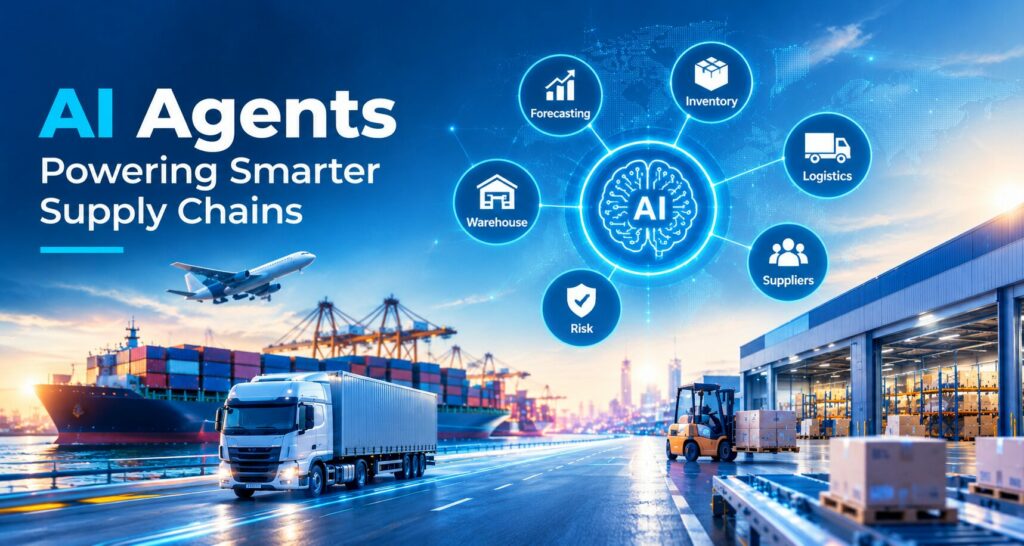
For example, a supply chain platform could include:
- A demand forecasting agent
- An inventory management agent
- A transportation agent
- A supplier communication agent
- A risk detection agent
- A warehouse planning agent
- A supervisory agent
Each agent focuses on a particular function while sharing relevant information with other agents.
This architecture makes multi-agent AI particularly interesting for supply chains because supply chain operations are interconnected. A transportation delay can affect inventory. Inventory shortages can affect production. Production changes can affect delivery schedules. Supplier problems can create downstream logistics issues.
A coordinated group of AI agents can analyze these relationships continuously rather than treating every operational decision as an isolated event.
From Recommendations to Execution
Traditional supply chain software has become increasingly sophisticated at predicting problems.
Demand forecasting systems can estimate future requirements. Transportation platforms can identify potential delays. Inventory systems can recommend replenishment levels. Analytics dashboards can highlight operational risks.
However, identifying a problem and actually resolving it are different tasks.
A human planner may still need to review the recommendation, check business rules, communicate with suppliers, approve the action, and update the relevant enterprise system.
Multi-agent AI changes this model by allowing software agents to perform some of those execution steps.
For example, if a shipment is delayed, a transportation agent could evaluate alternative routes. It could consider delivery deadlines, transportation costs, available carriers, inventory levels, and service agreements.
If the proposed change falls within predefined limits, the system could execute the rerouting automatically.
If the decision exceeds those limits, the system could send it to a human planner.
This creates a human-supervised autonomous supply chain model rather than complete uncontrolled automation.
How Multi-Agent AI Can Work Across a Supply Chain
The biggest opportunity is not simply automating one task. It is coordinating multiple operational activities.
1. Demand and Inventory Management
Demand can change quickly because of seasonality, market conditions, promotions, shortages, or unexpected events.
A demand agent can continuously analyze sales information and other operational signals.
An inventory agent can then evaluate whether current stock levels are sufficient.
If inventory is likely to become insufficient, the system could recommend or initiate replenishment based on predefined rules.
This can create a continuous feedback loop:
Demand Signal → Forecast → Inventory Analysis → Replenishment Decision → Execution
Instead of relying entirely on periodic planning cycles, AI agents can respond as new information becomes available.
2. Transportation Optimization
Transportation is another area where multi-agent systems can have a significant role.
A logistics agent can monitor:
- Carrier estimated arrival times
- Shipment status
- Transportation costs
- Delivery deadlines
- Route conditions
- Warehouse capacity
- Customer requirements
When a disruption occurs, the agent can evaluate alternatives.
A separate risk agent could provide information about the potential impact, while an inventory agent could determine whether a delayed shipment creates a stock problem.
The agents can then coordinate before an action is taken.
3. Supplier Management
Supplier relationships involve constant communication and information exchange.
AI agents can monitor supplier responses, delivery commitments, purchase orders, and potential disruptions.
A communication agent could prepare messages to suppliers, while a risk agent evaluates whether a supplier delay could affect production.
However, supplier-facing automation requires careful controls.
An AI system should not automatically make commitments that exceed approved commercial or operational limits. For unfamiliar suppliers, organizations may initially keep agents in draft mode until their communication performance has been validated.
Real-World Supply Chain Deployments
Recent enterprise deployments demonstrate how organizations are beginning to experiment with this model.
Lenovo has reported using an AI-driven supply chain infrastructure across 180 markets, more than 30 factories, and 100 logistics centers. Its system connects an Order Fulfilment Agent and a Risk Management Agent with existing transaction platforms.
According to Lenovo, fulfilment decisions became three times faster, disruption response became four times faster, risk assessment reached 85% accuracy, and delivery accuracy improved by 30%. These figures are company-reported results rather than independent measurements.
Another example involves a mid-sized automotive parts manufacturer that deployed five specialized agents across 15 countries and 200 suppliers during an 18-month production period.
The organization reported that on-time delivery improved from 82% to 94%. Its disruption agent also reportedly identified supply threats 48 hours earlier than manual monitoring teams.
These examples demonstrate an important point: the value of multi-agent AI is not limited to generating predictions. The technology is increasingly being connected to operational workflows where decisions can result in actual actions.
Multi-Agent AI Can Create a Continuous Supply Chain Loop
One of the biggest differences between traditional analytics and agentic systems is the move from observation to action.
A conventional analytics system might follow this process:
Data → Analysis → Recommendation → Human Decision → Action
A multi-agent system can potentially create:
Data → Analysis → Agent Coordination → Decision → Action → New Data
The final action creates new information that can be fed back into the system.
For example, a transportation agent reroutes a shipment. That decision changes the expected delivery time. The inventory agent receives the updated information and reassesses stock levels. If the new delivery schedule creates a potential shortage, another agent can evaluate replenishment options.
This creates a more dynamic operational environment.
The system does not necessarily need to operate without people. Instead, humans can focus on exceptions, strategic decisions, and situations that fall outside predefined boundaries.
Why Supply Chains Are Suitable for Multi-Agent AI
Supply chains contain many characteristics that make them suitable for agent-based automation.
Large Volumes of Data
Supply chains generate enormous amounts of information from orders, warehouses, suppliers, transportation systems, sensors, and enterprise applications.
AI agents can continuously process these signals.
Multiple Interconnected Decisions
Supply chain decisions rarely exist in isolation.
A change in transportation can affect inventory. A supplier issue can affect production. A production delay can affect customer delivery.
Multi-agent architectures are designed to coordinate different areas.
Time-Sensitive Operations
A decision that takes several hours may have a very different outcome from one made within minutes.
Agents can continuously monitor operational information and react when predefined conditions occur.
Repetitive Workflows
Many supply chain activities involve repetitive decision patterns.
This makes them potential candidates for automation, particularly when organizations can clearly define acceptable operating boundaries.
The Role of Supervisory AI Agents
As the number of agents increases, organizations need a mechanism to coordinate them.
This is where supervisory agents become important.
A supervisor agent can monitor specialized agents and coordinate their activities.
For example:
Supervisor Agent
→ Demand Agent
→ Inventory Agent
→ Transportation Agent
→ Supplier Agent
→ Risk Agent
→ Warehouse Agent
The supervisor does not necessarily perform every task itself.
Instead, it can determine which agent should handle a particular problem and coordinate information between them.
Industrial companies are already exploring this architecture. Kohler has deployed a supervisor agent coordinating demand, inventory, and planning functions, while Belden has developed a multi-tier supplier graph supported by task-oriented agents.
Why Guardrails Are Essential
Autonomous execution introduces new risks.
If an AI agent makes an incorrect recommendation inside a chatbot, the consequences may be limited.
If an AI agent directly modifies inventory, reroutes expensive shipments, changes supplier commitments, or updates purchasing systems, an error can have financial and operational consequences.
This is why organizations need clear guardrails.
For example:
- Transportation agents can operate within predefined cost limits.
- Inventory changes above a certain value can require human approval.
- Supplier communication can remain in draft mode for new vendors.
- High-impact decisions can automatically trigger human review.
- Agents can be restricted to specific enterprise systems and permissions.
- Every automated action can be logged for auditing.
These controls allow companies to increase automation without giving AI unlimited authority.
Multi-Agent AI and Warehouse Automation
Supply chain execution extends beyond software systems.
Warehouses increasingly combine AI with robotics, computer vision, sensors, and autonomous machines.
Multi-agent systems can coordinate robotic fleets, warehouse tasks, inventory movements, and planning decisions.
Research involving MIT and Symbotic has explored multi-robot path coordination in simulated e-commerce distribution environments, reporting a 25% throughput improvement in that simulated setting.
NVIDIA has also released a Multi-Agent Intelligent Warehouse reference architecture focused on coordinating multiple robotic fleets.
However, there is an important distinction between software-based supply chain execution and physical warehouse autonomy.
Giving an AI agent permission to update a digital transaction is very different from allowing an autonomous machine to physically move goods.
Physical environments contain unpredictable conditions, safety requirements, equipment limitations, and human workers.
As a result, many organizations are likely to adopt software autonomy before granting unrestricted physical autonomy.
Challenges of Multi-Agent Supply Chain Systems
Despite the potential, multi-agent AI is not a simple plug-and-play solution.
Data Quality
Agents depend on accurate and timely information.
Poor inventory data, outdated supplier records, incorrect delivery information, or inconsistent enterprise databases can lead to poor decisions.
System Integration
Supply chains often rely on ERP, warehouse management, transportation management, procurement, and supplier systems.
Connecting AI agents across these environments can be technically challenging.
Reliability
A single incorrect action may affect multiple downstream processes.
Recent research on autonomous AI agents in supply chains has highlighted reliability risks in multi-agent coordination, including the possibility that decision inconsistencies can amplify across different supply-chain levels.
Security
Agents require access to enterprise systems to perform useful work.
That creates a new security challenge.
Organizations need to carefully control what each agent can access, what actions it can perform, and when those permissions can be used.
Human Oversight
Complete autonomy is not appropriate for every decision.
High-value purchases, major supplier changes, unusual disruptions, and decisions with significant financial consequences may still require human approval.
Multi-Agent AI vs. Traditional Automation
Traditional automation generally follows predefined rules.
For example:
IF inventory < threshold → create purchase order
An agentic system can consider a wider range of information.
It may evaluate:
- Current inventory
- Demand forecasts
- Supplier availability
- Supplier reliability
- Transportation costs
- Delivery times
- Alternative suppliers
- Production requirements
The system can then determine the appropriate next step within its authority.
This does not mean traditional automation becomes obsolete.
Rules-based automation remains useful for predictable, repetitive processes. Multi-agent AI becomes more relevant when workflows involve changing conditions, multiple information sources, and several interconnected decisions.
The difference is therefore less about replacing automation and more about adding intelligence and adaptability to complex workflows.
What This Means for the Future of Supply Chain Management
The long-term development of multi-agent AI could change the role of supply chain professionals.
Instead of spending much of their time monitoring dashboards and manually approving routine decisions, planners could increasingly focus on:
- Strategic sourcing
- Supplier relationships
- Scenario planning
- Exception management
- Risk strategy
- Business optimization
- AI governance
AI agents could handle a larger share of routine operational execution while humans remain responsible for strategic direction and high-impact decisions.
This is part of the broader transition from AI that answers questions to AI that performs work.
Businesses exploring this shift can also examine how agentic AI differs from traditional automation and how multi-agent architectures are being developed for enterprise environments.
The Road Ahead for Multi-Agent Supply Chains
The next stage of supply chain AI will likely focus on controlled autonomy rather than unrestricted automation.
Companies will need to determine which decisions can safely be delegated to agents and which should remain under human supervision.
The most practical architecture may combine several technologies:
AI Models + Multi-Agent Systems + Enterprise Software + Real-Time Data + Human Oversight
As these components become more tightly integrated, supply chains could become increasingly responsive.
A shipment delay may trigger an automated response. An inventory shortage could initiate a replenishment workflow. A supplier risk could activate alternative sourcing analysis. A warehouse disruption could trigger coordinated changes across transportation and inventory planning.
The goal is not simply to make supply chains more automated.
It is to make them more adaptive, connected, and responsive.
Multi-agent AI is therefore becoming an important part of the broader enterprise AI landscape. Its success will depend not only on model capabilities, but also on reliable data, strong integrations, carefully defined permissions, security, monitoring, and human oversight.
For businesses considering this technology, building a focused proof of concept around a well-defined operational workflow can be a practical starting point. Enterprise AI development increasingly involves connecting intelligent agents with existing software, data, and business processes rather than developing AI in isolation.
Final Thoughts
Multi-agent AI is moving supply chain technology from passive analysis toward active execution.
Traditional systems can tell businesses what is happening and what might happen next. Multi-agent systems add another layer: determining what action should be taken and, when authorized, carrying out that action.
The emerging model combines specialized agents for demand, inventory, transportation, suppliers, risk, and warehouse operations. Supervisory agents can coordinate these functions while guardrails determine which decisions can happen automatically and which require human approval.
The technology is still developing, and reliability, security, integration, and physical-world constraints remain significant challenges.
But the direction is clear: supply chain AI is increasingly moving from recommendation to coordinated execution.
As enterprise systems become more connected, multi-agent AI could become an important foundation for the next generation of intelligent supply chain operations.
Frequently Asked Questions
What is multi-agent AI in supply chain management?
Multi-agent AI uses multiple specialized AI agents to coordinate tasks such as inventory, logistics, demand forecasting, supplier management, and risk monitoring.
How can AI agents improve supply chain operations?
AI agents can monitor real-time data, identify disruptions, optimize decisions, and automate routine supply chain workflows, helping businesses respond faster.
What is the role of AI agents in logistics?
AI agents can track shipments, evaluate transportation options, detect delays, and support route optimization to improve logistics efficiency.
Can multi-agent AI automate supply chain decisions?
Yes. AI agents can automate predefined decisions within approved limits, while high-impact or complex decisions can remain under human supervision.
What are the challenges of multi-agent AI in supply chains?
Key challenges include data quality, system integration, security, reliability, permission management, and maintaining appropriate human oversight.