
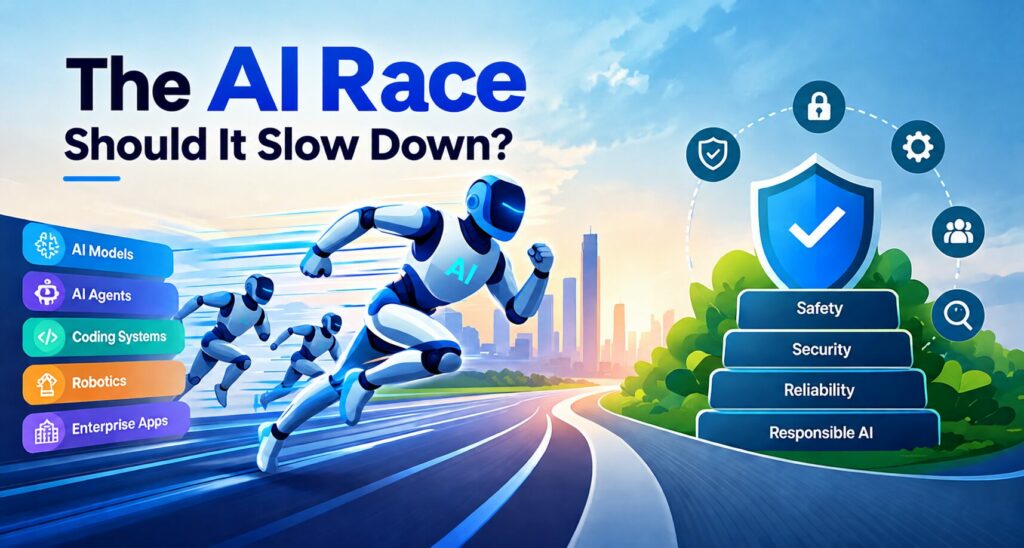
AI Race
TL;DR
• Faster AI development also creates new safety and security challenges.
• Slowing down does not mean stopping AI innovation.
• AI agents require stronger monitoring, permissions, and human oversight.
• Businesses should prioritize reliable, secure, and useful AI solutions.
• Responsible AI development can help balance innovation with safety.
Artificial intelligence has entered a period of extraordinary growth. New AI models, autonomous agents, coding systems, robotics platforms, and enterprise applications are appearing at a pace that would have seemed impossible only a few years ago. AI is no longer limited to experimental research labs or simple chatbot applications. It is increasingly becoming part of software development, business operations, customer service, data analysis, content creation, cybersecurity, healthcare, manufacturing, and many other areas.
This rapid progress has created an increasingly competitive AI race, with technology companies and developers working to build more capable, efficient, and useful artificial intelligence systems. Every new advancement can influence the direction of the industry, encouraging organizations to invest more heavily in AI research, infrastructure, automation, and real-world applications.
But in 2026, the conversation around artificial intelligence is changing.
The question is no longer only how quickly AI can become more capable or who can move fastest in the AI race. Increasingly, researchers, technology companies, developers, and businesses are asking whether the industry can continue moving at the same speed while keeping AI systems safe, reliable, secure, and controllable.
Is the AI industry really ready to slow down?
A slowdown does not necessarily mean stopping AI development. Instead, it could mean giving companies more time to evaluate increasingly capable models, strengthen security, test autonomous systems, improve monitoring, and establish better approaches to responsible AI development.
At the same time, the competitive nature of the AI industry makes a coordinated slowdown difficult.
Why Is the AI Industry Talking About Slowing Down?
The development of AI has traditionally been driven by rapid experimentation and competition.
Technology companies are competing to develop more capable foundation models, multimodal systems, AI agents, coding assistants, and specialized AI applications. Improvements in computing infrastructure and model architectures have allowed AI capabilities to expand quickly.
However, greater capability also creates new challenges.
AI systems are becoming capable of performing increasingly complex tasks. Modern systems can generate software, analyze large amounts of information, interact with external tools, automate workflows, and operate with less human intervention.This creates a difference between traditional software development and advanced AI development.
A conventional software application generally performs tasks that developers explicitly design and test. AI systems can produce unexpected outputs because their behavior depends on training data, model architecture, prompts, tools, and the context in which they operate.
As AI becomes more autonomous, testing every possible behavior becomes increasingly difficult.This is one reason AI safety, AI model evaluation, and responsible AI development are becoming increasingly important.
Slowing Down Does Not Mean Stopping AI
One of the most important distinctions in the current debate is the difference between slowing down and stopping.
A slowdown could involve reducing the speed at which the most advanced AI capabilities are released while continuing research and development.
For example, AI companies could spend more time on:
- Model safety testing
- Security assessments
- Red-team exercises
- Independent evaluations
- Privacy testing
- Agent behavior monitoring
- Cybersecurity testing
- Human oversight
- Deployment controls
- Incident reporting
Under this approach, companies could continue improving AI while creating additional safeguards around increasingly capable systems.This could also change the way organizations think about AI development. Instead of measuring progress only by model performance, companies could increasingly measure AI systems according to reliability, security, transparency, controllability, and real-world usefulness.
The AI Race Makes a Slowdown Difficult
The biggest challenge is competition.
The AI industry is not controlled by a single organization. Multiple companies and research groups are developing increasingly capable systems at the same time.
If one company slows development while competitors continue moving forward, the slower company could potentially lose customers, market opportunities, research talent, computing resources, and technological momentum.
This creates a classic coordination problem.
Companies may individually believe that additional testing is necessary, while simultaneously believing that they cannot afford to fall behind competitors.
The result is a difficult balance between AI innovation and AI risk management.
This is particularly relevant for frontier AI systems, where relatively small improvements in model capability can potentially create new applications and new risks.
Why AI Agents Change the Conversation
The rise of AI agents makes the slowdown debate even more significant.
Traditional AI applications usually respond to a user request. An AI agent can potentially go further by planning a sequence of actions, using tools, retrieving information, interacting with applications, and completing tasks.
This creates major opportunities for AI automation.
For example, an enterprise AI agent could help manage customer-service requests, organize documents, analyze business information, support software development, coordinate internal workflows, or perform repetitive operational tasks.
But autonomy also introduces additional risks.
An AI system that only generates a recommendation has limited direct control over the outside world. An AI agent that can take actions may have access to company systems, databases, APIs, financial information, customer records, or development environments.
That means organizations need to consider not only whether an AI agent can complete a task, but also:
- What permissions does it have?
- What information can it access?
- What happens when it makes a mistake?
- Can a human stop its actions?
- Can its decisions be audited?
- How are unusual behaviors detected?
- What happens if the underlying model changes?
These questions will become increasingly important as AI agent development moves into enterprise environments.
Safety Testing May Become More Important Than Speed
One possible consequence of an AI slowdown is that model testing could receive greater attention.
AI developers could spend more time evaluating how systems behave under unusual or adversarial conditions.
This could include testing for:
- Incorrect reasoning
- Hallucinations
- Security vulnerabilities
- Unauthorized actions
- Prompt manipulation
- Data leakage
- Harmful outputs
- Unexpected tool usage
- Excessive autonomy
- Model behavior changes
For businesses, this creates an important distinction between an AI model that performs well in a demonstration and an AI system that can safely operate inside a real organization.
A powerful model is not automatically a reliable business solution.
Companies adopting AI should therefore consider the entire system around the model.
That includes data pipelines, application architecture, authentication, permissions, monitoring, human review, logging, security, and fallback mechanisms.
This is where enterprise AI solutions and professional AI development services can become important.
Businesses May Not Need the Fastest AI
The slowdown debate also raises an interesting question for businesses.
Does every company need access to the most powerful AI model available?
In many cases, the answer may depend on the use case.
A business building an AI research platform may need advanced reasoning capabilities.
A company automating customer support may prioritize reliability, response speed, integration capabilities, privacy, and predictable costs.
A business processing sensitive information may place security and data governance above raw model performance.
This means organizations should evaluate AI technology based on business requirements rather than simply selecting the newest model.
Businesses exploring AI software development can focus on building systems that balance performance, security, cost, and reliability.
For organizations with specific requirements, custom AI solutions can also provide a way to integrate AI capabilities into existing workflows instead of relying entirely on general-purpose AI products.
The Importance of Responsible AI Development
As AI systems become more powerful, responsible development is becoming a practical business issue rather than simply a research topic.
Responsible AI involves considering how systems are designed, trained, deployed, monitored, and updated.
Important areas include:
1. Transparency
Businesses should understand what an AI system is designed to do, what data it uses, and where its limitations exist.
2. Security
AI applications need protection against unauthorized access, manipulation, data leakage, and other cybersecurity threats.
3. Human Oversight
Important decisions should have appropriate human involvement, particularly when errors could create significant consequences.
4. Monitoring
AI systems should be monitored after deployment because real-world usage can reveal problems that were not visible during development.
5. Accountability
Organizations should establish clear responsibility for AI systems and define what happens when something goes wrong.
These principles can become especially important as companies move from experimental AI projects toward production-scale enterprise AI development.
Could a Slower AI Industry Actually Become More Competitive?
A slowdown might initially appear to conflict with technological competition.
However, competition does not necessarily have to focus entirely on speed.
Companies could compete on the quality of their AI systems.
That could mean developing:
- More accurate AI models
- More efficient AI infrastructure
- More reliable AI agents
- Better AI security
- Better privacy controls
- Stronger evaluation systems
- More transparent AI applications
- Better enterprise integrations
- More efficient AI automation
This would create a broader definition of AI progress.
Instead of asking only who can release the next powerful model first, businesses and customers could increasingly ask which AI systems are reliable enough to use in real-world environments.
AI Infrastructure Is Also Becoming a Major Factor
Another reason the idea of slowing down is complicated is the infrastructure required to operate advanced AI.
AI development depends on computing resources, specialized processors, data centers, networking infrastructure, storage, and energy.
As models become larger and AI applications become more widely used, infrastructure requirements also increase.
This means the future of AI may not simply depend on developing larger models.
Efficiency could become equally important.
Smaller models, optimized inference, specialized hardware, edge AI, and better data pipelines could allow organizations to achieve useful AI performance without always depending on the largest available models.
This creates opportunities for businesses interested in AI software development and efficient AI application architecture.
What Would a Responsible AI Slowdown Look Like?
A responsible slowdown would not necessarily require companies to stop research.
Instead, it could involve a stronger focus on controlled development.
For example, organizations could:
- Increase testing before releasing highly capable models.
- Conduct independent evaluations of important AI systems.
- Improve security testing for AI agents.
- Introduce stronger permission controls.
- Increase human oversight for high-impact actions.
- Monitor AI systems after deployment.
- Share information about serious AI incidents.
- Improve industry-wide safety practices.
- Develop clearer governance frameworks.
- Prioritize reliability alongside capability.
The exact approach is still being debated, but the broader idea is becoming increasingly relevant: AI capability and AI safety need to develop together.
What Does This Mean for AI Developers?
For developers, the changing AI landscape means technical skills alone may no longer be enough.
Developers working on modern AI applications increasingly need to understand:
- AI model integration
- Prompt engineering
- Retrieval-augmented generation
- AI agents
- API security
- Data protection
- Model evaluation
- AI monitoring
- Automation workflows
- Cloud infrastructure
- Application security
The role of the AI developer is therefore expanding.
Developers are not simply connecting an application to an AI model. They are increasingly designing complete systems around AI.
This makes AI development services relevant for organizations that need to integrate AI while maintaining security, scalability, and operational control.
What Does This Mean for Businesses Adopting AI?
Businesses should not necessarily wait for the AI industry to settle before experimenting with the technology.
Instead, organizations can take a measured approach.
Start with clearly defined business problems.
Identify where AI can provide measurable value.
Select an appropriate model rather than automatically choosing the largest one.
Establish security and access controls.
Test the system with realistic scenarios.
Keep humans involved where necessary.
Monitor performance after deployment.
Then gradually expand the system as reliability improves.
This approach can help businesses benefit from AI automation without treating AI as a completely autonomous replacement for existing business processes.
Organizations looking for a structured approach can also explore AI consulting services to identify suitable use cases, technology requirements, implementation strategies, and governance considerations.
So, Is the AI Industry Really Ready to Slow Down?
The answer remains complicated.
There are strong incentives for AI companies to continue improving their systems rapidly. Competition, investment, customer demand, research breakthroughs, and advances in computing infrastructure all encourage continued development.
At the same time, increasingly capable AI systems create reasons for more extensive testing, monitoring, security, and governance.
The most realistic future may therefore not be a complete pause in AI progress.
Instead, the industry could move toward a model where capability development continues while safety and reliability receive greater attention.
That could mean slower releases in certain high-risk areas, more extensive testing, stronger deployment controls, or greater cooperation around safety standards.
For businesses, this shift could be significant.
The future of AI adoption may depend less on simply having access to the newest model and more on knowing how to deploy AI responsibly.
Conclusion
The AI industry has spent years competing to make artificial intelligence faster, smarter, more capable, and more autonomous.
Now it is facing another challenge: determining how to manage that progress responsibly.
The question of whether AI development should slow down does not have a simple answer. There are legitimate reasons to continue innovation quickly, just as there are legitimate reasons to increase testing and safeguards as AI capabilities expand.
For businesses, the important takeaway is not to focus exclusively on the speed of the AI industry.Instead, organizations should focus on useful, secure, reliable, and responsible AI implementation.
AI will continue to evolve. The companies that benefit from the next phase may be those that understand not only what AI can do, but also how to integrate it into real-world operations with appropriate security, oversight, and measurable objectives.The next stage of artificial intelligence may therefore be defined by a combination of innovation and responsibility rather than speed alone.
Frequently Asked Questions
Why is the AI industry developing so quickly?
Competition, investment, research breakthroughs, and advances in computing are accelerating AI development.
Does slowing down AI development mean stopping innovation?
No. A slowdown can focus on more testing, safety, security, monitoring, and responsible deployment.
Why are AI agents increasing the need for safety?
AI agents can use tools and perform actions, creating greater risks if they have excessive permissions or make mistakes.
Do businesses need the most powerful AI models?
Not always. Businesses should choose AI based on their specific needs, including reliability, security, cost, and performance.
How can businesses adopt AI responsibly?
Businesses can start with clear use cases, test AI systems, establish security controls, maintain human oversight, and monitor performance after deployment.