
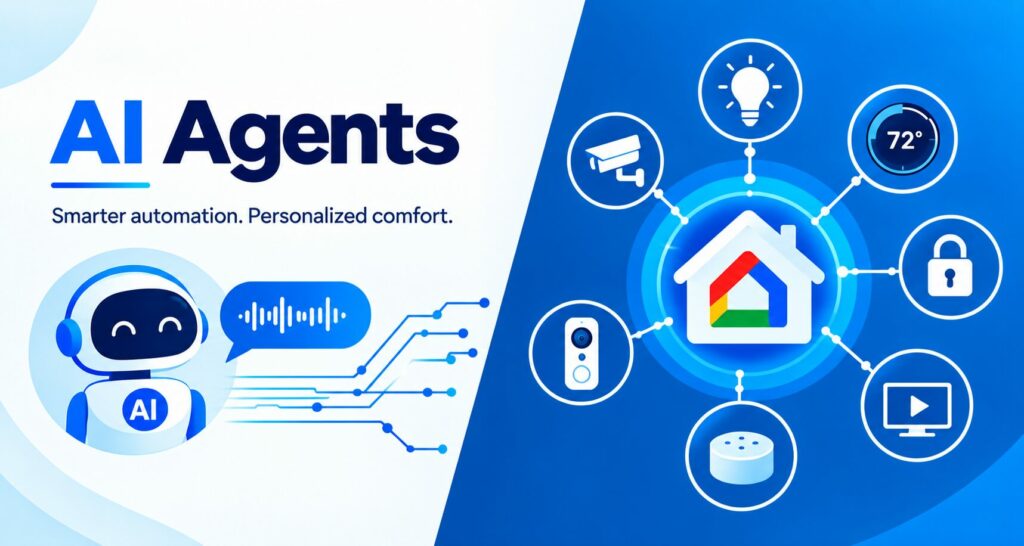
AI agents
TL;DR
• Google Home now supports AI agent interactions through MCP.
• AI agents can control compatible smart-home devices.
• MCP connects AI systems with external tools and services.
• AI enables more natural and personalized home automation.
• AI + IoT can improve monitoring and device management.
• Security and permission controls remain essential.
The relationship between AI technology and smart devices is changing rapidly. Google is now enabling compatible AI agents to interact with Google Home devices through the Model Context Protocol (MCP), opening new possibilities for conversational control, automation, and intelligent home management.
Instead of relying exclusively on predefined commands, users can increasingly interact with their smart home through AI-powered systems that understand natural-language requests and can work with connected devices and household information.
This development highlights how AI development, IoT development, and automation are converging to create more intelligent digital experiences.
What Is Google Home MCP?
Google Home MCP is an integration that allows compatible AI agents to communicate with supported Google Home devices and access certain device and event information.
The Model Context Protocol, commonly known as MCP, provides a standardized way for AI applications to interact with external tools and services. In the Google Home environment, this can allow an AI agent to access supported smart-home capabilities rather than simply generating a text response.
For example, a user could ask an AI agent about activity detected by connected devices or request an action involving supported equipment.
This represents an important step toward AI-powered smart home automation, where AI becomes an additional interface for managing connected environments.
How AI Agents Can Transform Smart Homes
Traditional smart-home systems typically depend on mobile applications, voice commands, schedules, and predefined routines. AI agents introduce a more flexible interaction model.
An agent can interpret a request, determine which connected tools are relevant, and perform supported actions. This creates opportunities for intelligent home automation solutions that are more conversational and context-aware.
1. Natural-Language Device Control
Users can interact with connected devices using natural language instead of navigating multiple applications.
For example, an instruction such as asking an agent to adjust a thermostat or manage compatible lights can be translated into an appropriate device action.
This demonstrates how AI automation can simplify interactions with connected technology.
2. Smart Home Activity Analysis
AI agents can potentially analyze information generated by connected devices and present it in a more understandable format.
Instead of manually checking individual device histories, users could ask an AI system to summarize relevant activity.
This type of functionality demonstrates the broader potential of AI solutions for turning large volumes of IoT data into useful information.
3. Connected Camera Insights
Smart cameras generate significant amounts of information. AI agents can provide a conversational layer for interacting with supported camera data.
Users may be able to ask questions about recent activity and receive summarized information rather than manually reviewing every event.
The combination of computer vision, machine learning, and AI agents could eventually create more sophisticated approaches to smart-home monitoring.
4. Personalized Automation
AI agents could become an additional layer for creating personalized smart-home experiences.
Rather than manually creating every automation rule, users could describe the desired outcome in natural language. The agent can then work with available tools and services to determine what actions are supported.
This could expand the possibilities for AI-powered smart home automation across lighting, climate control, entertainment, security, and other connected systems.
The Role of AI Agent Development
The Google Home integration also demonstrates why AI agent development services are becoming increasingly relevant to technology companies.
An AI agent is more than a chatbot. It can potentially connect with external systems, access information, use tools, and execute permitted actions.
For developers, this creates a need for robust architectures covering:
- Natural-language understanding
- Tool and API integration
- Authentication
- Permission management
- Data processing
- Event handling
- Monitoring
- Security controls
- Human oversight
Businesses exploring these capabilities can work with an AI software development company to design applications that connect AI models with enterprise platforms, APIs, databases, and connected devices.
AI + IoT: A Growing Technology Connection
The combination of AI and IoT creates another significant opportunity.
IoT devices continuously generate data from sensors, cameras, appliances, vehicles, industrial equipment, and other connected systems. AI can help process this information, identify patterns, and deliver actionable insights.
This makes AI-powered IoT application development an important area for businesses exploring intelligent connected products.
For example, an AI-enabled IoT platform could monitor equipment, identify unusual patterns, summarize events, or trigger predefined workflows based on specific conditions.
The same principle that enables an AI agent to interact with smart-home devices can potentially be applied to commercial and industrial environments.
Why Businesses Are Exploring Custom AI Solutions
The Google Home example shows that AI is increasingly becoming an interface between users and digital systems.
Businesses can apply similar concepts to their own products and workflows through custom AI development solutions.
Possible applications include:
- AI customer-service agents
- Enterprise productivity assistants
- Intelligent IoT platforms
- Automated business workflows
- AI-powered analytics
- Personalized recommendation systems
- Voice-enabled applications
- AI-enabled monitoring platforms
Organizations may also explore custom AI software development services to integrate generative AI, machine learning, automation, and existing business systems into a unified solution.
Benefits for Everyday Users
The integration of AI agents with smart-home devices could make everyday technology easier to manage. Instead of controlling each device separately, users can interact with multiple connected devices through a single AI interface.
For example, an AI agent could help coordinate lighting, temperature, entertainment, and other supported devices based on a user’s request. This creates a more convenient experience while reducing the need to remember individual commands or automation rules.
Opportunities for Developers and Businesses
The growth of connected AI systems creates new opportunities for developers building intelligent products. AI agent integration services can help connect AI models with APIs, IoT platforms, databases, and smart devices.
Businesses can use these capabilities to develop personalized automation tools, connected-device platforms, and AI-powered applications. As AI technology continues to evolve, combining AI solutions, IoT development, and automation could open new possibilities across both consumer and enterprise applications.
Security Remains Essential
Giving AI agents access to physical devices creates important security considerations.
An AI system should not automatically receive unrestricted access to every connected device. Developers need to establish clear permissions and action boundaries.
Google’s implementation includes safety restrictions, demonstrating the importance of limiting what an AI agent can do.
For businesses developing their own agentic systems, security should be considered throughout the architecture. Authentication, authorization, logging, data privacy, rate limits, human approval, and controlled tool access can help reduce unnecessary risks.
This is particularly important for enterprise AI development solutions, where AI agents may interact with sensitive business information and operational systems.
From Smart Assistants to Autonomous AI Systems
The evolution from voice assistants to AI agents represents a broader change in how people interact with technology.
Traditional assistants generally respond to individual commands. Modern agents can potentially understand a broader objective, interact with multiple tools, and complete a sequence of tasks.
This distinction is important for the future of AI automation software development.
Imagine an AI system that can monitor information from connected devices, identify a relevant event, notify a user, and initiate an approved workflow. Such systems could eventually move beyond isolated commands toward more coordinated automation.
What Comes Next for AI-Powered Homes?
Google Home’s MCP integration provides an example of how AI technology is entering physical environments.
As standards for connecting AI systems with external tools continue to develop, more applications could emerge across homes, offices, factories, healthcare environments, retail locations, and other connected spaces.
The future of the smart home may therefore involve more than connected appliances. AI agents could become an intelligent interaction layer that helps users understand their environment and manage supported devices through conversational interfaces.
For technology businesses, this convergence of AI software, IoT, and automation creates opportunities to develop new products and services.
Conclusion
The integration of AI agents with Google Home marks an important step in the evolution of smart home automation. By connecting AI technology with IoT devices, users can interact with their homes through natural language while accessing more intelligent and personalized experiences. From device control and activity analysis to automated workflows, these capabilities demonstrate how AI development can extend beyond traditional software applications.
For businesses, the growing connection between AI, machine learning, and IoT creates opportunities to build innovative products and AI solutions for homes and enterprises. As these technologies develop, security, privacy, permissions, and human oversight will remain essential. The combination of AI agents, smart home automation, and IoT development could shape how people interact with connected environments in the years ahead.
Frequently Asked Questions
What are AI agents in smart home automation?
AI agents are intelligent software systems that can understand natural-language requests, interact with connected devices, access information, and perform permitted smart-home actions.
What is Google Home MCP?
Google Home MCP is an integration that enables compatible AI agents to interact with supported Google Home devices and access certain device and event information through the Model Context Protocol.
How can AI agents improve smart home automation?
AI agents can simplify device control, analyze smart-home activity, provide conversational access to connected devices, and support more personalized automation workflows.
How do AI and IoT work together in smart homes?
AI can process data generated by IoT devices, identify patterns, provide insights, and trigger supported actions, creating more intelligent and responsive home automation experiences.
5. What are the security concerns with AI-powered smart homes?
AI-powered smart homes require strong authentication, authorization, privacy controls, permission management, monitoring, and limits on what actions an AI agent can perform.