
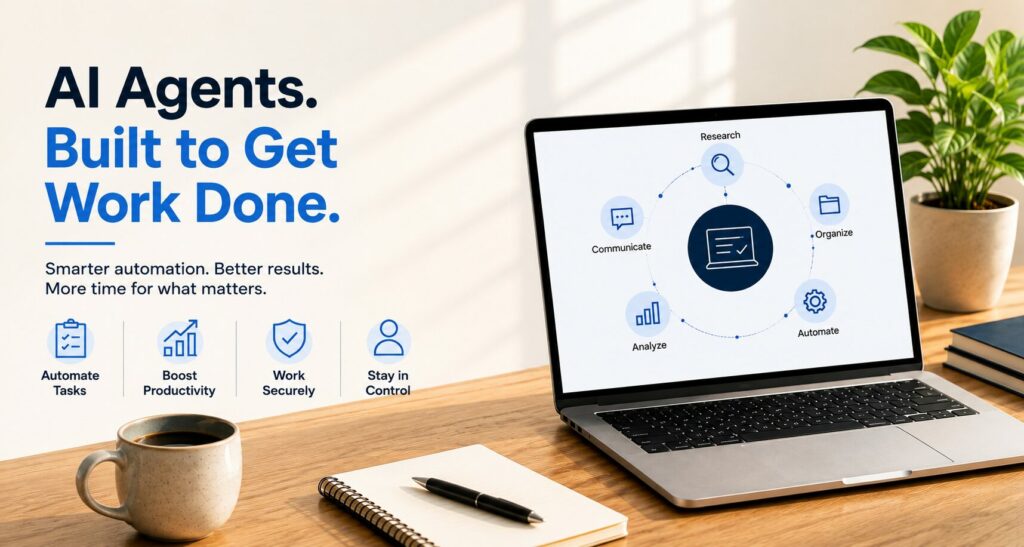
TL;DR
* AI agents can understand goals, use tools, and complete tasks.
* OpenAI is expanding agents beyond coding into business workflows.
* Agents can automate work in sales, finance, marketing, HR, and support.
* Trust, security, privacy, and cost remain key challenges.
* Businesses may adopt agents for repetitive, low-risk tasks.
* Specialized agents could work together across business systems.
* AI agents are more likely to transform tasks than replace jobs.
* Agents may become built into everyday apps without being visible.
* Future AI will focus on delegation, automation, and human oversight.
Artificial intelligence is moving into a new phase. For years, most people interacted with AI through chatbots: ask a question, generate content, summarize a document, write code, or brainstorm an idea. Now, the industry is moving toward more ambitious AI agents that can understand goals, use software, make decisions, and complete multi-step tasks with much less human intervention.
OpenAI is pushing heavily in this direction. Its latest efforts are focused on taking the agent experience beyond software development and bringing it into everyday professional workflows. The bigger question is no longer whether AI agents can perform useful work. The question is whether everyone will actually want to use them.
Recent reporting from TechCrunch highlights OpenAI’s effort to make agents accessible beyond developers through its broader workplace strategy. The company is attempting to turn capabilities that developers already use into tools that accountants, finance teams, marketers, researchers, and other knowledge workers can use.
That could represent one of the biggest shifts in business software since cloud computing and SaaS.
What Are AI Agents?
An AI chatbot generally waits for a prompt and responds. An AI agent goes a step further.
An agent can receive an objective, break it into smaller tasks, use connected tools, gather information, make decisions, execute actions, and evaluate its progress.
For example, instead of asking an AI:
“Create a sales report.”
You could ask an AI agent:
“Review this month’s CRM data, identify the biggest opportunities, compare them with last month’s performance, prepare a report, and send it to the sales leadership team.”
The difference is important.
The first interaction produces an answer.
The second delegates a workflow.
This shift from answering questions to completing objectives is at the heart of agentic AI. OpenAI describes agents as systems capable of reasoning, taking actions, and assisting with both simple tasks and complex projects. Its current agent ecosystem includes workspace agents, Codex, and developer tools for building custom agents.
OpenAI’s Bigger Bet: Agents for Everyone
OpenAI’s long-term strategy appears to be broader than building an AI coding assistant.
Developers were among the earliest professional users to benefit from agents because software development naturally involves structured digital tasks. Coding agents can inspect repositories, modify files, run commands, test changes, and iterate on solutions.
But software engineering represents only one category of knowledge work.
There are thousands of other workflows that happen primarily on computers:
- Financial analysis
- Market research
- Customer support
- Sales operations
- Recruiting
- Marketing
- Data analysis
- Document processing
- Legal research
- IT operations
- Project management
- Business reporting
OpenAI’s challenge is to make agents useful for these jobs without forcing users to understand code, prompts, APIs, or complex automation systems.
This is why its workplace agent strategy matters. OpenAI says workspace agents can operate across tools such as Slack, Google Drive, and Microsoft applications while following permissions and approval rules.
The goal is simple: tell the agent what needs to happen instead of explaining every individual step.
From Copilot to Digital Coworker
The evolution of workplace AI can be viewed in four stages.
1. AI as a Search Tool
The earliest mainstream AI assistants primarily answered questions.
Users asked:
- What does this mean?
- Summarize this document.
- Explain this concept.
- Give me five ideas.
The human remained responsible for execution.
2. AI as a Copilot
The next stage introduced AI into existing workflows.
For example:
- AI suggests code.
- AI drafts emails.
- AI summarizes meetings.
- AI creates presentations.
- AI analyzes spreadsheets.
The human still drives the process.
3. AI as an Agent
Agents begin executing multiple steps independently.
Instead of writing an email, the agent might identify the recipient, review previous communication, draft the message, request approval, and send it.
Instead of simply analyzing data, an agent might collect information, run calculations, identify anomalies, generate a report, and update a business system.
4. AI as a Digital Workforce
The most ambitious vision is a world where organizations delegate entire workflows to networks of specialized agents.
One agent could handle research.
Another could analyze financial information.
Another could manage customer inquiries.
Another could monitor operations.
Humans would increasingly focus on decisions, strategy, relationships, and exceptions.
This is where the promise of AI agents for business becomes much larger than simply adding AI features to software.
Why Everyone May Not Use AI Agents
Despite the excitement, widespread adoption is not guaranteed.
The biggest mistake would be assuming that more autonomy automatically means more value.
For many users, AI agents introduce new complexity.
Trust Is the First Barrier
People are comfortable asking an AI to draft a paragraph.
They may be much less comfortable allowing an AI to:
- Send an important email
- Modify financial records
- Approve expenses
- Change a production system
- Contact customers
- Delete files
- Make business decisions
The cost of an incorrect answer can be very different from the cost of an incorrect action.
That is why AI agent security and governance will become increasingly important.
OpenAI’s enterprise approach emphasizes permissions, policies, guardrails, monitoring, and escalation. Its Presence product, for example, is designed around agents that can use company systems and take approved actions while escalating issues to humans when necessary.
The Permission Problem
Imagine an employee connecting an AI agent to:
- Gmail
- Slack
- Google Drive
- CRM
- Accounting software
- HR systems
- Internal databases
The agent could become extremely powerful.
It could also become extremely risky.
A compromised or poorly configured agent could potentially access information that a normal chatbot never sees.
This means businesses will need granular permissions.
An agent might be allowed to read a sales database but not modify it.
Another might create invoices but require human approval before sending them.
A customer-support agent might issue refunds up to a certain amount but escalate larger requests.
This concept of human-in-the-loop AI will remain critical even as agents become more autonomous.
The Cost of Running AI Agents
There is another challenge: economics.
AI agents can consume considerably more compute than simple chatbot interactions because they may perform many model calls, tool operations, searches, reasoning steps, and iterations.
TechCrunch reported an example of extremely high token consumption during extended agent usage, highlighting the difficulty of making long-running agents economically sustainable at consumer subscription prices.
For AI companies, this creates a difficult equation.
If an agent performs more work, it can create more value.
But more work also means more inference costs.
OpenAI is therefore working on efficiency as well as capability. The economics of AI agents could ultimately determine which use cases become mainstream.
For consumers, an agent that saves two hours but costs more than the value of those two hours may not be attractive.
For businesses, however, the equation can be very different.
If an agent can automate a repetitive process that costs a company thousands of dollars every month, the return can be significant.
Why Businesses Are More Likely to Adopt Agents
Enterprise adoption may happen faster than mass consumer adoption.
Businesses already spend money on:
- Employees
- SaaS subscriptions
- Outsourcing
- Business process automation
- Customer support
- Data analysis
- Software development
If an AI agent can reliably perform part of that work, the financial incentive is obvious.
This is also why AI agent development services are becoming increasingly relevant for organizations that need custom workflows rather than generic AI assistants.
Companies such as Promatics India are focusing on enterprise AI agent development, including integrations with CRM, ERP, HRMS, and other business systems.
For businesses, the opportunity isn’t necessarily to replace every employee with an agent. A more realistic approach is to identify repetitive workflows where agents can reduce manual work and allow employees to focus on higher-value activities.
The Importance of Agentic AI Development
Building an effective agent is more complicated than connecting a language model to an API.
A production-ready agent needs:
- Clear objectives
- Reliable tool access
- Context and memory
- Permission controls
- Monitoring
- Evaluation
- Error handling
- Security
- Human approval mechanisms
- Integration with existing systems
OpenAI’s developer ecosystem reflects this shift. Its Agents SDK supports capabilities such as tool use, file interaction, code execution, and long-horizon tasks within controlled environments.
This means the competitive advantage may increasingly come from the complete agent system rather than the underlying AI model alone.
Recent research and industry discussion also point toward the importance of the “harness”—the software layer that manages tools, memory, supervision, and execution around the model.
The Rise of Specialized AI Agents
Not every company needs one universal agent.
In fact, specialized agents may be more practical.
Consider a company with:
Sales Agent: Finds leads, researches prospects, updates CRM records, and prepares outreach.
Marketing Agent: Monitors trends, researches competitors, creates content briefs, and analyzes campaign performance.
Finance Agent: Reviews expenses, prepares financial reports, and identifies unusual transactions.
HR Agent: Screens applications, schedules interviews, and answers employee questions.
Support Agent: Handles routine customer requests and escalates complex cases.
These agents could eventually communicate with one another.
A marketing agent might ask the research agent for competitor information.
A sales agent might request customer insights from the analytics agent.
A finance agent might provide budget constraints to a planning agent.
This creates the possibility of multi-agent systems where several AI workers collaborate on a larger objective.
Will Consumers Use AI Agents?
This is where the answer becomes less certain.
Consumers generally don’t want complicated automation platforms.
They want outcomes.
A person may not care that an AI agent uses tools, memory, planning, or multiple model calls. They simply want to say:
“Plan my trip.”
“Organize my schedule.”
“Find the best insurance option.”
“Compare these products.”
“Handle my emails.”
“Prepare my tax documents.”
The more invisible the technology becomes, the more likely consumers may be to adopt it.
The real consumer product may therefore not be the “AI agent.”
It may simply be an application that quietly uses agents behind the scenes.
The UX Problem Could Decide Everything
There is a major difference between powerful AI and usable AI.
An agent can theoretically complete a complex workflow, but users still need to understand:
- What it is doing
- What information it can access
- What actions it can take
- When it needs approval
- What went wrong
- How to stop it
Too much control makes agents feel like complicated automation software.
Too little control makes them feel dangerous.
The winning products will probably find a balance between autonomy and transparency.
AI Agents Could Change Software Itself
The rise of agents may also change the way software is designed.
Traditional software requires humans to learn interfaces.
Agents could increasingly become the interface.
Instead of opening five applications and manually transferring information between them, a user could simply describe the desired outcome.
This could create a new software model:
Human → AI Agent → Multiple Software Systems
rather than:
Human → Multiple Applications
That could significantly change SaaS.
If users interact primarily with agents, individual application interfaces may become less important.
The value could shift toward data, integrations, APIs, permissions, proprietary workflows, and trusted execution environments.
What Happens to Jobs?
The most realistic outcome is likely to be task transformation rather than immediate job elimination.
A marketer may still be a marketer, but spend less time compiling reports.
A developer may still write software, but spend more time reviewing AI-generated implementations.
An analyst may spend less time cleaning data and more time interpreting results.
An accountant may spend less time processing repetitive documents and more time advising clients.
OpenAI’s own research suggests that agentic tools are already changing the nature of knowledge work, with users increasingly delegating tasks that would take humans substantial amounts of time.
The important distinction is between automating a job and automating tasks within a job.
Most organizations will probably start with the second.
What Businesses Should Do Now
Companies shouldn’t rush to deploy an AI agent everywhere.
Instead, they should identify workflows based on three questions:
1. Is the process repetitive?
If employees perform the same steps every day, it may be a strong candidate for automation.
2. Is the process digital?
Agents are most effective when they can access the systems and information required to complete the work.
3. Is the risk manageable?
A workflow involving low-risk administrative tasks is usually easier to automate than one involving sensitive financial or legal decisions.
Businesses should start with narrow, measurable use cases and expand gradually.
The Future: Agents Everywhere, But Not Necessarily Visible
OpenAI’s strategy suggests that AI agents are moving from developer tools toward mainstream workplace infrastructure.
The company has already expanded agent capabilities beyond coding, and its broader product direction focuses on agents that can operate across workflows and tools.
But the future probably won’t look like every person managing dozens of visible AI agents.
Instead, agents may become embedded inside the software people already use.
Your CRM may have an agent.
Your accounting platform may have an agent.
Your email application may have an agent.
Your project-management software may have an agent.
And eventually, these agents may work together.
That is a much more realistic path toward mass adoption.
Conclusion: Will Everyone Use AI Agents?
OpenAI’s push toward AI agents represents a major change in how people may interact with technology. Instead of simply asking AI for information or content, users can increasingly delegate complete, multi-step tasks and allow AI to work across the digital tools they already use. OpenAI’s current strategy is particularly focused on bringing agent capabilities beyond software developers to professionals in areas such as finance, accounting, research, and other computer-based work.
However, the future of AI agents will not be determined by capability alone. Trust, security, privacy, reliability, cost, and human oversight will be equally important. Giving an AI system permission to perform actions is fundamentally different from asking it to generate an answer.
For businesses, the opportunity is especially significant. Organizations can begin with repetitive, low-risk workflows and gradually expand AI automation as their systems become more reliable. Companies that successfully combine AI agents, business automation, secure integrations, and human oversight could gain a meaningful competitive advantage.
Will everyone use AI agents? Probably not in the same way.
Some people will actively manage multiple AI agents. Others may never use the term “AI agent” at all. Instead, agents will simply become invisible capabilities inside email platforms, productivity tools, CRM systems, accounting software, browsers, and other applications.
The most likely future is not a world where humans disappear from the workflow. It is a world where humans increasingly delegate routine digital work to intelligent systems and focus their time on judgment, creativity, strategy, and relationships.
OpenAI’s bet is that AI agents can become the next major interface for getting work done. Whether that vision becomes mainstream will depend on one simple question: Can AI become trustworthy enough for people to give it the keys?
Frequently Asked Questions
What is an AI agent?
An AI agent is an AI-powered system that can understand a goal, plan multiple steps, use tools or software, perform actions, and work toward completing a task with limited human intervention. Unlike a traditional chatbot that mainly responds to prompts, an agent is designed to take action.
What is OpenAI building AI agents for?
OpenAI is expanding AI agents beyond software development into broader workplace and knowledge-work applications. Its current direction is aimed at helping professionals use agents for multi-step digital tasks across areas such as finance, accounting, research, communications, and other computer-based workflows.
How are AI agents different from chatbots?
A chatbot generally answers a question or produces content after receiving a prompt. An AI agent can take a broader objective and perform multiple actions to accomplish it. For example, a chatbot can write a sales report, while an agent could potentially collect the required data, analyze it, create the report, and place it in the appropriate business system.
Will AI agents replace human workers?
AI agents are more likely to automate tasks and workflows before they completely replace entire jobs. Employees can use agents to handle repetitive activities while spending more time on strategy, decision-making, creativity, customer relationships, and other work that requires human judgment.
Why are businesses interested in AI agents?
Businesses are interested in AI agents for business automation because agents can potentially reduce repetitive manual work, accelerate workflows, improve productivity, and operate across multiple digital systems.
For companies, the most valuable use cases are likely to be those where the agent can produce measurable time or cost savings.