
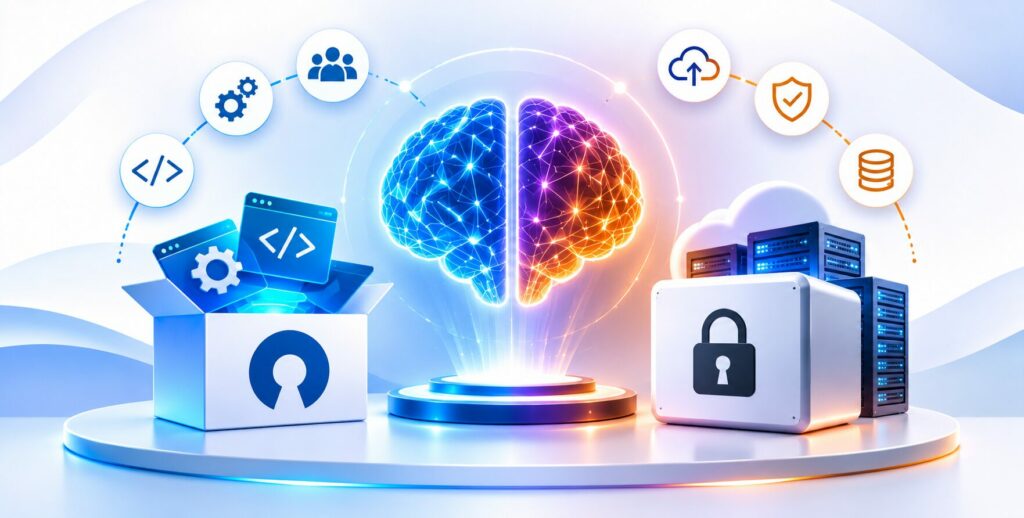
Open-Source vs. Closed AI Models
TL;DR
• Open-source AI offers flexibility and customization.
• Closed AI provides easy access and managed infrastructure.
• Open models offer greater control over data and deployment.
• Closed models simplify integration and maintenance.
• Hybrid AI balances cost, security, and performance.
Artificial intelligence is transforming how businesses operate, develop products, automate workflows, and serve customers. From intelligent chatbots and content generation to predictive analytics and enterprise automation, AI models are becoming essential tools for modern organizations. However, as AI adoption grows, businesses face an important decision: should they choose open-source AI models or closed, proprietary AI systems? Companies exploring AI development and integration solutions must understand how these two approaches differ in performance, accessibility, flexibility, and long-term costs.
The debate around Open-Source vs. Closed AI Models is no longer limited to developers and technology researchers. It has become an important business decision that affects innovation, data privacy, infrastructure investments, and competitive advantages. Organizations following the latest artificial intelligence developments are increasingly exploring both approaches to identify the right technology for their specific requirements.
Although both types of AI models can perform advanced tasks, they offer different levels of control, customization, accessibility, and technical support. Understanding these differences can help businesses make informed decisions and build more reliable AI-powered applications. For additional insights into how businesses are comparing these approaches in 2026, explore this guide to open-source and closed AI models.
What Are Open-Source AI Models?
Open-source AI models are artificial intelligence systems whose model weights, architecture, or other important development components are made publicly available under specific licenses. Developers and organizations can access these models, study their capabilities, customize them, and deploy them according to the permissions provided by their licenses.
Unlike traditional proprietary systems, many open-weight models allow developers to download model files and run them on their own infrastructure. This creates opportunities for businesses that want greater control over their AI applications.
Popular examples include:
- Meta Llama: A family of language models designed for various applications, including content generation, coding, and conversational AI.
- Mistral AI: Known for efficient language models and options suitable for different deployment environments.
- Alibaba Qwen: A model family offering capabilities across language understanding, coding, and multilingual applications.
- DeepSeek: Known for models focused on reasoning, mathematics, coding, and other complex tasks.
One of the biggest advantages of open AI models is flexibility. Businesses can fine-tune models using relevant datasets, adjust their deployment environments, and integrate them into existing software systems.
However, open-source does not always mean completely free or unrestricted. Licensing conditions vary, and organizations must review commercial usage rights, redistribution requirements, and other restrictions before deployment.
What Are Closed AI Models?
Closed AI models, also known as proprietary AI models, are developed and controlled by private organizations. Their internal architecture, model weights, and training processes are generally not publicly accessible.
Users typically interact with these systems through web applications, subscription platforms, or application programming interfaces (APIs).
Popular examples include:
- OpenAI GPT models: Designed for language understanding, reasoning, content generation, coding, and business automation.
- Anthropic Claude: Known for conversational capabilities, document analysis, and instruction-following.
- Google Gemini: Supports text, image, and other multimodal AI applications.
Closed AI systems are generally easier to access because the provider manages the underlying infrastructure, model updates, and technical operations.
Businesses can integrate these models into their applications without purchasing expensive computing hardware or managing complex model deployment processes.
However, users have limited access to internal model components. Customization generally depends on available APIs, prompting capabilities, fine-tuning options, and provider-supported features.
Open-Source vs. Closed AI Models: Key Differences
Understanding the differences between open and closed AI models requires examining several important factors.
1. Performance and Accuracy
AI model performance depends on the model architecture, training data, parameter efficiency, optimization techniques, and the task being performed.
Closed AI models frequently offer strong performance across general-purpose applications. Leading proprietary systems are designed to handle complex reasoning, coding, summarization, content creation, and multimodal tasks.
Open-source models have also improved significantly. Many modern open-weight systems deliver competitive results in coding, mathematics, language processing, and specialized business applications.
However, performance should not be judged only through benchmark scores. A model that performs well in general testing may not be the best choice for a specific business requirement.
For example, a smaller open model fine-tuned on company documents may provide more relevant responses than a larger general-purpose model.
Businesses should evaluate AI models using real-world testing, accuracy requirements, response quality, latency, and reliability.
2. Accessibility and Availability
Accessibility is another major difference between open and closed AI models.
Open-source models provide developers with opportunities to download, inspect, modify, and deploy available model components. This makes experimentation easier for research teams, startups, independent developers, and organizations with technical resources.
Closed AI models generally require users to access a provider’s platform or API. Although this approach reduces technical complexity, access depends on subscription plans, usage limits, regional availability, and provider policies.
For businesses that want complete control over deployment, open models can be attractive. For teams that want immediate access to advanced AI capabilities, closed models often provide a simpler starting point.
3. Customization and Flexibility
Customization is one of the strongest advantages of open-source AI.
Developers can adapt an open model to specific requirements through fine-tuning, retrieval-augmented generation (RAG), prompt optimization, and other techniques.
For example, a financial organization may customize an AI model to understand industry-specific terminology, while an e-commerce company may optimize a model for product recommendations and customer support.
Closed AI systems generally provide fewer customization opportunities. Developers can use supported API parameters, system instructions, tools, and other available features, but they cannot freely modify the underlying model architecture or weights.
Organizations requiring specialized AI behavior should carefully evaluate how much customization their chosen platform supports.
4. Cost and Infrastructure Requirements
The cost of AI implementation involves more than the initial model price.
Open-source AI models may reduce recurring API expenses, particularly when businesses process large volumes of requests. However, organizations must account for GPU infrastructure, cloud computing, storage, deployment, maintenance, monitoring, and technical staff.
Closed AI models usually follow subscription-based or usage-based pricing. This makes initial implementation easier because businesses do not need to manage their own model-serving infrastructure.
However, API expenses can increase as application usage grows.
The right financial comparison should consider the total cost of ownership (TCO), including infrastructure, maintenance, engineering, and ongoing usage.
For smaller projects, closed AI services may be more economical. For high-volume workloads, a properly optimized open model may offer better long-term cost control.
5. Data Privacy and Security
Data privacy is particularly important for businesses handling customer information, financial records, internal documents, and confidential business data.
Open-source models can be deployed within private cloud environments or on-premises infrastructure. This gives organizations greater control over where information is processed and stored.
However, self-hosting does not automatically guarantee security. Companies must manage access controls, encryption, infrastructure protection, model vulnerabilities, and regular security updates.
Closed AI providers may offer enterprise security features, contractual privacy commitments, and administrative controls. Nevertheless, businesses must review data processing policies, retention practices, and compliance requirements before sharing sensitive information.
The most suitable approach depends on the organization’s security policies, regulatory obligations, and deployment architecture.
6. Transparency and Vendor Dependency
Open models provide greater visibility into model components when the relevant weights, architecture details, and documentation are available.
This can help technical teams examine model behavior, conduct evaluations, and build customized development processes.
Closed AI systems offer less visibility into their internal operations. Businesses depend on providers for model updates, pricing decisions, API availability, and feature changes.
This creates the possibility of vendor lock-in, particularly when an application relies heavily on one provider’s proprietary tools.
Organizations can reduce this dependency by using modular architectures, standardized APIs, and model-independent application components.
Advantages of Open-Source AI Models
Open-source AI models provide several benefits for developers and organizations.
Greater control: Businesses can manage model deployment, infrastructure, and data processing according to their requirements.
Deep customization: Developers can fine-tune models for industry-specific tasks and specialized applications.
Community innovation: Open AI ecosystems encourage collaboration, experimentation, and the development of new tools.
Deployment flexibility: Models can be deployed in private cloud environments, local systems, or supported hybrid infrastructure.
Long-term cost opportunities: Organizations with sufficient technical resources may reduce recurring API expenses through optimized self-hosting.
These advantages make open AI models particularly useful for organizations that want to develop specialized products and maintain greater control over their technology.
Advantages of Closed AI Models
Closed AI models also provide important benefits, particularly for businesses that prioritize convenience and rapid deployment.
Quick implementation: APIs allow developers to integrate AI capabilities without building model infrastructure from scratch.
Managed infrastructure: Providers handle model hosting, updates, and much of the underlying operational complexity.
Advanced capabilities: Leading proprietary models frequently offer strong general-purpose reasoning, language, and multimodal performance.
Technical support: Enterprise plans may include dedicated assistance, service-level agreements, and additional administrative features.
Simplified maintenance: Businesses can focus on application development rather than managing model-serving infrastructure.
For startups and smaller development teams, these advantages can significantly reduce the time required to launch AI-powered products.
When Should Businesses Choose Open-Source or Closed AI Models?
There is no universal solution for every organization. The right approach depends on business goals, technical expertise, budget, data requirements, and application complexity.
Startups and Small Businesses
Startups often benefit from closed AI models during the early development stage. They can test product ideas, build prototypes, and launch initial features without investing heavily in infrastructure.
Once usage increases, businesses can evaluate open models to reduce operational costs or gain additional customization options.
Large Enterprises
Large organizations may prefer open-source models when they need greater control over sensitive information, internal deployment, and specialized workflows.
However, closed models can still be useful for departments that require advanced AI capabilities without additional infrastructure responsibilities.
Software and SaaS Companies
Software companies often benefit from a hybrid AI architecture.
For example, a SaaS platform could use a closed model for complex customer-facing conversations and an open model for document classification, data extraction, or routine summarization.
Companies building these systems can explore AI integration solutions to understand how different AI technologies can work together within existing business applications.
AI Agent Development Projects
AI agents often require reasoning, planning, information retrieval, and interaction with external tools.
A closed model may be suitable for complex orchestration, while a smaller open model can handle repetitive or specialized tasks.
Organizations developing custom AI agent applications should evaluate response quality, tool-calling reliability, latency, and cost per task before selecting a model.
The Rise of Hybrid AI: Combining Open and Closed Models
One important development in modern AI adoption is the growing interest in hybrid AI architectures.
Instead of relying entirely on one model category, businesses can combine open-source and proprietary systems within the same application.
For example, a company might use a closed model for advanced reasoning and an open model for routine information processing. A routing system can select the appropriate model based on task complexity, security requirements, response time, and operational cost.
Hybrid architectures offer several potential benefits:
- Better control over AI infrastructure.
- Flexible model selection for different workloads.
- Opportunities to optimize operating costs.
- Reduced dependency on a single AI provider.
- Greater flexibility when business requirements change.
However, hybrid systems require careful integration, monitoring, security management, and performance testing.
The objective should not be to use more AI models simply because they are available. Businesses should select the smallest and most suitable combination of technologies that meets their requirements.
What Should You Consider Before Choosing an AI Model?
Before selecting an AI model for a business application, organizations should evaluate the following factors:
- Business objectives: Identify the specific problems the AI system needs to solve.
- Performance requirements: Test model accuracy, reasoning, response quality, and latency.
- Data security: Determine whether information can be processed through external services.
- Budget: Compare API expenses with infrastructure and maintenance costs.
- Customization: Evaluate whether the application requires fine-tuning or specialized behavior.
- Technical resources: Consider whether the team can manage model deployment and maintenance.
- Scalability: Choose an architecture that can support future business growth.
A structured evaluation process helps businesses avoid unnecessary expenses and choose an AI foundation that supports long-term development.
Conclusion: Finding the Right Balance Between Open and Closed AI
The comparison of Open-Source vs. Closed AI Models highlights an important reality: neither approach is automatically better for every business.
Open-source models offer flexibility, customization, transparency, and greater control over deployment. They are attractive for organizations with technical expertise, specialized requirements, and a need for private infrastructure.
Closed AI models provide convenience, managed infrastructure, rapid implementation, and access to advanced general-purpose capabilities. They are particularly useful for businesses that want to introduce AI features without managing complex technical systems.
For many organizations, a hybrid approach can provide a practical balance between performance, accessibility, cost, and control.
As artificial intelligence continues to evolve, businesses should focus on choosing models that solve real problems rather than following technology trends. The best AI strategy is one that aligns with organizational goals, protects valuable data, delivers measurable results, and remains flexible as technology changes.
For more insights into AI models, emerging tools, and business applications, visit AI Tech Updates.
Frequently Asked Questions
What is the difference between open-source and closed AI models?
Open-source AI models offer access to model components and customization, while closed AI models are controlled by private providers.
Which AI models are open-source?
Popular examples include Meta Llama, Mistral AI, Alibaba Qwen, and DeepSeek.
Are open-source AI models free to use?
Many are available without licensing fees, but infrastructure, hosting, maintenance, and licensing restrictions may involve costs.
Are closed AI models more powerful than open-source models?
Not always. Performance depends on the model, task, training, and specific business requirements.
Which AI models are better for data privacy?
Self-hosted open models offer greater control over data, but security depends on proper deployment and management.
Can businesses use open-source and closed AI models together?
Yes. Hybrid AI combines both approaches to balance performance, customization, security, and operational costs.