
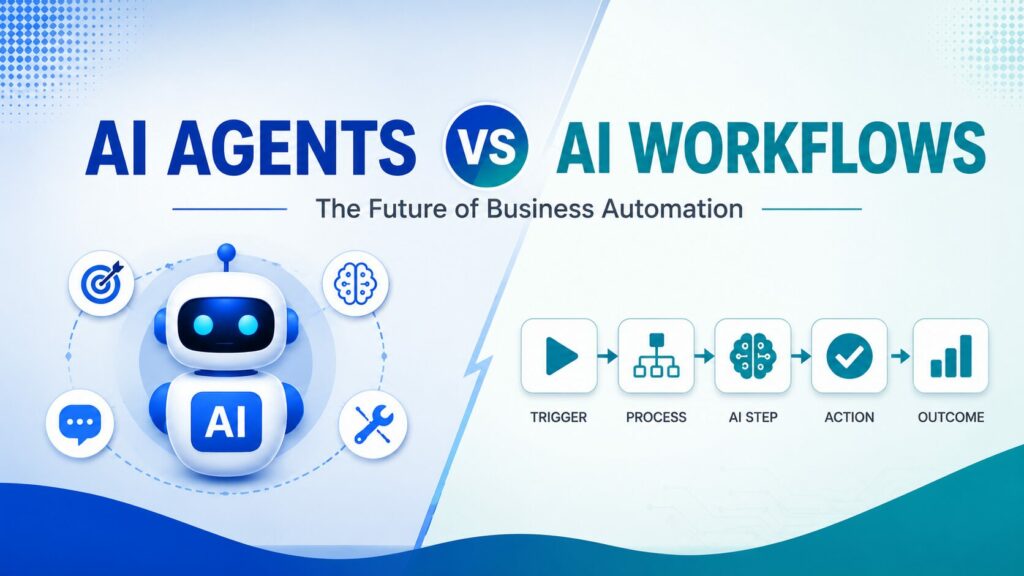
AI Agents vs AI Workflows
Business automation is entering a new phase. For years, organizations have relied on rule-based systems and predefined workflows to automate repetitive tasks such as data entry, email routing, reporting, approvals, and customer support processes. These systems continue to provide significant value, especially when a process is predictable and well defined.
However, the rise of AI Agents is changing how businesses think about automation.
Instead of simply following a predefined sequence of instructions, AI Agents can work toward a goal, analyze information, select from available tools, and adapt their next action based on context. This shift is driving interest in AI automation, agentic AI, and more intelligent approaches to business automation.
So, what is the real difference between AI agents and AI workflows? More importantly, which approach represents the next step for modern organizations?
The answer is not necessarily that AI agents will replace workflows. Instead, businesses may increasingly combine structured automation with goal-oriented AI systems, using each approach where it delivers the most value. AI workflows are generally designed around explicit steps, while agents have more autonomy to determine how to pursue an objective.
For businesses and technology professionals following the rapid evolution of artificial intelligence, AI Tech Updates provides additional coverage and insights into AI, emerging technologies, automation, and the evolving digital landscape.
What Are AI Workflows?
An AI workflow is a structured process in which specific steps, triggers, conditions, and actions are defined in advance. Artificial intelligence can be incorporated into one or more stages of that process, such as summarizing information, classifying data, generating text, or analyzing customer requests.
Consider a customer support example.
A predefined workflow might look like this:
- A customer submits a support request.
- The system identifies the category.
- An AI model analyzes the message.
- The ticket is routed to the appropriate team.
- A response template is generated.
- The interaction is recorded in the CRM.
The process itself is already defined. AI may make individual steps more intelligent, but the workflow controls the overall sequence.
This makes AI workflow automation particularly useful for predictable processes with clear inputs, outputs, and business rules. Structured workflows can also be easier to monitor, audit, debug, and estimate in terms of execution time and resource usage.
Common Use Cases for AI Workflows
AI workflows can support:
- Customer support ticket routing
- Lead qualification
- Document classification
- Invoice processing
- Employee onboarding
- Data extraction
- Content moderation
- Scheduled reporting
- Email categorization
- CRM updates
These use cases share a common characteristic: the business generally knows what should happen at each stage.
That makes workflows an effective solution for workflow automation, particularly when consistency and predictability are more important than flexibility.
What Are AI Agents?
AI Agents take automation a step further.
Instead of defining every step in advance, a business can provide an agent with a goal and a set of approved tools or capabilities. The agent can then determine which actions may be necessary to pursue that goal.
For example, imagine a sales organization gives an AI system the following objective:
Identify whether this prospect is a strong potential customer and prepare a personalized outreach strategy.
An AI agent could potentially:
- Review CRM information.
- Search approved data sources.
- Analyze the prospect’s business.
- Compare the information with ideal customer criteria.
- Identify potential needs.
- Generate relevant messaging.
- Request human approval before sending communication.
The exact path does not have to be scripted step by step.
This is one of the most important distinctions in the debate around AI Agents vs AI Workflows. A workflow is generally told what to do, while an agent is given an objective and has greater autonomy to determine how to pursue it within its available rules and tools.
Key Capabilities of AI Agents
Modern AI Agents may combine:
- Large language models
- Planning and reasoning capabilities
- Memory and contextual information
- APIs and software integrations
- Databases and knowledge systems
- Tool usage
- Monitoring and guardrails
- Human approval mechanisms
This enables autonomous AI agents for businesses to handle tasks that involve ambiguity, multiple data sources, or changing conditions.
AI Agents vs AI Workflows: Understanding the Core Difference
The simplest way to understand the difference is this:
AI workflows follow a predefined path.
AI Agents can determine the path toward a defined goal.
| Feature | AI Workflows | AI Agents |
| Primary approach | Predefined process | Goal-oriented execution |
| Control flow | Structured and explicit | More dynamic and adaptive |
| Decision-making | Limited to defined rules | Can select actions within constraints |
| Predictability | Generally higher | Can vary depending on context |
| Memory | Often externally managed | May maintain context across steps |
| Debugging | Usually easier | Requires stronger observability |
| Cost | More predictable | Can vary with task complexity |
| Best for | Repetitive, structured tasks | Complex, ambiguous tasks |
The architectural distinction matters. Simply adding an LLM or generative AI step to a workflow does not automatically turn that workflow into an agent. An AI agent is defined more by its ability to determine actions and use tools toward an objective than by the mere presence of an AI model.
This distinction is essential for organizations researching the difference between AI agents and AI workflows before investing in automation technology.
How AI Agents Improve Business Automation
One of the most important long-tail search topics is how AI agents improve business automation.
Traditional automation works extremely well when the process is stable. However, real business environments are not always predictable. Employees often need to interpret information, handle exceptions, compare data from different systems, and make decisions when a process does not follow the expected path.
This is where AI Agents for business automation can add value.
1. Handling Complex and Unstructured Information
Traditional automation often performs best when information is structured.
For example:
- A form has defined fields.
- A database has a known format.
- An invoice follows a consistent structure.
However, businesses also deal with:
- Emails
- Customer messages
- Documents
- Reports
- Conversations
- Research data
AI Agents can potentially interpret and work with unstructured information before deciding what action should be taken.
This capability makes AI agents for complex business processes particularly valuable in environments where human employees currently spend significant time interpreting information.
2. Working Across Multiple Systems
Modern organizations often operate with multiple platforms, including CRMs, ERPs, CMS platforms, analytics systems, support tools, and internal databases.
An AI agent can potentially coordinate information across approved systems and tools to complete a broader objective.
This is one reason businesses are increasingly exploring AI-powered workflow automation solutions rather than isolated automation tools.
3. Adapting to Changing Conditions
A traditional workflow may need updates when business rules or process conditions change.
By contrast, AI agents can be designed to respond more flexibly to context and changing information. They may re-plan, select different tools, or escalate a task when they encounter uncertainty.
This adaptability is a major reason why agentic AI for business automation is receiving increased attention.
However, greater flexibility also creates additional responsibilities around testing, monitoring, permissions, security, and human oversight.
When Should Businesses Use AI Agents vs AI Workflows?
The question should not simply be:
“Which technology is better?”
A better question is:
“What type of business problem are we trying to solve?”
Use AI Workflows When:
An AI workflow is often the better option when:
- The process follows predictable steps.
- Inputs and outputs are clearly defined.
- Consistency is essential.
- Compliance and auditability are important.
- The organization needs predictable costs.
- Errors must be easy to reproduce and debug.
Examples include:
- Invoice approval
- Employee onboarding
- Scheduled reporting
- Lead assignment
- Data processing
- Standard customer requests
Structured workflows can provide greater control and observability because each step is explicitly defined.
Use AI Agents When:
Businesses should consider AI Agents when:
- The task is complex or open-ended.
- Information comes from multiple sources.
- The next step cannot always be predicted.
- Context and reasoning are required.
- The system must handle exceptions.
- The process requires dynamic decision-making.
Examples may include:
- AI research assistants
- Intelligent customer support
- Sales research
- Decision support
- Complex issue triage
- Multi-system task coordination
These are examples of when to use AI agents vs AI workflows, one of the most relevant long-tail keyword themes for businesses evaluating intelligent automation.
The Rise of Agentic Workflows
The future of enterprise AI automation may not be entirely agent-based or workflow-based.
Instead, organizations can use a hybrid approach.
This is often described as an agentic workflow, where structured automation and intelligent agents work together.
For example:
Step 1: A workflow receives a customer request.
Step 2: The workflow categorizes common requests.
Step 3: Standard issues follow a predefined automation path.
Step 4: Complex or ambiguous requests are transferred to an AI agent.
Step 5: The agent analyzes the available context and determines possible actions.
Step 6: High-risk actions require human approval.
Step 7: The workflow records the final outcome.
This hybrid approach combines the predictability of workflows with the flexibility of agents. Retool specifically highlights hybrid patterns where workflows handle standard execution and agents are triggered when ambiguity or more complex reasoning is required.
For many organizations, this may represent a practical next step in AI automation solutions for digital transformation.
AI Agents for Customer Service and Business Operations
One promising use case is AI agents for customer service automation.
A traditional support workflow may classify tickets and send them to the appropriate department.
An AI agent could potentially go further by:
- Understanding the customer’s request.
- Accessing approved account information.
- Searching relevant knowledge bases.
- Asking follow-up questions.
- Completing permitted actions.
- Escalating sensitive or complex cases to humans.
This does not mean businesses should remove human oversight. Instead, organizations can use AI agents to handle routine reasoning and coordination while employees focus on high-value decisions, relationship management, and complex problem-solving.
The same concept can apply to sales, operations, IT, HR, and other departments.
Building the Right Digital Foundation for AI Automation
AI agents require more than an AI model.
Organizations also need a strong technology foundation capable of supporting:
- Secure integrations
- APIs
- Data access controls
- Content management
- Workflow orchestration
- Monitoring
- User interfaces
- Human approval processes
- Scalable infrastructure
Businesses exploring scalable platforms for intelligent automation can learn more through CMS and Web Development Services from Promatics Technologies.
A flexible CMS and web development architecture can help organizations manage digital content, integrate external systems, and build applications capable of supporting future AI-powered business solutions.
For ongoing discussions around AI technology trends, agentic AI, AI Agents, and the changing artificial intelligence ecosystem, readers can also explore AI Tech Updates.
Together, strong digital infrastructure and a clear understanding of emerging AI technologies can help organizations make more informed decisions about automation.
Challenges of Implementing AI Agents
Although AI Agents offer significant potential, they also introduce new challenges.
Security and Permissions
AI agents may interact with business systems and data. Organizations should carefully define what information an agent can access and which actions it is authorized to perform.
Observability and Debugging
AI workflows generally have predefined steps, making their execution easier to trace.
AI agents may take different paths depending on the context. Organizations therefore need strong logging, monitoring, and evaluation systems to understand how an agent reached an outcome.
Cost and Latency
A workflow usually has a predictable number of steps.
An agent may require different numbers of reasoning steps, tool calls, or model interactions depending on the task. This can make costs and execution times more variable.
Guardrails and Human Oversight
Businesses should define clear boundaries for AI agents.
Examples include:
- Limiting access to approved tools.
- Restricting sensitive actions.
- Requiring human approval.
- Implementing fallback processes.
- Monitoring unexpected behavior.
The goal is not unlimited autonomy. Effective enterprise AI solutions should balance automation with governance and control.
AI Agents vs Traditional Automation: What Does the Future Look Like?
The growth of AI Agents does not mean traditional automation will disappear.
Traditional automation remains valuable for high-volume, repetitive, and predictable tasks. AI agents are better suited to situations involving ambiguity, reasoning, and adaptation. The two approaches can complement one another rather than compete directly.
A business might use automation to process thousands of standard requests while using an AI agent to handle exceptions.
This creates a more practical model for intelligent automation:
Automate what is predictable.
Use AI agents where adaptability and reasoning create additional value.
This approach can help organizations improve efficiency without unnecessarily introducing complexity into processes that are already well structured.
The Next Step for Business Automation
So, what is the next step?
For many businesses, it will be a gradual evolution.
First, organizations automate repetitive processes.
Then, they add AI capabilities to improve specific workflow steps.
Finally, they may introduce AI Agents to handle more complex objectives that require reasoning, planning, tool usage, and adaptation.
This progression makes AI agents and intelligent automation a natural part of the broader digital transformation journey.
The most successful organizations may not be those that deploy AI agents everywhere. Instead, they may be the ones that carefully identify where structured workflows are sufficient and where intelligent agents can provide meaningful advantages.
Businesses exploring the future of AI development, automation, and intelligent digital platforms can strengthen their technology foundation with scalable solutions such as Promatics Technologies’ CMS and Web Development Services.
To continue exploring developments in AI Agents, artificial intelligence, automation, and emerging technologies, visit AI Tech Updates.
Frequently Asked Questions
What is the difference between AI Agents and AI workflows?
AI Agents are goal-oriented systems that can determine actions and use available tools to pursue an objective. AI workflows follow predefined steps, although AI models can be included within individual workflow stages.
How do AI Agents improve business automation?
AI Agents can improve business automation by helping organizations manage complex, multi-step, or ambiguous tasks that require context, reasoning, and adaptation.
When should businesses use AI Agents?
Businesses should consider AI Agents when tasks involve multiple data sources, changing conditions, unstructured information, or situations where the complete process cannot easily be defined in advance.
Can AI Agents and AI workflows work together?
Yes. A hybrid model can use AI workflows for predictable execution while AI agents handle complex reasoning, exceptions, and dynamic decision-making.
What is agentic AI?
Agentic AI refers to AI systems designed to pursue objectives with varying degrees of autonomy, often using planning, memory, reasoning, and tools within defined constraints.
Conclusion
The comparison between AI Agents vs AI Workflows is not about declaring one technology the winner.
AI workflows provide structure, consistency, transparency, and predictability.
AI Agents provide flexibility, context-aware decision-making, and the ability to pursue complex goals.
The future of business automation will likely involve both.
Organizations can use structured AI workflow automation for stable and repeatable processes while introducing AI Agents for enterprise automation where tasks require reasoning, adaptability, and interaction across multiple systems.
The key is to start with the business problem rather than the technology.
By understanding how AI agents improve business automation, when workflows are more appropriate, and how hybrid architectures can combine both approaches, organizations can build a more practical path toward intelligent automation.
For businesses preparing their digital infrastructure for future AI initiatives, explore CMS and Web Development Services from Promatics Technologies. For more insights into AI technology trends, AI Agents, and emerging innovations, visit AI Tech Updates.