
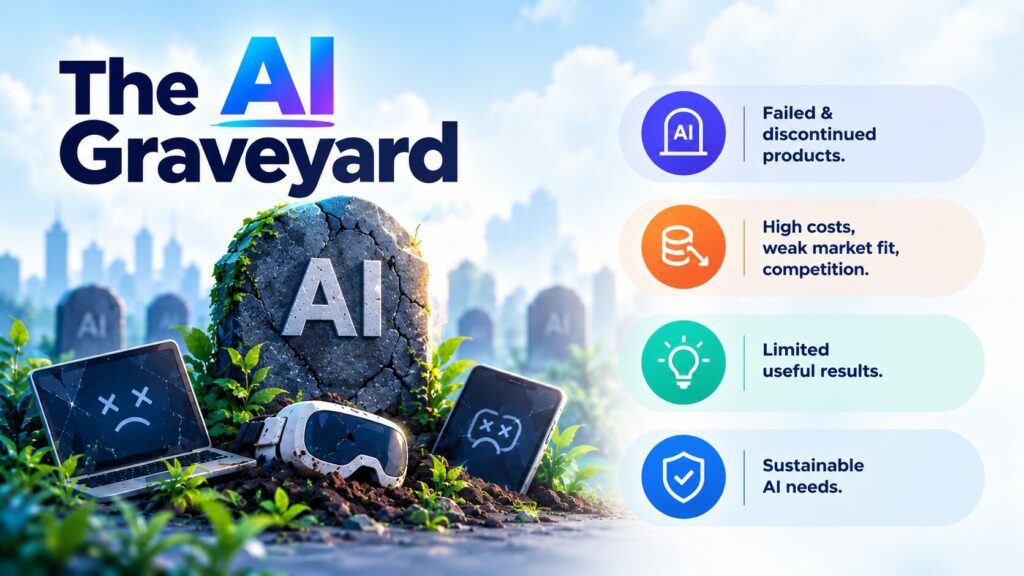
AI Graveyard
TL;DR
• The AI graveyard includes failed and discontinued AI products.
• Common causes include high costs, weak market fit, and competition.
• Failed AI products offer valuable lessons for future development.
• Sustainable AI requires practical, trustworthy solutions.
Artificial intelligence has become one of the fastest-growing areas of technology, attracting billions of dollars in investment and inspiring companies to launch new products at remarkable speed. But behind the success stories is another side of the AI boom: products that were discontinued, startups that shut down, features that were delayed, and ambitious experiments that failed to gain enough traction.
This growing collection of abandoned AI projects has been described as an “AI graveyard.” The examples range from major technology companies such as OpenAI, Apple, and Microsoft to smaller startups building AI hardware, productivity tools, entertainment platforms, and model comparison services.
The important lesson is not simply that these products failed. Their stories show how difficult it is to turn an impressive AI demonstration into a sustainable product.
What Is the AI Graveyard?
The term “AI graveyard” refers to AI products, startups, features, and projects that have been discontinued, abandoned, absorbed into other products, or significantly changed direction.
The trend is not limited to startups. According to S&P Global Market Intelligence, around 42% of AI initiatives are ultimately abandoned by their corporate parents. The reasons can include funding limitations, technical problems, competition, scaling difficulties, and insufficient user demand.
This is particularly important because AI development often moves faster than traditional software development. Companies can build prototypes quickly, but creating a product that people consistently use and pay for is a different challenge.
An AI product may work technically but still fail because users do not need it, the cost of operating it is too high, a larger platform adds a similar feature, or the product creates privacy and security concerns.
Relay: When Big Platforms Absorb the Opportunity
Relay is one of the newer examples in the AI graveyard.
The AI-powered workflow automation platform was designed as an alternative to tools such as Zapier. It allowed users to automate email and task workflows using AI agents.
However, larger technology companies, including OpenAI and Google, began incorporating similar automation capabilities into their own products. Relay ultimately shut down in September 2026.
The situation illustrates a major challenge for independent AI startups: platform competition.
A startup may build a useful AI feature and find a market for it, only to discover that a much larger company can add a similar capability to an existing ecosystem.
For businesses developing AI products, this means differentiation is becoming increasingly important. A simple AI feature may not be enough. Companies may need proprietary data, specialized workflows, strong integrations, industry expertise, or a particularly strong user experience.
OpenAI’s Product Experiments
Even major AI companies are not immune to failed experiments or discontinued products.
OpenAI recently attempted to broaden ChatGPT into a “super app” by combining multiple experiences, including Chat, Codex, and Work. The redesign received criticism from users who found the new interface confusing, and OpenAI subsequently rolled back the change.
OpenAI has also consolidated several standalone products and capabilities into ChatGPT.
Its standalone AI browser, ChatGPT Atlas, was discontinued after less than a year, while features associated with Operator were incorporated into the company’s broader ChatGPT experience. Image-generation capabilities have also increasingly become part of ChatGPT rather than relying entirely on DALL-E as a separate destination.
Sora, OpenAI’s video-sharing platform, also shut down in March 2026 after facing challenges including operating costs and user retention.
These examples demonstrate another pattern in the AI market: product consolidation.
A discontinued product does not always mean the underlying technology was useless. Sometimes the technology survives inside another product where it can reach a larger audience.
Apple’s Delayed AI Siri
Apple’s next-generation Siri became one of the most closely watched AI projects after the company introduced Apple Intelligence.
The vision was for Siri to become more context-aware, understand activity across apps, and perform more complex tasks.
However, the upgraded Siri faced repeated delays associated with engineering problems and bugs. The delays also contributed to a $250 million settlement related to claims about how Apple marketed AI capabilities associated with the iPhone 16. The AI-powered Siri eventually appeared in an iOS 27 beta, with English-language availability beginning in September 2026.
Siri’s story highlights an important difference between announcing AI and delivering AI.
Consumers increasingly expect AI features to work reliably from day one. When an AI assistant is expected to interact with personal information, applications, and device functions, reliability becomes just as important as intelligence.
Microsoft Recall and the Privacy Challenge
Microsoft Recall provides another important lesson.
The feature was introduced as an AI-powered memory for Windows PCs. It was designed to periodically capture screenshots of user activity so that people could search through their digital history later.
However, the announcement generated significant privacy and security concerns because the captured information could potentially include sensitive material such as passwords, private conversations, financial information, and other personal activity.
Microsoft delayed the feature for nearly a year while it worked on its security and privacy protections. Even after redesigns, questions about the security of captured information continued.
The Recall experience demonstrates that AI products cannot be evaluated only by what they can do.
Trust, privacy, security, and user control are becoming core product requirements.
For companies building AI-powered software, privacy should therefore be considered during product architecture rather than added after development.
Notion Mail and the Changing Productivity Market
Notion Mail launched in 2025 as an AI-focused email product designed to organize and automate inboxes.
But the company observed that users were increasingly turning to separate AI agents for email-related tasks. As a result, Notion announced that Notion Mail would shut down on September 22, 2026.
This example shows how quickly user behavior can change in the AI era.
Email management was once a clear standalone productivity category. Today, AI agents can potentially perform multiple tasks across applications. Instead of using a dedicated AI email application, users may prefer an assistant that can manage email alongside calendars, documents, messaging, and other workflows.
This shift could have major implications for the future of AI automation and agentic software.
Humane AI Pin: The Difficulty of AI Hardware
The Humane AI Pin became one of the most visible examples of AI hardware that struggled to establish itself.
The wearable device attempted to provide AI functionality without relying on a conventional smartphone interface. Humane reportedly raised $230 million and generated considerable attention around the product.
However, the AI Pin experienced performance problems. The company also warned customers about a potential battery fire risk involving its charging case. Humane eventually shut down its AI Pin business in February 2025, while HP acquired most of the company’s assets for $116 million.
The AI Pin demonstrates how difficult hardware startups can be.
A compelling AI concept must also work within constraints involving battery life, thermals, connectivity, hardware reliability, manufacturing, pricing, and user behavior.
Rabbit R1: Hype Versus Everyday Use
Rabbit R1 was another highly visible AI hardware product.
Introduced at CES in January 2024, the device was designed as an AI companion capable of performing tasks for users. Rabbit said it sold 100,000 units shortly after launch.
However, early reviews raised concerns about unfinished software, unreliable performance, and limited integrations.
Rabbit has continued developing the R1 and has repositioned it around computer-control and agentic capabilities. The company has also announced another hardware project called Project Cyberdeck.
The R1 story is therefore slightly different from a complete shutdown. It demonstrates that an AI product can struggle with its initial proposition while the company continues trying to find a sustainable direction.
For AI startups, this highlights the value of iteration and product-market fit over launch-day attention.
Huxe: When Big Platforms Move Into the Same Market
Huxe was an AI audio application developed by former Google NotebookLM developers. The platform transformed written information into conversational, podcast-style audio.
The company shut down in May 2026 as larger platforms began offering similar experiences to large existing audiences. Spotify, for example, has been expanding its AI-powered audio capabilities.
Huxe represents another recurring pattern: feature commoditization.
When an AI capability becomes easy for major platforms to reproduce, independent companies need a strong reason for customers to choose them instead.
Yupp and the Product-Market Fit Problem
Yupp took a different approach.
The platform allowed users to compare responses from hundreds of AI models side by side. At its peak, users could test more than 800 models from companies including OpenAI, Google, and Anthropic.
Despite its interesting concept, Yupp ultimately shut down in March 2026 because, according to its founders, it did not achieve sufficient product-market fit.
This is a fundamental startup lesson.
Having access to many AI models does not automatically create a sustainable business. A successful product needs a clear audience, a recurring problem to solve, and enough value for users to return.
Figgs AI and the Cost of Free AI
Figgs AI operated from 2023 to 2024 and allowed users to create and interact with customizable AI characters.
The platform reportedly attracted more than one million users. However, its developers said maintaining a free service became too expensive, eventually leading to its shutdown.
This highlights one of the biggest challenges facing AI startups: AI has operating costs.
Traditional software can often serve additional users at relatively low incremental costs. AI applications may need to pay for model inference, cloud infrastructure, storage, GPUs, APIs, and other resources every time customers interact with the product.
A large user base therefore does not necessarily translate into a profitable business.
What AI Startups Can Learn From the Graveyard
The growing list of discontinued AI products provides several useful lessons for founders and businesses.
1. AI alone is not a business model
Adding an AI chatbot or AI agent to a product does not automatically create sustainable demand.
Companies need to identify a real customer problem and determine whether AI provides a meaningful improvement.
2. Product-market fit matters
Yupp and Figgs AI show that user interest and even significant adoption are not enough if the economics do not work.
Startups need to understand retention, willingness to pay, operating costs, and long-term demand.
3. Big platforms can change the competitive landscape
Relay and Huxe demonstrate how quickly larger platforms can enter a market.
Startups should consider whether their product has defensible advantages beyond a feature that another company can easily replicate.
4. AI infrastructure costs matter
Inference, hosting, storage, model APIs, and computing resources can become significant expenses.
A product with millions of users can become financially difficult to operate if each interaction generates substantial AI costs.
5. Privacy and security cannot be afterthoughts
Microsoft Recall illustrates how an AI feature can face serious resistance when it handles sensitive personal information.
Businesses should consider data protection, permissions, encryption, access controls, and transparency from the beginning.
6. Hardware requires more than an impressive demo
Humane AI Pin and Rabbit R1 show that AI hardware must deliver a reliable everyday experience.
Battery life, connectivity, physical design, software, integrations, and pricing all contribute to the final product.
7. Consolidation is becoming part of AI development
Some products may disappear as standalone offerings while their underlying technology continues inside larger platforms.
This means the end of an AI product does not necessarily mean the end of its technology.
The AI Graveyard Could Become a Learning Library
The AI industry’s rapid growth has created enormous experimentation. Not every experiment will survive.
Some projects will shut down because they lack demand. Others will be absorbed into larger platforms. Some will fail because their operating costs are too high, while others will struggle with technical limitations, privacy concerns, or poor user experiences.
That makes the AI graveyard more useful as a learning resource than as a simple list of failures.
For businesses planning new AI solutions, the key question should not be whether every product can survive. Instead, organizations need to understand what makes an AI product sustainable.
The future AI market will likely include both highly specialized startups and large platforms offering broad AI ecosystems. Companies that understand customer needs, control costs, build secure systems, and continuously adapt their products will be better positioned to navigate this changing environment.
The stories of Relay, OpenAI’s discontinued or consolidated products, Apple’s delayed Siri, Microsoft Recall, Notion Mail, Humane AI Pin, Rabbit R1, Huxe, Yupp, and Figgs AI all illustrate different sides of the same reality: building AI is becoming easier, but building AI products that people trust, use, and pay for remains difficult.
The AI graveyard will probably continue to grow. But each abandoned project can also provide valuable information for the companies building the next generation of AI applications.
Conclusion
The growing AI graveyard shows that artificial intelligence is not a guaranteed path to success. Even well-funded startups and major technology companies can struggle when products fail to achieve product-market fit, control AI infrastructure costs, address privacy concerns, or provide enough value to users.
For businesses entering the AI market, these examples offer an important lesson: successful AI development requires more than powerful models. Companies need a clear customer problem, sustainable economics, reliable technology, strong security, and an experience that people genuinely want to use.
As the AI industry continues to evolve, the AI graveyard will likely keep expanding. However, every abandoned project can provide valuable lessons that help developers, startups, and enterprises build more practical, trustworthy, and sustainable AI solutions.
Frequently Asked Questions
What is the AI graveyard?
The AI graveyard refers to AI startups, products, features, and projects that have been discontinued, shut down, abandoned, or significantly changed direction. It highlights the challenges involved in turning AI concepts into sustainable products.
Why do AI startups fail?
AI startups can fail for several reasons, including weak product-market fit, high operating costs, strong competition, technical limitations, privacy concerns, poor user experience, and difficulty converting users into paying customers.
What are some examples of failed AI startups and projects?
Examples discussed in this article include Relay, Humane AI Pin, Huxe, Yupp, and Figgs AI, along with discontinued or consolidated AI products and initiatives from larger technology companies.
Does a discontinued AI product mean the technology failed?
Not necessarily. Some discontinued products are consolidated into larger platforms, while their underlying technology, ideas, or talent may continue through other products or companies.
What can businesses learn from failed AI projects?
Businesses can learn the importance of identifying a genuine customer problem, validating product-market fit, managing AI infrastructure costs, protecting user data, building reliable products, and creating defensible value beyond basic AI features.