
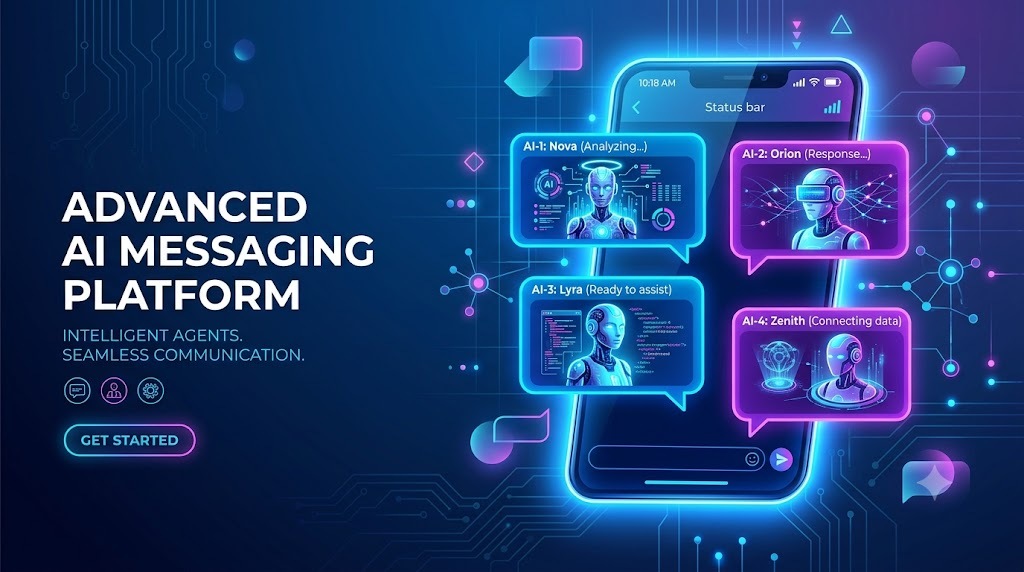
AI Agents That Live in Your Text Messages
TL;DR
• AI agents can now work directly through text messages.
• They can handle tasks like reminders, research, scheduling, and travel.
• Messaging AI can connect multiple apps and services.
• More automation also brings privacy and security risks.
• Trust, security, and user control will shape their future.
Artificial intelligence is moving beyond traditional chatbots and standalone apps. A new generation of AI agents that live in your text messages is making it possible for people to interact with AI through channels they already use every day.
Instead of opening a dedicated application, users can simply send a message asking an AI assistant to schedule an appointment, organize a calendar, research a trip, manage reminders, handle email, or complete another everyday task.
This shift could make AI feel less like software that users have to operate and more like a digital assistant that is always available. AI Tech Updates regularly covers developments in AI agents, automation, enterprise technology, and emerging AI applications.
The trend is gaining attention as several startups experiment with AI assistants that work through iMessage, SMS, WhatsApp, Telegram, and other messaging platforms. A growing group of services is bringing AI directly into everyday conversations, making it easier for users to access AI assistance without opening a separate application.
This development raises an important question: Could text messaging become one of the simplest interfaces for the next generation of AI?
What Are AI Agents That Live in Your Text Messages?
Traditional AI assistants usually require users to open an application, type a prompt, and wait for a response. Text-based AI agents take a different approach.
An AI agent that lives in your text messages can be reached through a messaging conversation. Users can send natural-language instructions just as they would message another person.
The agent can then interpret the request, access connected services, remember relevant context, and potentially perform actions on the user’s behalf.
For example, a user could send:
“Remind me about my meeting tomorrow and add it to my calendar.”
Instead of manually opening a calendar application, finding the correct date, creating an event, and setting a reminder, the AI agent could potentially handle those steps.
This makes AI messaging assistants interesting because the interface is already familiar.
Users do not necessarily need to learn a new application or understand complicated AI commands.
Why Text Messaging Is Becoming an AI Interface
Messaging has several advantages as an interface for artificial intelligence.
First, it is familiar. Billions of people already use messaging applications every day.
Second, messaging is persistent. A conversation can provide context over time, allowing an AI assistant to understand previous requests and preferences.
Third, messaging is convenient. Users can send a short instruction without navigating through menus or opening multiple applications.
This creates a different model for AI automation.
Instead of asking users to interact with individual apps, an AI agent can potentially become the layer between the user and those applications.
For example, one message could eventually involve a calendar, email account, travel website, payment service, and reminder system.
The user sees a conversation.
The agent handles the underlying workflow.
The Rise of Personal AI Assistants
The growing number of text-based AI products shows that developers are experimenting with different versions of the personal AI assistant.
TechCrunch’s October 2026 overview highlighted several examples, including Caddy, Fambot, Folk, Instinct, Iris, Martin, Miso, Ohai, Ollie, Orbits, Pally, Poke, Rene, Skye, Stanley, and Tomo. These products target different use cases, ranging from family organization and travel to professional productivity and content creation.
Some assistants focus on calendars and reminders.
Others are designed around family coordination, travel planning, shopping, content creation, or professional tasks.
The diversity of these products suggests that the market is not simply creating another general-purpose chatbot. Instead, developers are experimenting with specialized AI agents for everyday tasks.
This could eventually lead to a large ecosystem of personal agents with different strengths.
1. AI Agents Could Reduce App Switching
One of the biggest advantages of messaging-based AI is the possibility of reducing the number of applications people need to open.
Today, completing a simple task can involve several apps.
Imagine planning a weekend trip.
A user might need to:
- Search for flights.
- Compare hotels.
- Check a calendar.
- Review travel dates.
- Research restaurants.
- Save booking information.
- Set reminders.
A capable AI agent could potentially coordinate several of these tasks from a single conversation.
That does not mean every agent can perform all of these actions today. Capabilities vary significantly between products.
However, the broader direction is clear: AI agents are increasingly being designed to interact with multiple services rather than simply answer questions.
This shift could make AI more useful in everyday situations.
2. Context Could Make AI More Personal
Another important development is persistent context.
A traditional chatbot may respond to an individual prompt without knowing much about the user’s broader situation.
A personal messaging agent could potentially remember useful information such as preferences, recurring activities, upcoming events, or previous requests.
For example, an AI assistant could understand that a user prefers morning flights, has a particular calendar schedule, or regularly needs reminders for certain activities.
This could make interactions feel more natural.
Instead of repeatedly explaining the same information, users could communicate with the agent conversationally.
However, persistent context also introduces an important issue: privacy.
The more an AI agent knows about a person, the more carefully that information needs to be protected.
3. AI Agents Could Become More Proactive
Most digital assistants wait for users to ask something.
Messaging-based agents are increasingly exploring a more proactive model.
An assistant might send a reminder about an upcoming appointment, summarize tomorrow’s schedule, highlight an unfinished task, or notify a user about something requiring attention.
TechCrunch reported that some of the emerging assistants already provide proactive summaries, reminders, and follow-up actions.
This represents a significant change in how people could interact with AI.
Instead of:
User → asks AI → AI responds
the model could become:
AI → monitors context → identifies something useful → notifies user
That could make AI assistants feel more like personal digital staff.
4. Messaging AI Could Connect Multiple Services
The real potential of these systems may come from integrations.
An AI agent becomes more useful when it can work with calendars, email, documents, travel services, shopping platforms, productivity applications, and other digital tools.
For example, a user could ask:
“What do I need to prepare for tomorrow?”
An integrated agent might review the calendar, identify meetings, check relevant emails, locate documents, and create a short preparation list.
This is where AI agents through text messages could move beyond simple conversation.
The text message becomes the command interface, while the agent operates across multiple connected systems.
For businesses developing similar systems, AI development services can help create applications that combine AI models, APIs, automation, data systems, and user-facing interfaces.
5. AI Agents Could Change How People Shop
Shopping is another area where messaging-based AI could become useful.
Instead of searching multiple websites manually, a user could describe what they need in a conversation.
For example:
“Find me a lightweight laptop under my budget with good battery life.”
An AI agent could potentially research available options, compare specifications, and present recommendations.
With appropriate permissions, future agents could go further by placing orders, tracking deliveries, or handling returns.
However, financial actions require much stronger controls than simple recommendations.
An AI system that can purchase products or make payments needs clear authorization, transaction limits, authentication, and mechanisms for reversing mistakes.
6. Family and Household Management Could Become Easier
Some emerging AI assistants are specifically focused on families.
Family life involves a large amount of information distributed across calendars, school messages, email, reminders, shopping lists, appointments, and group conversations.
An AI assistant could potentially bring these pieces together.
A parent might send a message asking:
“What does everyone have tomorrow?”
The assistant could summarize relevant calendar events, appointments, activities, and reminders.
This could make AI personal assistants via SMS particularly useful for households.
The important difference is that the AI is not simply answering questions. It is helping organize information that already exists across multiple services.
7. The Biggest Challenge Is Trust
The convenience of text-based AI agents comes with a major trade-off.
The more capable an agent becomes, the more access it may require.
An agent that can only answer questions has limited power.
An agent that can read email, access calendars, make purchases, send messages, modify documents, or create accounts has significantly more power.
That creates several security concerns:
- Excessive permissions
- Unauthorized account access
- Sensitive data exposure
- Incorrect actions
- Prompt manipulation
- Malicious instructions
- Fraudulent transactions
- Poor authentication
- Lack of human approval
These concerns are particularly important because AI agents are becoming more autonomous.
AI Tech Updates has previously explored the broader security implications of autonomous systems in its coverage of AI agent security. The growth of messaging-based agents adds another dimension because these systems may have access to highly personal conversations and connected services.
Privacy Will Become a Major Differentiator
Privacy could become one of the most important factors separating successful AI agents from less trusted products.
A personal agent may eventually have access to:
- Emails
- Calendar events
- Travel plans
- Shopping history
- Contacts
- Documents
- Conversations
- Financial information
- Location-related information
That creates a valuable but sensitive data environment.
Users will want to know where their information is stored, who can access it, whether conversations are retained, and how connected services use the data.
AI companies therefore need to make privacy controls understandable rather than hiding them inside complicated settings.
The Business Opportunity Behind Messaging AI
The rise of AI messaging assistants is also creating a new business opportunity.
Instead of building another standalone application that requires users to change their habits, startups can place AI inside communication channels people already use.
This lowers the friction involved in adopting new technology.
For businesses, messaging-based agents could support:
- Customer service
- Appointment scheduling
- Sales follow-ups
- Employee assistance
- Lead qualification
- Travel coordination
- Order management
- Internal communication
- Personal productivity
This could create opportunities for companies developing custom AI applications and workflow automation.
Businesses interested in implementing these technologies can explore AI-powered solutions designed around their specific workflows rather than relying only on generic assistants.
AI Agents May Change the Meaning of an App
One of the more interesting implications is that the traditional concept of an application could change.
Today, users usually open an app to perform a task.
Tomorrow, users may simply tell an AI agent what they want.
The agent could decide which service to use.
That means users may care less about individual apps and more about whether their AI assistant can complete a task reliably.
This could create a new layer of competition between AI platforms.
Instead of competing only for downloads or screen time, technology companies may compete to become the trusted agent through which users access multiple digital services.
What This Means for Developers
For developers, messaging-based AI agents create new technical challenges.
Developers need to think beyond model quality.
A successful agent may require:
- Natural-language processing
- Large language models
- API integrations
- Authentication
- Permission management
- Memory systems
- Workflow orchestration
- Monitoring
- Error handling
- Human approval
- Data security
The agent must also understand when it should act and when it should ask the user for confirmation.
That distinction will become increasingly important as AI moves from generating information toward taking actions.
What Comes Next?
The next stage of messaging AI is likely to involve deeper integrations and greater autonomy.
AI agents could become capable of managing increasingly complex tasks across multiple services.
A user may eventually send one message such as:
“Plan my business trip for next week and keep everything within my preferences.”
The agent could potentially research transportation, check the calendar, identify suitable accommodation, prepare an itinerary, and request approval before making purchases.
This type of interaction could make AI agents that live in your text messages one of the most accessible forms of agentic AI.
However, widespread adoption will depend on trust.
People will need confidence that agents understand their instructions, protect their data, avoid unauthorized actions, and provide clear control over important decisions.
Final Thoughts
AI agents that live in your text messages represent a significant shift in how people may interact with artificial intelligence.
Instead of requiring users to open another application, these assistants bring AI into an interface that people already understand: messaging.
The opportunity goes beyond simple chat. These systems can potentially connect calendars, email, travel services, productivity tools, shopping platforms, and other applications to help users complete real-world tasks.
But greater convenience comes with greater responsibility.
Privacy, security, permissions, authentication, reliability, and human oversight will become essential as messaging-based AI agents gain more capabilities.
The biggest change may ultimately be simple: people may stop thinking about AI as a separate application and start treating it as a contact they can message whenever they need something done.
As AI continues moving into everyday communication, the impact of AI agents and automation will extend far beyond messaging. To explore more developments in emerging AI technologies, agentic systems, and the future of artificial intelligence, visit AI technology and AI agent insights on AI Tech Updates.
Frequently Asked Questions
What are AI agents that live in your text messages?
They are AI assistants that work through messaging platforms, allowing users to request information, reminders, research, and other tasks through text.
What can messaging-based AI agents do?
They can help with scheduling, reminders, travel planning, research, shopping, productivity, and connecting different digital services.
How are AI messaging agents different from chatbots?
Traditional chatbots mainly provide responses, while AI agents can potentially use tools, access services, remember context, and complete tasks.
Are AI agents in text messages safe?
They can be useful, but they may create privacy and security risks when given access to personal data, accounts, or connected services.
Can AI agents connect with other apps?
Yes. Depending on the service, an AI agent may connect with calendars, email, productivity tools, travel services, and other applications.
What is the future of AI agents in messaging?
Messaging-based AI could become a convenient interface for everyday automation, but adoption will depend on privacy, security, reliability, and user control.