
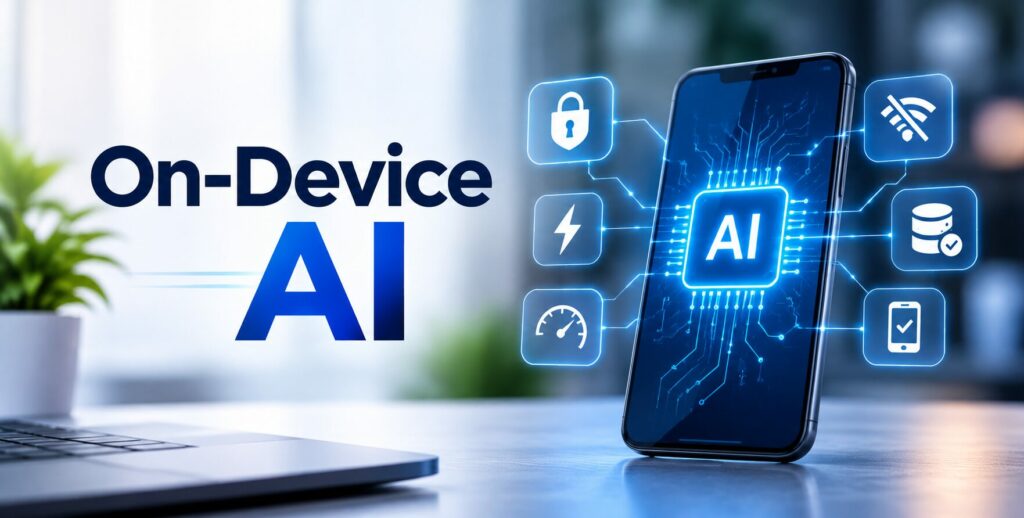
On-Device AI
TL;DR
• On-Device AI processes data locally on smart devices.
• It improves privacy, speed, and offline functionality.
• Small AI models enable efficient device performance.
• Smartphones, wearables, and smart homes benefit from local AI.
• AI optimization reduces memory and battery usage.
• On-Device AI makes devices smarter and more secure in 2027.
Artificial intelligence is becoming an essential part of everyday digital experiences, from smartphones and smart home systems to wearable devices and business applications. As AI technology continues to evolve, a major shift is taking place: intelligence is moving closer to the devices people use every day. On-Device AI is emerging as a transformative technology that enables AI models to process information directly on local hardware rather than relying entirely on remote cloud servers. Businesses exploring this innovation can leverage advanced AI software development solutions to build intelligent applications with improved performance, data privacy, and seamless user experiences. This approach can improve response times, enhance data privacy, and make intelligent features available even without a continuous internet connection. According to the On-Device AI technology overview, local AI processing is becoming increasingly important for modern applications. In 2027, smaller AI models, efficient processors, and advanced machine learning techniques are expected to expand the role of local intelligence across consumer and enterprise devices.
As businesses explore smarter digital solutions, understanding how on-device artificial intelligence works and where it delivers value is becoming increasingly important.
What Is On-Device AI?
On-Device AI refers to artificial intelligence models that run directly on a user’s device, such as a smartphone, laptop, smartwatch, camera, or connected appliance. Instead of sending every request to a cloud-based AI service, the device processes data locally using its own computing resources.
Traditional cloud AI systems generally depend on internet connectivity to transmit information to remote servers, process it, and return a response. Local AI models reduce this dependency by performing inference on the device itself.
For example, a smartphone equipped with an on-device AI model can recognize speech, summarize notifications, identify objects in images, or predict user behavior without necessarily uploading the underlying data to an external server. Similarly, businesses can enhance their software capabilities through AI model integration in business applications, enabling intelligent features to improve operational efficiency, automate workflows, and deliver smarter user experiences.
This technology is supported by several hardware and software advancements, including neural processing units (NPUs), optimized machine learning frameworks, model quantization, and compact language models.
The growing availability of powerful mobile processors is making local AI more practical for everyday use.
Why On-Device AI Is Becoming Important in 2027
The increasing adoption of artificial intelligence has created new expectations for privacy, speed, accessibility, and reliability. Users want AI-powered experiences that respond instantly while protecting their personal information.
On-Device AI addresses several of these expectations.
1. Improved Data Privacy and Security
Privacy is one of the most significant advantages of local AI processing. Many digital applications handle sensitive information, including personal messages, financial data, voice recordings, health information, and business documents.
Cloud-based AI systems may require some information to be transmitted to external servers. In contrast, local AI processing can keep much of this data on the user’s device.
For example, an AI-powered keyboard can predict text using locally processed language patterns. A smart camera can recognize objects or detect unusual activity without automatically uploading every video recording.
Although local processing does not eliminate every security risk, it can reduce the amount of sensitive information transmitted over the internet.
Businesses that prioritize privacy-preserving AI can benefit from evaluating on-device architectures as part of their security strategy.
2. Faster AI Responses and Reduced Latency
Cloud AI systems depend on network connectivity, server availability, and data transmission speed. These factors can introduce delays when users interact with intelligent applications.
On-device AI reduces latency by processing requests directly on local hardware.
This capability is particularly valuable for applications that require real-time responses, such as voice assistants, augmented reality tools, smart cameras, and autonomous systems.
For instance, an AI-powered wearable device can analyze movement patterns and provide immediate feedback without waiting for a cloud server to process the information.
Low-latency AI can create smoother and more responsive digital experiences.
3. AI Features Without Constant Internet Connectivity
Internet connectivity is not always reliable. Users may experience network interruptions while traveling, working in remote locations, or using connected devices in areas with limited coverage.
Local AI models can continue performing supported tasks even when the device is offline.
Examples include offline voice recognition, local document summarization, smart photo organization, and certain predictive features.
This capability makes on-device artificial intelligence valuable for mobile professionals, field workers, and users who require dependable digital services.
How Local AI Models Work on Smart Devices
On-device AI combines machine learning models with specialized hardware and optimized software.
The process typically involves several stages.
Data Collection
The device collects relevant information through sensors, microphones, cameras, user interactions, or application inputs.
For example, a smartwatch may collect motion data, while a smartphone receives a voice command.
Local Data Processing
The device processes the input using its local AI model. This may involve recognizing speech, identifying objects, predicting patterns, or understanding language.
The processing occurs on the device’s CPU, GPU, or Neural Processing Unit.
AI Inference
The trained model generates an output based on the input data. A voice assistant may interpret a command, while a smart camera may classify an object.
User Response
The device delivers the result directly to the user. Depending on the application, the response may include a notification, recommendation, automated action, or generated content.
This workflow allows AI-powered devices to provide intelligent services while reducing their reliance on cloud infrastructure.
Compact AI Models and Efficient Machine Learning
Large AI models can deliver advanced capabilities, but they often require substantial computing power and memory. Running such models directly on smaller devices can be challenging, particularly because memory limitations can affect AI model performance and efficiency, as discussed in our article on the AI memory bottleneck.
In 2027, compact AI models are expected to remain a significant area of development.
Small Language Models (SLMs) are designed to perform selected language-related tasks with fewer computational resources than larger models. They can support text generation, summarization, classification, and conversational interactions on compatible hardware.
Several optimization techniques help make local AI more efficient.
Model Quantization
Model quantization reduces the numerical precision used by a machine learning model. This can decrease memory requirements and improve inference efficiency, although it may affect accuracy.
Model Pruning
Pruning removes less important parameters or components from a model to reduce its size and computational requirements.
Knowledge Distillation
Knowledge distillation transfers useful capabilities from a larger model into a smaller model that is easier to deploy on mobile and embedded devices.
Hardware Acceleration
Modern processors include specialized components that accelerate machine learning workloads. NPUs are designed to perform certain AI operations efficiently while potentially reducing power consumption.
Together, these techniques make local AI models more suitable for smartphones, wearables, smart home devices, and edge computing applications.
How On-Device AI Is Transforming Smart Devices
The impact of local AI extends beyond smartphones. It is changing how connected devices interact with users and their surroundings.
Smartphones and Personal AI Assistants
Smartphones are becoming more intelligent through AI-powered features such as offline translation, photo enhancement, voice recognition, message summarization, and contextual recommendations.
On-device AI can help these features operate with lower latency and improved privacy.
Personal AI assistants may also become more context-aware by processing selected information locally. For example, an assistant could organize reminders or understand a voice command without sending every interaction to a remote server.
Smart Home Automation
Smart home devices can use local AI to recognize activities, understand commands, and automate household routines.
Smart speakers, lighting systems, thermostats, and security cameras may benefit from locally processed intelligence.
A smart home system could recognize when a room is occupied and adjust lighting automatically. Local voice processing may also allow users to control certain devices without depending on cloud connectivity.
These capabilities can improve responsiveness and provide greater control over personal data.
Wearable Devices and Health Monitoring
Wearable devices such as smartwatches and fitness trackers continuously collect information about movement, activity, and other measurements.
Local AI can analyze these signals to identify patterns, estimate activity levels, or provide personalized fitness insights.
Processing selected information on the device may reduce unnecessary data transmission and improve responsiveness.
However, AI-generated health insights should not replace professional medical evaluation. Accuracy, device limitations, and appropriate clinical validation remain important considerations.
Smart Cameras and Security Systems
On-device AI can support object detection, person recognition, motion classification, and unusual activity detection.
A smart camera may identify movement patterns locally and send a notification only when a relevant event occurs.
This can reduce unnecessary uploads, bandwidth usage, and cloud storage requirements.
Security systems still require strong encryption, secure software updates, access controls, and careful handling of biometric data.
Automotive and Connected Devices
Modern vehicles and connected systems increasingly rely on AI for perception, assistance, and real-time decision-making.
Local AI can support functions such as driver monitoring, voice interaction, and object recognition.
In industrial environments, intelligent sensors can identify equipment abnormalities and alert operators quickly.
These applications demonstrate how edge AI and on-device intelligence can support time-sensitive operations.
On-Device AI vs. Cloud AI: Understanding the Difference
On-device AI and cloud AI are not competing technologies in every situation. Each approach offers different benefits depending on the application’s requirements.
On-device AI is suitable for privacy-sensitive tasks, low-latency interactions, offline functionality, and applications with frequent local processing needs.
Cloud AI is useful for large-scale model inference, computationally demanding tasks, centralized model management, and processing that requires access to extensive computing resources.
A hybrid AI architecture combines both approaches. A device may handle basic tasks locally while sending more complex requests to a cloud service when necessary.
This architecture can balance performance, privacy, scalability, and computational requirements.
For example, a smart assistant could recognize a wake word locally, interpret a simple command on the device, and use cloud AI for a complex research request.
Challenges of On-Device AI Adoption
Despite its advantages, on-device AI presents several technical and operational challenges.
Hardware Limitations
Not every device has sufficient memory, processing power, or hardware acceleration to run advanced AI models. Developers must optimize models for the target hardware.
Battery Consumption
AI inference can consume energy, particularly when models operate continuously. Efficient model design and power-aware scheduling are important for battery-powered devices.
Model Accuracy
Smaller models may perform less accurately than larger cloud-based models on complex tasks. Developers need to evaluate performance carefully before deployment.
Device Fragmentation
Different smartphones, wearables, and embedded devices use different processors, operating systems, and hardware capabilities. Supporting multiple device configurations can increase development complexity.
Security Risks
Local processing can reduce data transmission, but devices remain vulnerable to malware, unauthorized access, model manipulation, and insecure updates.
Organizations must adopt secure development practices and regularly evaluate AI system risks.
The Role of AI Development in Building Local Intelligence
Developing effective on-device AI applications requires expertise in machine learning, software engineering, hardware optimization, application development, and security.
Businesses seeking to integrate intelligent features into their products can explore custom AI software development solutions to design applications that align with their performance and business requirements.
Development teams need to select appropriate models, optimize inference pipelines, evaluate device compatibility, and design secure data processing workflows.
For organizations building AI-powered mobile applications, connected devices, or enterprise software, these capabilities can help turn emerging AI technology into practical digital products.
A well-designed AI solution should consider user experience, computational efficiency, privacy requirements, and long-term scalability from the beginning.
Future of On-Device AI Beyond 2027
The future of on-device AI is likely to involve increasingly capable local models, efficient hardware, and more intelligent connected environments.
As processors become more efficient and model optimization techniques improve, AI features may become accessible across a wider range of devices.
Personal AI assistants could provide more contextual experiences. Smart home systems may become more autonomous. Wearable devices may offer more advanced activity analysis. Enterprise applications could process selected sensitive information locally.
Another important development is the growth of hybrid AI systems. These systems will combine local processing with cloud-based intelligence to deliver flexible and scalable experiences.
AI developers will also need to focus on transparency, responsible data handling, model evaluation, and security.
The long-term success of on-device artificial intelligence will depend not only on technological progress but also on how effectively developers address user expectations and practical limitations.
Conclusion
On-Device AI is transforming the way artificial intelligence is integrated into smartphones, smart home systems, wearable devices, cameras, and enterprise applications. By enabling local model inference, this technology can improve response times, support offline functionality, and reduce the need to transmit sensitive information to cloud servers.
In 2027, compact AI models, specialized processors, and efficient machine learning techniques are expected to make local intelligence increasingly practical. Although challenges involving hardware limitations, battery consumption, accuracy, and security remain, on-device AI offers valuable opportunities for building more responsive and privacy-conscious digital experiences.
Businesses that invest in optimized AI applications and intelligent device ecosystems can prepare for a future where computing power and decision-making increasingly operate closer to users.
Explore more emerging AI technologies, industry developments, and practical insights on AI Tech Updates.
Frequently Asked Questions
What is On-Device AI?
On-Device AI is artificial intelligence that processes data directly on devices like smartphones, laptops, and wearables without relying entirely on cloud servers.
How does On-Device AI improve privacy?
On-Device AI keeps data processing local, reducing the need to transmit sensitive information to external servers.
What are the benefits of On-Device AI?
Key benefits include faster processing, improved privacy, offline functionality, reduced latency, and lower cloud dependency.
How is On-Device AI used in smart devices?
It powers voice assistants, smart cameras, wearable monitoring, smartphone features, and home automation systems.
What are Small Language Models in On-Device AI?
Small Language Models (SLMs) are compact AI models designed to perform tasks like text generation and summarization using fewer computing resources.
What is the future of On-Device AI in 2027?
On-Device AI is expected to expand across smart devices with better privacy, efficient local models, faster responses, and improved intelligent features.