
Micro Language Models
TL;DR
• Micro Language Models bring AI to small devices.
• They require less computing power and memory.
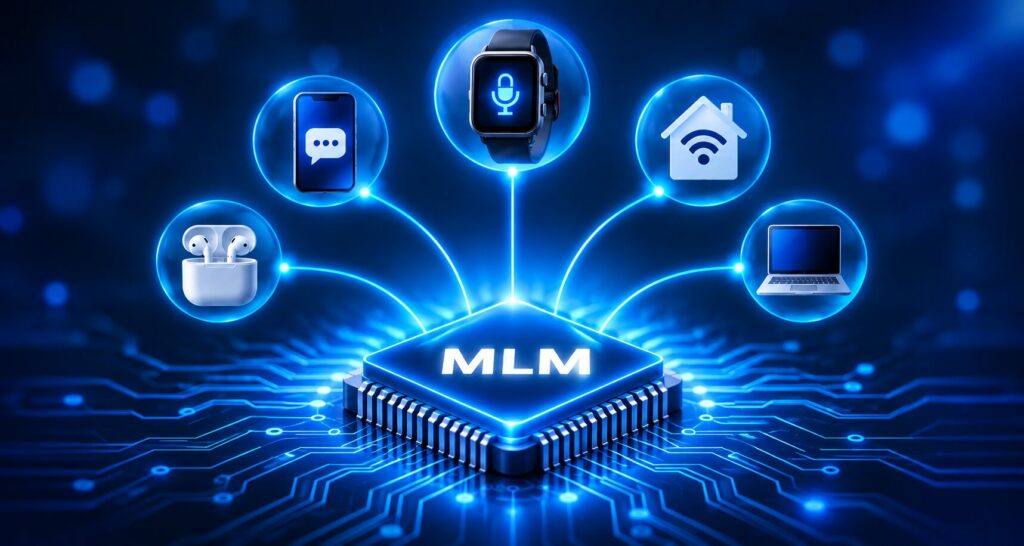
• They support wearables, earbuds, and smart homes.
• On-device processing can improve privacy and speed.
• They can work offline for supported tasks.
• Hybrid AI combines micro models with cloud intelligence.
• Hardware limits and accuracy remain key challenges.
Artificial intelligence is becoming a part of everyday life, from smartphones and smartwatches to home automation systems and connected healthcare devices. However, most advanced AI applications depend on powerful computing resources, large language models, and cloud-based infrastructure. This creates challenges for devices with limited memory, processing power, battery capacity, and internet connectivity.
Micro Language Models (MLMs) offer an interesting direction for addressing these limitations. These compact AI models are designed to perform focused language-related tasks while using fewer computational resources. Instead of relying entirely on large cloud-based AI systems, smaller models can bring certain intelligent capabilities closer to the devices people use every day.
As businesses explore more responsive, energy-efficient, and privacy-conscious digital products, micro language models could become an important part of the next generation of connected technology.
From wearable AI assistants and smart home devices to industrial IoT systems, these models have the potential to make artificial intelligence more accessible and practical.
What Are Micro Language Models?
Micro Language Models are extremely compact language models designed to perform specific AI tasks with limited computing resources. They build on the broader concept of Small Language Models (SLMs), but focus on even smaller deployment environments, including resource-constrained edge devices.
Traditional large language models contain billions of parameters and generally require substantial computing infrastructure. Smaller models reduce these requirements through techniques such as model compression, quantization, knowledge distillation, and task-specific training.
Their purpose is not necessarily to replace large AI models. Instead, they make it possible to perform selected language tasks directly on devices such as smartphones, smartwatches, earbuds, and connected sensors.
For example, a smartwatch equipped with a micro language model could recognize a simple voice command, interpret a short instruction, or provide a quick contextual response without sending every interaction to a remote server.
Recent research into ultra-compact language models has also explored models with approximately 8 million to 30 million parameters. One proposed approach uses an on-device model to generate the beginning of a response while a larger cloud model completes it. This demonstrates how tiny models and powerful AI systems can work together rather than operate independently.
Why Are Micro Language Models Becoming Important?
The growing demand for intelligent connected devices is changing how businesses approach AI development. Users increasingly expect applications to respond instantly, work reliably, and protect personal information.
However, cloud-dependent AI systems can introduce network delays, connectivity problems, and additional infrastructure costs.
Micro language models offer several potential advantages:
- Lower Computing Requirements: Smaller models can operate with less processing power and memory.
- Faster Responses: Local inference can reduce delays caused by sending requests to remote servers.
- Improved Privacy: Certain tasks can be processed locally without transmitting all user information to the cloud.
- Battery Efficiency: Optimized models can reduce the energy required for selected AI operations.
- Offline Functionality: Basic AI features may continue working when internet connectivity is unavailable.
- Affordable Deployment: Smaller computational requirements can reduce operating costs for certain applications.
These advantages make micro language models particularly interesting for wearable technology, IoT devices, and edge AI applications.
How Micro Language Models Work on Smart Devices
Micro language models use compact neural networks to understand and generate language within the limitations of smaller hardware platforms.
Their development involves optimizing the model architecture, reducing its computational requirements, and training it for specific tasks.
Here is how the process generally works:
1. Data Collection and Preparation
Developers collect relevant datasets based on the intended application. For example, a smart home assistant may require datasets containing voice commands, device instructions, and common conversational patterns.
2. Model Training and Fine-Tuning
The model is trained or fine-tuned to perform a limited set of tasks. Instead of learning to answer every possible question, it focuses on the language patterns and instructions relevant to its application.
3. Model Compression
Techniques such as quantization and pruning help reduce model size and computational requirements. Knowledge distillation can also transfer useful capabilities from a larger model into a smaller one.
4. Edge Deployment
The optimized model is deployed on compatible hardware, such as a smartphone processor, smartwatch chipset, or IoT device.
5. Real-Time Processing
When users interact with the device, the model processes supported commands locally and generates a response. More complex requests can be transferred to a cloud-based AI system when necessary.
This approach creates a flexible architecture in which local and cloud-based intelligence work together.
Micro Language Models vs. Small and Large Language Models
Although these terms are closely related, they describe different levels of model scale and deployment capabilities.
| Feature | Large Language Models | Small Language Models | Micro Language Models |
| Model size | Usually billions of parameters | Smaller parameter counts | Extremely compact models |
| Computing needs | High | Moderate to low | Very low relative to larger models |
| Deployment | Primarily cloud or powerful hardware | Cloud, edge, and selected devices | Resource-constrained edge devices |
| Response time | Depends on infrastructure and network | Often faster for focused tasks | Potentially very fast for supported tasks |
| Battery consumption | High for local execution | Lower when optimized | Designed for limited-power environments |
| Capabilities | Broad and complex | Focused and general-purpose tasks | Narrow, specialized tasks |
| Common applications | Research, content generation, advanced assistants | Chatbots, business automation, mobile AI | Wearables, embedded AI, smart devices |
The important distinction is that smaller models are not automatically better for every application. Large models remain valuable when advanced reasoning, extensive knowledge, and complex language understanding are required.
Micro language models are most useful when an application needs a fast, lightweight, and focused AI capability.
7 Ways Micro Language Models Could Transform Wearables and Smart Devices
1. Smarter Wearable AI Assistants
Smartwatches and wearable devices are becoming more capable, but their limited hardware makes running large AI models challenging.
Micro language models could enable lightweight assistants that understand basic commands, respond to simple questions, and help users interact with their devices.
For example, users could ask their smartwatch to summarize a notification, create a short reminder, or control connected applications.
Local processing could also make interactions more responsive when network connectivity is limited.
2. Intelligent Smart Home Systems
Smart home ecosystems include connected lights, thermostats, security systems, speakers, and household appliances.
Micro language models could help these devices understand simple instructions and perform actions without depending entirely on cloud-based processing.
For example, a user might say, “Turn off the bedroom lights and lower the temperature.”
A compact model could interpret the instruction and communicate with the appropriate connected devices.
This could improve the responsiveness of home automation systems while reducing unnecessary cloud requests.
3. AI-Powered Smart Earbuds
Smart earbuds are evolving beyond audio playback and basic voice assistance.
Micro language models could support lightweight conversational features, voice command recognition, contextual responses, and simple language assistance.
For instance, earbuds could recognize a supported command, summarize a short notification, or help users interact with connected applications.
When combined with speech recognition and audio processing technologies, compact AI models could make earbuds more useful without requiring constant interaction with a smartphone.
4. Healthcare and Fitness Wearables
Healthcare and fitness wearables continuously collect information such as activity levels, sleep patterns, heart rate, and other device-supported measurements.
Micro language models could help users understand this information through simple conversational interfaces.
For example, a fitness wearable might explain daily activity summaries or respond to questions about recorded exercise sessions.
However, these models should not independently diagnose medical conditions or replace qualified healthcare professionals. Their role would be to improve access to basic information and make health applications easier to use.
5. Industrial IoT and Connected Equipment
Manufacturing facilities use connected sensors and industrial devices to monitor equipment performance, detect unusual activity, and support maintenance operations.
Micro language models could provide simple natural-language interfaces for these systems.
For example, an industrial worker might ask a connected device to explain an equipment alert or summarize recent machine activity.
This could make technical information easier to access without requiring workers to navigate complex dashboards.
6. Smart Glasses and Ambient Computing
Smart glasses are creating new opportunities for hands-free digital interactions.
However, wearable devices must balance computing performance, battery life, heat generation, and physical size.
Micro language models could support lightweight interactions such as recognizing simple instructions, generating short responses, and processing contextual information.
Combined with cameras, microphones, and other sensors, they could contribute to more natural AI experiences.
7. Connected Automotive Systems
Modern vehicles increasingly include voice assistants, navigation systems, entertainment platforms, and connected applications.
Micro language models could support basic voice commands and selected conversational features within automotive infotainment systems.
For example, drivers could request navigation information, control entertainment settings, or interact with supported vehicle functions using natural language.
For safety-critical operations, however, these models would require strict validation, controlled permissions, and reliable fallback mechanisms.
Key Benefits of Micro Language Models for Businesses
Businesses developing connected products can explore micro language models as part of a broader AI and digital transformation strategy.
| Business Benefit | How It Helps |
| Reduced cloud dependency | Performs selected AI tasks locally |
| Better responsiveness | Reduces network-related processing delays |
| Data privacy | Keeps certain information on the device |
| Lower infrastructure costs | Reduces unnecessary cloud inference requests |
| Offline capabilities | Supports selected functions without internet access |
| Device integration | Enables AI features on compact hardware |
| Scalability | Supports distributed AI experiences across connected products |
These advantages can be particularly valuable for startups and enterprises developing wearable applications, smart home products, industrial IoT platforms, and connected mobile solutions.
Challenges of Implementing Micro Language Models
Despite their potential, micro language models also introduce technical challenges that developers must address before deploying them in commercial products.
Limited Language Understanding: Extremely compact models may struggle with complex instructions, ambiguous questions, and conversations requiring deeper reasoning.
Hardware Compatibility: Different wearable devices and embedded systems use different processors, memory configurations, and operating environments. Models must be optimized for their target hardware.
Battery and Thermal Management: Even lightweight AI processing consumes energy. Continuous inference can affect battery life and generate unwanted heat.
Model Accuracy: Smaller models may produce incorrect or incomplete responses, particularly when handling tasks outside their training scope.
Security and Privacy: Local processing can reduce data transmission, but it does not automatically guarantee security. Developers must implement encryption, secure storage, access controls, and appropriate data-handling practices.
Model Updates: AI models need regular evaluation and updates to maintain performance, improve compatibility, and address newly identified weaknesses.
Addressing these challenges requires careful AI engineering, hardware optimization, software architecture, and continuous testing.
The Future: Combining Micro AI With Cloud Intelligence
One of the most promising directions for micro language models is hybrid AI architecture.
Instead of expecting a tiny model to perform every task, developers can combine on-device intelligence with larger cloud-based models.
In this architecture, the micro model handles simple commands, quick responses, and initial language processing. More complex requests are transferred to a cloud AI system capable of deeper reasoning and broader knowledge.
For example:
- A smartwatch processes a basic reminder request locally.
- A smart home device interprets simple voice commands without unnecessary cloud communication.
- A smartphone handles routine text operations using an optimized local model.
- A cloud-based model supports more complicated questions and multi-step tasks.
This division of responsibilities can create a better balance between speed, computing efficiency, and advanced AI capabilities.
The emerging research direction of ultra-compact models that initiate responses locally while larger models continue them in the cloud is another example of this collaborative approach.
As hardware and model optimization techniques improve, these architectures could become increasingly useful for always-available AI experiences.
How Businesses Can Prepare for Micro Language Model Development
Organizations interested in adopting micro language models should begin by identifying practical use cases rather than focusing only on model size.
A successful implementation requires several important considerations:
- Identify the Application: Determine whether the product needs voice assistance, command recognition, text summarization, or another focused AI feature.
- Evaluate Hardware: Understand the device’s processor, memory, storage, battery, and operating system limitations.
- Choose the Right Model: Select or develop a model that matches the required accuracy, size, and performance.
- Optimize for Edge Deployment: Apply quantization, compression, and other suitable optimization techniques.
- Integrate With Applications: Connect the model with mobile applications, device sensors, APIs, and backend systems.
- Test Real-World Performance: Evaluate response quality, latency, battery consumption, reliability, and security.
- Plan for Continuous Improvement: Monitor performance and update the model as application requirements evolve.
Working with an experienced technology development partner can help businesses bring these elements together into a reliable digital product.
Key Considerations for Building AI-Powered Smart Devices
Developing intelligent wearable applications and connected smart devices requires expertise across artificial intelligence, mobile application development, IoT integration, cloud infrastructure, and software engineering.
Businesses exploring micro language models should focus on building solutions that balance performance, reliability, and user experience.
Some important development considerations include:
- AI Model Integration: Integrating compact AI models into applications to support focused language-processing tasks.
- Mobile Application Development: Creating applications that connect smartphones, wearables, and intelligent services.
- IoT Integration: Connecting smart devices, sensors, and software platforms for seamless data exchange.
- Cloud and Edge Architecture: Combining local processing with cloud-based intelligence for better flexibility.
- Custom Software Development: Building scalable digital platforms based on specific product requirements.
- Testing and Optimization: Evaluating performance, device compatibility, battery consumption, reliability, and security.
A well-planned development strategy can help businesses turn micro language model capabilities into practical digital products.
Conclusion
Micro Language Models could play an important role in the next phase of artificial intelligence by bringing selected language capabilities directly to smaller, resource-constrained devices.
From smartwatches and earbuds to connected homes, industrial equipment, and automotive systems, these compact models offer opportunities to make AI more responsive, accessible, and efficient.
However, their success will depend on more than reducing model size. Developers must balance accuracy, battery consumption, hardware compatibility, security, and user experience.
The future of connected AI will likely involve a combination of micro models, small language models, and powerful cloud-based systems working together.
For businesses, this creates an opportunity to develop smarter digital products that deliver useful AI capabilities wherever users need them.
Frequently Asked Questions
What are Micro Language Models?
Micro Language Models are compact AI models designed to perform specific language tasks using limited computing resources.
How do Micro Language Models work on smart devices?
They process voice commands, text, and simple instructions directly on devices without always requiring cloud connectivity.
What devices can use Micro Language Models?
Smartwatches, wireless earbuds, smart glasses, smartphones, smart home systems, and industrial IoT devices can use them.
What are the main benefits of Micro Language Models?
They offer lower computing requirements, faster responses, improved data privacy, reduced cloud dependency, and potential battery savings.
Can Micro Language Models work without the internet?
Yes. They can perform supported tasks locally without an internet connection, although complex requests may require cloud-based AI.