
TL;DR
- AI orchestration connects and coordinates multiple AI systems, workflows, and enterprise tools in real time.
- It helps businesses eliminate disconnected AI workflows, improve automation, and scale operations efficiently.
- Modern orchestration systems manage AI agents, memory, context, governance, and workflow execution together.
- As enterprises adopt autonomous and multi-agent AI systems, orchestration is becoming the hidden backbone of AI infrastructure.
- The future of software will rely on intelligently orchestrated AI ecosystems instead of standalone applications.
Artificial Intelligence is entering a new era where the focus is shifting beyond chatbots, copilots, and generative AI tools. The real transformation is happening behind the scenes through orchestration systems that coordinate AI models, agents, workflows, APIs, and enterprise systems in real time.
While users interact with conversational interfaces or AI-generated content, the invisible infrastructure powering these experiences includes large language models (LLMs), autonomous agents, retrieval systems, vector databases, workflow engines, monitoring tools, and security frameworks working together simultaneously. Without orchestration, these systems become fragmented, unreliable, and difficult to scale.
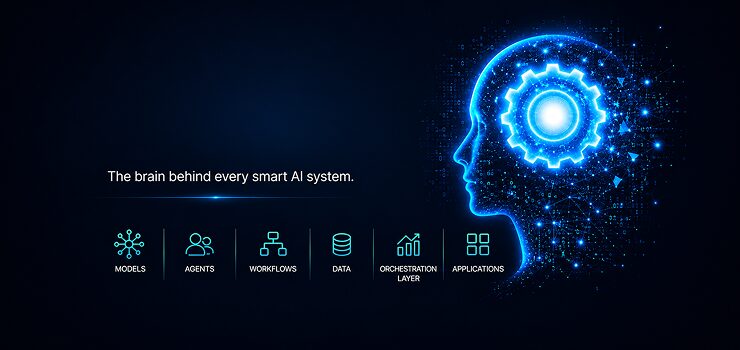
AI orchestration acts as the operational brain of modern intelligent applications by managing communication, workflow execution, memory, governance, and decision-making across connected systems. Much like cloud infrastructure transformed the internet, orchestration is becoming the hidden foundation powering modern AI ecosystems. According to MarketsandMarkets, the global AI orchestration market is expected to grow from approximately USD 11 billion in 2025 to over USD 30 billion by 2030, highlighting how organizations are moving from isolated AI tools toward fully connected AI ecosystems.
The Evolution of AI: From Models to Intelligent Ecosystems
The early phase of enterprise AI was primarily centered around prediction and automation. Businesses adopted machine learning systems to improve efficiency in areas such as fraud detection, recommendation engines, demand forecasting, customer segmentation, and process automation. While these systems delivered measurable business value, they largely operated in isolation and were designed to perform narrow, task-specific functions.
The next wave of AI adoption introduced generative AI, which significantly expanded enterprise use cases. Organizations began deploying AI chatbots, writing assistants, coding copilots, AI-powered search systems, and conversational business tools to improve productivity and accessibility across teams. However, as enterprises adopted more AI tools, a new challenge emerged. Most systems operated independently, creating disconnected workflows and operational silos. One AI system handled customer support, another generated reports, and another analyzed enterprise data, while separate automation platforms managed workflows. Despite their capabilities, these systems rarely communicated or collaborated effectively with each other.
Today, enterprises are entering the third phase of AI adoption, the era of agentic and autonomous AI systems. Unlike traditional AI tools that simply generate outputs, modern AI agents can plan tasks independently, use external software tools, coordinate with other agents, execute multi-step workflows, learn from operational feedback, and adapt to changing environments in real time. This shift is fundamentally transforming the role of AI inside organizations. AI systems are no longer functioning as standalone assistants but are becoming active participants in enterprise operations and decision-making.
According to Gartner, by 2028, nearly 33% of enterprise software applications will include agentic AI capabilities, while at least 15% of daily business decisions are expected to be made autonomously by AI systems. At the same time, Gartner predicts that more than 40% of agentic AI projects could fail due to the lack of orchestration and governance infrastructure required for large-scale deployment.
This highlights one of the biggest realities of modern AI adoption: the challenge is no longer building intelligent models. The real challenge is coordinating intelligence at scale.
What Is AI Orchestration?
Most enterprises today operate multiple AI systems simultaneously across different departments and business functions. Customer support teams rely on conversational AI to handle queries and automate responses, finance departments use predictive analytics and risk assessment models, operations teams depend on supply chain optimization systems, while HR departments increasingly adopt AI recruitment platforms and internal copilots. Individually, these systems provide measurable value by improving efficiency, reducing manual effort, and accelerating decision-making across the organization.
However, as enterprises continue adopting more AI tools, a major operational challenge begins to emerge. Most of these systems are designed to function independently, often without sharing context, synchronizing workflows, or communicating effectively with one another. This growing complexity is becoming a major concern for businesses investing heavily in enterprise AI adoption and intelligent automation solutions. As highlighted in Promatics’ blog on Artificial Intelligence Development Services, organizations are rapidly moving toward AI-driven operations to improve efficiency and scalability. But as AI ecosystems expand, enterprises also need a structured way to connect and coordinate these systems effectively.
The orchestration layer prevents this by ensuring:
- AI systems communicate efficiently
- Tasks are executed in the correct sequence
- Context flows continuously across workflows
- Governance and compliance policies remain enforced
- Failures and exceptions are handled intelligently
- Human intervention is triggered when necessary
As organizations move toward multi-agent and autonomous AI environments, orchestration is rapidly becoming the hidden operational backbone of enterprise AI. It transforms disconnected AI tools into intelligent, collaborative ecosystems capable of executing complex workflows at scale while maintaining performance, reliability, and governance.
Why Orchestration Is Becoming Mission-Critical
Most enterprises today operate multiple AI systems simultaneously across different departments and business functions. Customer support teams rely on conversational AI to handle queries and automate responses, finance departments use predictive analytics and risk assessment models, operations teams depend on supply chain optimization systems, while HR departments increasingly adopt AI recruitment platforms and internal copilots. Individually, these systems provide measurable value by improving efficiency, reducing manual effort, and accelerating decision-making across the organization.
However, as enterprises continue adopting more AI tools, a major operational challenge begins to emerge. Most of these systems are designed to function independently, often without sharing context, synchronizing workflows, or communicating effectively with one another. As a result, organizations frequently encounter fragmented workflows, inconsistent outputs, duplicate processes, rising infrastructure costs, data silos, governance risks, and scalability limitations. Different AI systems may generate conflicting recommendations, repeat the same tasks unnecessarily, or fail to coordinate with other operational platforms, creating inefficiencies instead of intelligent automation.
This is where AI orchestration becomes essential. Orchestration introduces a centralized intelligence layer that coordinates how AI systems, workflows, and enterprise applications operate together. It enables:
- Intelligent task routing
- Workflow sequencing
- Multi-agent collaboration
- Context synchronization
- Policy enforcement
- Human approval systems
- Real-time observability and monitoring
Instead of isolated automation tools operating separately, orchestration transforms enterprise AI into a connected operational ecosystem where systems collaborate seamlessly, exchange context continuously, and execute workflows efficiently. The result is no longer just automation. It is operational intelligence at enterprise scale.
The Core Architecture of Modern AI Orchestration Systems
AI orchestration platforms are typically built across multiple interconnected layers that collectively enable intelligent enterprise operations.
Model Orchestration Layer
Modern enterprises rarely rely on a single AI model anymore. As AI ecosystems become more advanced, organizations are increasingly using multiple specialized models designed for different operational needs.
Different AI systems are optimized for different tasks, such as:
- GPT-based models for reasoning and complex problem-solving
- Lightweight models for faster, low-latency responses
- Vision models for image and video analysis
- Speech systems for voice-based interactions
- Domain-specific models for healthcare, finance, legal, and compliance operations
Managing these diverse AI systems manually at scale would be highly inefficient. This is where the orchestration layer becomes essential. AI orchestration dynamically decides which model should handle a task based on:
- Performance requirements
- Accuracy needs
- Latency expectations
- Infrastructure costs
- Context availability
- Compliance and security requirements
For example, a customer support platform may use:
- A lightweight model for handling quick customer queries
- A larger reasoning model for complex escalations
- A retrieval engine for accessing enterprise knowledge bases
This process, known as intelligent routing, helps enterprises improve scalability, operational efficiency, response quality, and cost optimization while balancing performance and infrastructure utilization in real time.
Multi-Agent Coordination Layer
One of the biggest shifts in enterprise AI is the rise of multi-agent architectures. Instead of deploying one monolithic AI assistant, organizations are increasingly building teams of specialized AI agents designed to handle different operational tasks.
For example:
- A research agent gathers and analyzes information
- A planning agent structures workflows and execution strategies
- A compliance agent verifies policies and regulations
- A coding agent writes and reviews software
- A monitoring agent tracks system performance and anomalies
The orchestration layer coordinates how these agents work together by managing:
- Memory sharing and context synchronization
- Information exchange between agents
- Task delegation and workflow sequencing
- Conflict resolution and issue escalation
- Collaborative execution across systems
This architecture closely mirrors how human organizations function through specialized teams working toward shared objectives. Research shows orchestrated multi-agent systems significantly improve workflow reliability, operational scalability, decision quality, task efficiency, and autonomous execution capabilities, making multi-agent orchestration one of the most important foundations of enterprise AI systems.
Context Engineering: The Memory Backbone of Enterprise AI
One of the biggest limitations of early AI systems was memory fragmentation.
Traditional AI assistants often:
- Forgot previous interactions
- Lost contextual awareness
- Produced inconsistent outputs
- Failed to maintain workflow continuity
Modern orchestration systems solve this through advanced context engineering.
This includes:
- Shared memory systems
- Retrieval-Augmented Generation (RAG)
- Vector databases
- Session continuity
- Knowledge graph integration
- Context synchronization
Context engineering allows AI systems to maintain operational awareness across users, departments, and workflows.
For example, in customer support environments, orchestration systems enable AI agents to remember:
- Previous customer interactions
- Ticket history
- Escalation patterns
- Purchase history
- Enterprise policies
In healthcare, orchestration systems can coordinate:
- Patient records
- Diagnostic data
- Treatment recommendations
- Compliance requirements
- Clinical workflows
This persistent memory layer is becoming one of the most valuable components of enterprise AI infrastructure.
Workflow Orchestration: Turning AI Into Operational Systems
AI orchestration is not just about coordinating models and agents.
It also manages workflow execution.
Modern orchestration platforms determine:
- What action should happen next
- Which systems need to be triggered
- Which approvals are required
- How workflows adapt dynamically
- How exceptions are handled
- How failures are recovered
This allows AI systems to move beyond passive assistance into active operational execution.
Consider a supply chain disruption scenario.
An orchestrated AI system may:
- Detect abnormal inventory patterns
- Predict supply chain delays
- Analyze vendor risks
- Recommend alternative suppliers
- Reroute logistics automatically
- Update forecasting systems
- Notify stakeholders in real time
All of these actions can occur autonomously through orchestrated workflows.
According to Gartner, spending on supply-chain software with agentic AI capabilities is projected to grow from under USD 2 billion in 2025 to approximately USD 53 billion by 2030, highlighting how rapidly enterprises are adopting orchestrated autonomous systems.
Governance: The Layer That Determines Enterprise Trust
As AI systems become increasingly autonomous, governance becomes mission-critical.
Without proper governance:
- AI agents may access sensitive data
- Autonomous workflows may violate regulations
- Hallucinations may trigger operational failures
- Decisions become impossible to audit
This is why orchestration platforms increasingly integrate governance directly into workflow execution.
Modern orchestration systems now include:
- Policy enforcement engines
- Access control systems
- Audit logging
- Human approval checkpoints
- Risk scoring frameworks
- Constraint-aware execution
In industries such as:
- Healthcare
- Finance
- Insurance
- Government
- Legal services
Governance-aware orchestration is becoming essential for enterprise AI adoption.
Recent enterprise AI research increasingly focuses on orchestration systems capable of enforcing frameworks such as:
- GDPR
- HIPAA
- SOX
- Enterprise security policies
in real time.
The Economics of AI Orchestration
One major reason orchestration is gaining momentum is economic efficiency.
Organizations deploying orchestrated AI systems are reporting measurable improvements in:
- Workflow automation
- Infrastructure utilization
- Operational speed
- AI ROI
- Resource efficiency
Industry estimates suggest orchestrated multi-agent systems can reduce operational costs by 25–30%, while some enterprises report up to 60–80% reductions in repetitive integration tasks through workflow automation.
Meanwhile, Citigroup recently increased its forecast for the global AI market to more than USD 4.2 trillion by 2030, with nearly USD 1.9 trillion tied directly to enterprise AI adoption.
These numbers reflect a larger transformation: AI is no longer experimental technology.
It is becoming an enterprise infrastructure.
Why Many Agentic AI Projects Still Fail
Despite massive investment, many enterprises continue struggling to operationalize AI effectively.
The primary reasons include:
- Weak orchestration infrastructure
- Poor context management
- Fragmented enterprise data
- Limited observability
- Governance gaps
- Reliability issues in autonomous workflows
This is why Gartner predicts that over 40% of agentic AI projects may be canceled by 2027 due to operational and governance challenges. The lesson is becoming increasingly clear:
Building powerful AI models is not enough. The organizations that succeed will be the ones that build scalable orchestration systems around those models.
The Future of Software: AI-Native Operating Environments
The software industry is undergoing one of the biggest architectural transformations in decades. Traditional software systems were primarily interface-driven, human-operated, rule-based, and designed around fixed workflows. Users interacted with applications manually, workflows followed predefined logic, and software systems largely depended on human input for execution and decision-making.
AI-native systems, however, are fundamentally changing this model. Modern enterprise platforms are becoming increasingly autonomous, conversational, goal-oriented, context-aware, and self-coordinating. Instead of simply responding to commands, these systems can understand intent, adapt to changing conditions, coordinate workflows, and make operational decisions in real time.
This transformation is also reshaping the future of software itself. As discussed in our blog on AI Is Becoming Infrastructure: Why Software Will Disappear in the Next 5 Years, AI is gradually shifting from being an application layer to becoming the operational foundation behind modern digital systems. Instead of interacting with rigid software interfaces, users will increasingly rely on intelligent systems capable of orchestrating tasks, workflows, and enterprise operations autonomously.
Future enterprise platforms may function less like standalone applications and more like orchestrated ecosystems composed of:
- AI agents
- Workflow engines
- Memory and context systems
- Governance and compliance layers
- Human oversight frameworks
In this new architecture, orchestration becomes the intelligence infrastructure that connects everything together. It enables AI systems, workflows, enterprise tools, and human decision-makers to operate as a unified operational ecosystem rather than disconnected software applications.
The Future: Invisible Intelligence Infrastructure
Over time, AI orchestration itself may become almost invisible to end users. People will not directly interact with orchestration layers or coordination systems. Instead, they will simply experience smarter applications, faster operations, personalized workflows, autonomous systems, real-time decision-making, and seamless collaboration between AI tools and enterprise platforms.
Much like cloud computing evolved into invisible infrastructure powering the modern internet, orchestration is becoming the hidden infrastructure powering modern AI ecosystems. Users may interact with AI assistants, autonomous agents, or intelligent business applications without realizing that multiple models, workflows, APIs, and decision systems are being coordinated behind the scenes in real time.
This shift is expected to accelerate rapidly over the next few years. According to Gartner, by the end of 2026, nearly 40% of enterprise applications are expected to include task-specific AI agents, compared to less than 5% in 2025. As enterprises move toward AI-native operations, orchestration will become one of the most critical competitive advantages in enterprise technology.
The organizations leading the next decade of AI will not necessarily be the ones building the largest AI models. Instead, they will be the companies capable of building the most scalable, governed, context-aware, and intelligently orchestrated AI ecosystems behind those models.
Conclusion
AI orchestration is rapidly emerging as one of the most important infrastructure layers in modern technology. As enterprises move toward multi-agent architectures, autonomous workflows, AI-native operations, intelligent decision systems, and real-time automation, the need for coordination, governance, workflow intelligence, and memory management becomes increasingly critical. This is exactly where orchestration plays a transformative role.
Rather than allowing AI systems to operate as disconnected tools, orchestration brings them together into unified operational ecosystems capable of executing complex workflows at enterprise scale. It enables AI models, agents, enterprise applications, workflows, and human oversight systems to collaborate seamlessly while maintaining scalability, reliability, security, and contextual awareness.
The future of AI is no longer defined only by how powerful individual models become. The real competitive advantage will come from how effectively organizations coordinate intelligence across systems, workflows, and business operations. In many ways, orchestration is becoming the invisible operational layer quietly powering the next generation of intelligent applications, autonomous enterprises, and AI-driven digital ecosystems.
Frequently Asked Questions
What is AI orchestration in modern applications?
AI orchestration is the process of coordinating AI models, agents, workflows, APIs, and enterprise systems to work together efficiently. It helps businesses automate complex operations, improve scalability, and maintain seamless workflow execution across multiple AI systems.
Why is AI orchestration important for enterprise AI?
AI orchestration is important because most enterprise AI tools operate independently. Orchestration connects these systems, enabling real-time collaboration, context sharing, workflow automation, governance, and intelligent decision-making at scale.
How does AI orchestration improve business operations?
AI orchestration improves business operations by automating workflows, reducing manual tasks, improving response times, optimizing resource utilization, and enabling AI systems to collaborate efficiently across departments and platforms.
What are the key components of an AI orchestration system?
The key components of an AI orchestration system include model orchestration, workflow automation, multi-agent coordination, context engineering, governance systems, compliance frameworks, and real-time monitoring capabilities.
What is multi-agent AI orchestration?
Multi-agent AI orchestration refers to managing multiple specialized AI agents that work together on complex tasks. These agents can collaborate, share context, delegate tasks, and execute workflows autonomously within enterprise environments.

1 thought on “The Hidden Layer of AI: Orchestration Systems Powering Modern Applications”