
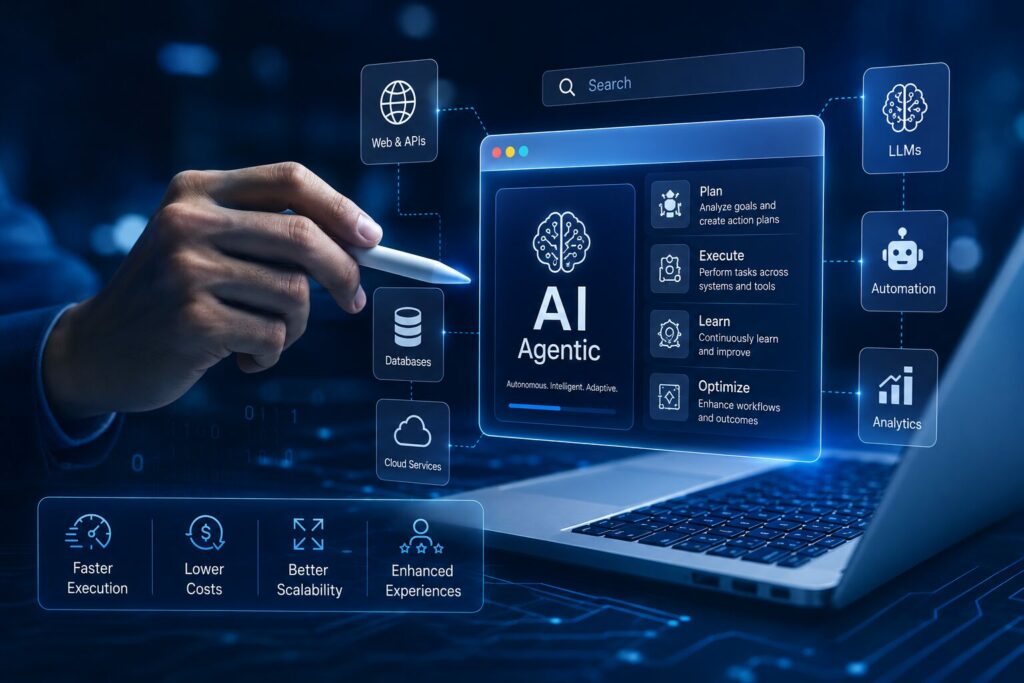
TL;DR
• Agentic AI enables autonomous workflows with minimal human intervention.
• Unlike generative AI, AI agents can plan, decide, and execute tasks independently.
• Enterprises are adopting AI agents to improve productivity and scalability.
• LLMs, APIs, orchestration, and memory systems power agentic AI workflows.
• AI agents are transforming customer support, HR, finance, IT, and logistics.
What happens when AI stops waiting for instructions and starts making decisions on its own? That shift is no longer theoretical. It is already transforming how modern enterprises operate. AI is rapidly evolving from a simple assistant into an autonomous operational layer capable of managing workflows, handling customer interactions, coordinating enterprise systems, and making business decisions with minimal human involvement.
From intelligent support automation to self-operating business processes, organizations across industries are integrating AI agents into their daily operations at an unprecedented pace. Technology giants like Microsoft and IBM are actively positioning agentic AI as the next major evolution of enterprise automation and digital transformation.
But despite the growing excitement, one major challenge continues to slow widespread adoption: reliability.
Despite rapid progress in enterprise AI, reliability remains a major challenge. A 2025 Carnegie Mellon University study found that advanced AI agents completed only around 30% of complex multi-step office workflows successfully. Even in 2026, enterprise evaluations continue reporting AI agent success rates between 24% and 35% for real-world autonomous business tasks.
This growing gap between AI’s enormous potential and its real-world operational performance is quickly becoming one of the most important discussions in enterprise technology today.
In this blog, we’ll explore what agentic AI really means, how autonomous enterprise workflows function, why businesses are rapidly investing in AI agents, where these systems commonly fail, and the technologies and best practices shaping the future of reliable AI-driven enterprise operations.
What Is Agentic AI?
Agentic AI refers to intelligent systems designed to autonomously pursue goals, make decisions, execute tasks, and adapt based on context and feedback. These systems combine reasoning, planning, memory, and tool usage to independently manage complex workflows.
In simple terms, agentic AI allows machines to behave less like passive assistants and more like active digital operators capable of handling business processes with limited human supervision.
The rise of agentic AI represents the next major phase of enterprise automation.
The Evolution of Enterprise AI
Traditional AI: Rule-Based Automation
The earliest stage of enterprise AI focused on structured, rule-based automation. These systems were designed to perform narrow tasks using predefined logic and structured datasets.
Traditional AI worked effectively for:
- Fraud detection
- Recommendation systems
- Inventory forecasting
- Data classification
- Robotic Process Automation (RPA)
However, these systems had major limitations. They could not reason dynamically, adapt to unexpected scenarios, or independently make decisions outside predefined workflows.
For example, a traditional support automation system could route tickets using keywords, but it could not understand customer context or resolve new problems autonomously.
Generative AI: The Rise of Intelligent Assistants
The emergence of generative AI transformed how businesses interact with machines. Large Language Models (LLMs) enabled systems to:
- Understand natural language
- Generate human-like responses
- Create content
- Summarize information
- Assist employees conversationally
This accelerated the adoption of:
- AI chatbots
- Virtual assistants
- Coding copilots
- AI-powered search
- Content generation tools
Unlike rule-based systems, generative AI could respond dynamically and generate intelligent outputs in real time.
Still, most generative AI systems remained reactive. They could answer questions and generate recommendations, but humans still needed to approve actions and complete workflows manually.
Agentic AI: The Shift Toward Autonomous Operations
Agentic AI moves beyond assistance and introduces autonomous execution into enterprise environments.
Instead of only generating responses, agentic AI systems can:
- Understand high-level objectives
- Break tasks into smaller actions
- Make dynamic decisions
- Interact with enterprise software
- Monitor outcomes
- Adjust workflows in real time
- Complete operations independently
For example:
- Traditional AI classifies customer complaints.
- Generative AI drafts a response.
- Agentic AI analyzes the complaint, retrieves customer data, processes refunds, updates systems, sends notifications, and closes the case automatically.
This transition from “AI that assists” to “AI that operates” is why many experts consider agentic AI the next era of enterprise transformation.
Core Characteristics of Agentic AI
1. Autonomy
Autonomy is the defining feature of agentic AI.
Unlike traditional systems that require constant human input, agentic AI can:
- Monitor workflows
- Detect issues
- Decide next steps
- Execute actions independently
For example, an AI operations agent may detect a server issue, analyze logs, identify the root cause, initiate corrective actions, and notify IT teams automatically.
2. Goal-Oriented Behavior
Agentic AI systems are designed around objectives instead of isolated prompts.
Rather than responding to one instruction at a time, AI agents continuously work toward completing larger business goals while adapting to changing conditions.
Example:
A supply chain AI agent may continuously optimize delivery schedules and inventory levels to reduce costs and improve fulfillment speed.
3. Multi-Step Reasoning
Enterprise operations involve interconnected workflows, approvals, dependencies, and decisions.
Agentic AI systems can:
- Break objectives into smaller tasks
- Prioritize execution
- Coordinate across systems
- Manage sequential workflows
Example:
An HR onboarding agent can automatically:
- Create accounts
- Configure access
- Assign training
- Schedule orientation
- Notify managers
all within one autonomous workflow.
4. Memory Retention
Advanced AI agents retain:
- Workflow history
- User preferences
- Operational context
- Historical decisions
- Conversation continuity
This contextual awareness enables better personalization and more accurate long-term decision-making.
Without memory, AI systems lose continuity between interactions and workflows.
5. Tool Usage and System Integration
One of the most powerful capabilities of agentic AI is tool interaction.
Modern AI agents can integrate with:
- APIs
- CRM platforms
- ERP systems
- Databases
- Browsers
- Cloud infrastructure
- Internal enterprise software
This allows AI agents to move beyond generating text and actually perform operational business tasks.
6. Feedback Loops and Self-Optimization
Agentic AI systems increasingly use feedback mechanisms to improve performance over time.
These loops help systems:
- Detect failures
- Compare expected vs actual outcomes
- Refine future actions
- Improve workflow reliability
While fully self-improving AI systems are still evolving, adaptive optimization is becoming a core enterprise capability.
How Agentic AI Works
Behind every autonomous AI workflow is a sophisticated architecture combining multiple technologies.
Large Language Models (LLMs)
LLMs serve as the intelligence layer of agentic systems.
They help AI agents:
- Understand instructions
- Interpret context
- Generate reasoning
- Make decisions
- Communicate naturally
Popular enterprise LLM ecosystems include:
- GPT models by OpenAI
- Claude by Anthropic
- Gemini by Google
- Open-source models like Llama and Mistral
Planning Engines
Planning systems convert high-level goals into actionable workflows by:
- Breaking tasks into steps
- Prioritizing execution
- Managing dependencies
- Coordinating workflows
Without planning engines, AI struggles with complex multi-step enterprise operations.
Memory Systems
Memory systems maintain contextual continuity across long-running workflows.
These systems store:
- Previous interactions
- Enterprise knowledge
- Workflow states
- Historical actions
This enables AI agents to make more informed decisions over time.
Tool Integrations
Tool integration layers connect AI agents directly with enterprise software and external systems.
These integrations may include:
- CRM platforms
- ERP systems
- Cloud infrastructure
- Analytics tools
- Communication platforms
This transforms AI from an assistant into an operational execution system.
Orchestration Frameworks
Orchestration frameworks coordinate workflows, agents, tools, and enterprise systems.
Popular orchestration platforms include the following:
- LangChain
- CrewAI
- AutoGen
- Semantic Kernel
These frameworks manage:
- Workflow sequencing
- Agent coordination
- Failure handling
- Monitoring
- Governance
Why Enterprises Are Rapidly Investing in Agentic AI
Growing Operational Complexity
Modern enterprises operate across fragmented digital ecosystems involving:
- CRM platforms
- ERP systems
- Cloud tools
- Collaboration software
- Analytics platforms
Disconnected workflows create delays, inefficiencies, and operational silos.
Agentic AI acts as an orchestration layer capable of coordinating operations across systems automatically.
Pressure to Improve Productivity
Businesses are under constant pressure to improve efficiency while reducing operational costs.
Organizations implementing AI-driven automation are already reporting:
- Faster ticket resolution
- Lower operational overhead
- Higher employee productivity
- Reduced support costs
- Improved workflow efficiency
AI agents automate repetitive administrative work, allowing teams to focus on strategic initiatives.
Need for Real-Time Decision Making
Modern enterprises require instant responses to:
- Cybersecurity threats
- Customer issues
- Market changes
- Operational disruptions
Agentic AI enables:
- Real-time monitoring
- Automated actions
- Dynamic workflow coordination
- Rapid incident response
Example:
A cybersecurity AI agent can detect suspicious activity and isolate threats within seconds.
Limitations of Traditional Automation
Rule-based automation works well for predictable workflows but struggles with:
- Dynamic decisions
- Unstructured data
- Changing priorities
- Cross-platform coordination
- Context-aware actions
Agentic AI introduces adaptability, reasoning, and contextual decision-making into enterprise automation.
Real-World Enterprise Use Cases
Customer Support Automation
AI support agents can:
- Understand customer intent
- Access CRM records
- Retrieve account details
- Process refunds
- Escalate complex issues
- Update tickets automatically
Platforms like Salesforce and ServiceNow are rapidly integrating autonomous AI agents into enterprise workflows.
HR and Employee Onboarding
AI onboarding agents can automate:
- Offer documentation
- Payroll setup
- IT provisioning
- Training assignments
- Access management
This significantly reduces HR administrative overhead.
IT Operations
AI agents are transforming enterprise IT through:
- Infrastructure monitoring
- Incident management
- Log analysis
- Automated troubleshooting
- Predictive maintenance
This improves operational reliability while reducing downtime.
Supply Chain and Logistics
Agentic AI helps optimize the following:
- Inventory forecasting
- Procurement coordination
- Warehouse operations
- Delivery routing
- Vendor communications
AI agents can automatically adapt workflows when disruptions occur.
Finance and Compliance
AI finance agents can autonomously manage:
- Invoice processing
- Fraud detection
- Compliance reporting
- Expense analysis
- Transaction monitoring
This improves operational accuracy and reduces compliance risk.
Benefits of Agentic AI in Enterprises
Faster Workflow Execution
AI agents can complete workflows continuously without waiting for human intervention, significantly improving operational speed.
Reduced Operational Costs
Autonomous AI workflows reduce expenses related to:
- Manual processing
- Administrative tasks
- Support operations
- Incident management
24/7 Operations
Unlike human teams, AI systems can operate continuously across time zones without downtime.
Better Customer Experiences
AI-driven operations improve the following:
- Response times
- Personalization
- Service consistency
- Customer satisfaction
Improved Employee Productivity
By automating repetitive work, employees can focus more on:
- Strategy
- Creativity
- Innovation
- Relationship management
Challenges and Risks
Despite its advantages, agentic AI also introduces significant risks.
Security and Governance
AI agents often require access to sensitive systems and data.
Without proper governance, they may:
- Execute unauthorized actions
- Expose sensitive information
- Create operational vulnerabilities
Enterprises must implement:
- Role-based permissions
- Audit trails
- Human approval checkpoints
- AI governance frameworks
- Hallucinations and Reliability Issues
AI systems can still:
- Misinterpret instructions
- Generate inaccurate outputs
- Make flawed decisions
Even small errors in enterprise environments can create operational or financial risks.
Compliance Challenges
Organizations must ensure AI workflows comply with:
- GDPR
- Data privacy laws
- Industry regulations
- Enterprise governance standards
Transparency and auditability remain critical.
Human Trust and Adoption
Many employees remain concerned about:
- Job displacement
- Reduced oversight
- AI decision accuracy
Successful adoption depends on strong human-AI collaboration models and workforce enablement.
Best Practices for Enterprises
Organizations implementing agentic AI should:
Start with Low-Risk Workflows
Begin with repetitive operational tasks before expanding autonomy into critical systems.
Keep Humans in the Loop
Use human oversight for:
- Financial approvals
- Compliance workflows
- High-risk decisions
Implement Strong Governance
Establish:
- Access controls
- Audit systems
- Monitoring frameworks
- Compliance checkpoints
Build Fallback Mechanisms
AI workflows should automatically escalate failures or low-confidence decisions to human teams.
Invest in Workforce Readiness
Train employees to collaborate effectively with AI systems rather than viewing automation purely as a replacement.
Future of Agentic AI in Enterprises
The next decade will likely redefine enterprise operations through autonomous AI ecosystems.
Key emerging trends include the following:
- Multi-agent AI collaboration
- Self-improving workflows
- Autonomous digital workforces
- AI operating systems for enterprises
- Hyperautomation platforms
Instead of isolated tools, businesses are moving toward centralized AI orchestration environments capable of managing workflows, tools, systems, and decisions from a unified intelligence layer.
As enterprise AI spending continues rising, organizations are accelerating investments in:
- AI infrastructure
- Governance systems
- Orchestration platforms
- Autonomous workflow technologies
Final Thoughts
Agentic AI is not replacing enterprise software. Instead, it is becoming the intelligence layer that connects systems, automates workflows, and enables businesses to operate with greater speed, efficiency, and adaptability. What began as simple automation is now evolving into autonomous enterprise ecosystems capable of making decisions, coordinating operations, and continuously optimizing business processes in real time.
This shift from rule-based automation to intelligent, AI-driven workflows represents one of the most significant transformations in modern enterprise technology. Organizations that adopt agentic AI early are likely to gain a major competitive advantage through faster execution, lower operational costs, improved scalability, smarter decision-making, and more personalized customer experiences. At the same time, businesses that fail to evolve may struggle to compete in increasingly automated and AI-driven markets.
However, the future of enterprise AI will not be fully autonomous or entirely human-led. Instead, it will be built around collaborative human-AI environments where intelligent agents handle repetitive operational execution while human teams focus on strategy, creativity, leadership, governance, and innovation.
As AI orchestration platforms, autonomous agents, and enterprise automation technologies continue to mature, agentic AI is rapidly moving from experimental innovation to core business infrastructure. Over the next decade, the companies building reliable, scalable, and well-governed AI ecosystems today may ultimately define the next era of digital transformation and intelligent enterprise operations.
Frequently Asked Questions
1. What is agentic AI in enterprises?
Agentic AI refers to autonomous AI systems that can independently make decisions, execute workflows, interact with enterprise tools, and adapt to changing conditions with minimal human intervention. Unlike traditional AI systems, agentic AI focuses on goal-oriented execution rather than simple task automation.
2. How is agentic AI different from generative AI?
Generative AI primarily focuses on creating content, answering queries, or generating responses based on prompts. Agentic AI goes a step further by planning actions, coordinating workflows, using external tools, and autonomously completing multi-step business operations.
3. What are autonomous enterprise workflows?
Autonomous enterprise workflows are AI-driven operational processes where intelligent agents manage tasks, coordinate systems, make decisions, and execute workflows automatically across departments such as customer support, HR, finance, IT, and logistics.
4. Why are enterprises investing heavily in agentic AI?
Businesses are investing in agentic AI to improve operational efficiency, reduce manual workloads, accelerate decision-making, lower costs, and enable real-time workflow automation. Agentic AI also helps organizations scale operations more effectively across complex digital ecosystems.
5. What technologies power agentic AI systems?
Agentic AI systems are powered by technologies such as the following:
Large Language Models (LLMs)
AI orchestration frameworks
Memory and vector database systems
APIs and enterprise software integrations
Workflow automation engines
Multi-agent AI architectures
Popular frameworks include LangChain, CrewAI, AutoGen, and Semantic Kernel.

3 thoughts on “Agentic AI in Enterprises: The Rise of Autonomous Workflows”