
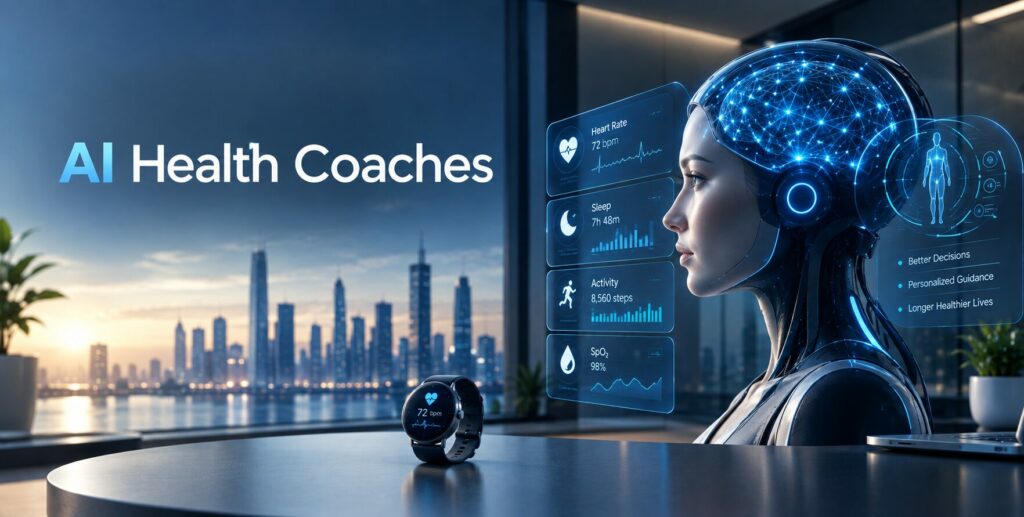
AI Health Coaches
TL;DR
• AI Health Coaches personalize health insights from wearable data.
• Wearables help AI track heart rate, sleep, and activity.
• AI can support preventive care and healthier daily choices.
• Privacy and data accuracy remain key concerns.
• AI health coaches can support, not replace, doctors.
Wearable technology has changed the way people understand their everyday health. Smartwatches, fitness trackers, and connected health devices can continuously collect information about heart rate, sleep, activity, stress, blood oxygen, body temperature, and other physiological signals. But collecting health data is only the beginning. The next major shift is using artificial intelligence to understand that information and turn it into personalized guidance. Businesses developing AI-powered healthcare solutions are increasingly exploring how AI, wearable sensors, mobile applications, and data analytics can work together to create smarter digital health experiences.
This evolution is giving rise to a new generation of AI health coaches. Instead of simply displaying statistics, AI-powered health platforms can analyze patterns, understand individual goals, provide personalized insights, and help users make more informed lifestyle decisions.
Recent developments from major technology companies highlight how quickly this area is evolving. Samsung has been researching health foundation models capable of learning from wearable biosignals, while Google has been working on AI-powered health coaching experiences that combine information from wearable devices and other health sources.
The convergence of AI and wearable technology could eventually transform the smartwatch from a passive health tracker into a more intelligent personal health assistant. However, this opportunity also raises important questions about privacy, accuracy, reliability, data ownership, and the role of AI in healthcare.
What Are AI Health Coaches?
An AI health coach is an artificial intelligence-powered system designed to provide personalized health, fitness, wellness, and lifestyle guidance.
Traditional health and fitness applications generally present users with numbers and dashboards. They may show how many steps someone has taken, how long they slept, their average heart rate, or how many calories they burned during exercise.
AI health coaching attempts to make this information more meaningful.
For example, rather than simply reporting that a user slept for six hours, an AI system could compare that information with the person’s historical sleep patterns, exercise activity, heart rate trends, and daily routine. It could then provide contextual insights about potential changes in recovery or energy levels.
This represents an important transition from health data tracking to health data interpretation.
The objective is not simply to collect more information. It is to help people understand patterns in their information and use those insights to make better everyday decisions.
Why Wearable Data Is Important for AI
Wearables provide something traditional healthcare interactions often cannot: continuous information about a person’s everyday behavior and physiological signals.
A medical appointment generally provides a snapshot of health at a specific point in time. A wearable device, by contrast, can collect information over days, weeks, months, and potentially years.
Depending on the device and available sensors, wearable platforms can monitor:
- Heart rate
- Heart rate variability
- Sleep duration
- Sleep patterns
- Physical activity
- Exercise intensity
- Blood oxygen levels
- Skin temperature
- Breathing rate
- Movement
- Recovery indicators
This continuous stream of information creates opportunities for AI health monitoring.
Artificial intelligence can analyze large amounts of data much faster than a person manually reviewing charts and measurements. Over time, AI models may identify relationships between different signals and establish an individual’s normal baseline.
For example, an AI health platform could recognize that a person’s sleep quality usually decreases after several days of intense exercise. It could then use that historical pattern to provide a more personalized recommendation.
This is where the combination of wearable technology and artificial intelligence becomes particularly interesting.
Samsung and the Rise of Health Foundation Models
Samsung is one of the technology companies researching how foundation-model technology can be applied to wearable health data.
Its research into health foundation models includes approaches such as xMAE and HiMAE, which are designed to learn from complex wearable biosignals.
These systems are intended to understand information from signals such as ECG, PPG, sleep, heart rate, and physical activity.
The broader significance is that AI models could potentially learn general patterns from large quantities of physiological data and then use those capabilities across different health-related applications.
Samsung has also explored AI-based predictive health applications involving wearable signals. This demonstrates the industry’s broader movement toward using wearables not only to report health measurements but also to identify potentially meaningful patterns.
For AI in healthcare, this distinction is important.
A device that reports a heart rate is useful. A system that understands how a person’s current heart-rate pattern differs from their normal baseline and provides appropriate context could be considerably more useful.
However, predictive health technologies must be carefully validated before users interpret them as medical conclusions.
Google’s AI Health Coach Approach
Google is also exploring the future of personalized health coaching through AI.
Its Health Coach concept is designed to combine health and wellness information from supported devices, applications, and user profiles to provide more personalized guidance.
This could allow an AI system to consider multiple signals simultaneously rather than treating every health metric as an isolated number.
Imagine a user who has experienced several nights of poor sleep while also increasing physical activity. A traditional fitness application may show separate sleep and exercise charts.
An AI health coach could potentially connect those signals and provide a simple explanation of the broader trend.
This is one of the biggest opportunities for personalized health AI.
Instead of forcing users to interpret multiple dashboards, AI can act as an intelligent interpretation layer between raw data and the individual.
From Wearable Data to Personalized Health Insights
The real value of wearable AI may come from personalization.
Consider two people who both record seven hours of sleep.
For one person, seven hours may be normal. For another, it may represent a significant reduction from their typical eight-hour sleep pattern.
A generic recommendation treats both users the same.
A personalized AI system can consider historical data and individual context.
This could allow an AI health coach to identify trends such as:
- Changes in normal sleep patterns
- Increased exercise load
- Reduced recovery
- Changes in resting heart rate
- Shifts in daily activity
- Repeated periods of poor sleep
- Changes in other measurable health signals
The system could then communicate these trends in simple language.
Instead of presenting a complex graph, it might explain that a user’s recent sleep and activity patterns have changed compared with their normal baseline.
This type of contextual communication could make health data more accessible to everyday users.
AI and Preventive Healthcare
One of the most promising applications of AI-powered healthcare is preventive health.
Healthcare systems have traditionally focused heavily on diagnosing and treating conditions after symptoms appear. Continuous health monitoring introduces the possibility of identifying changes earlier.
AI could continuously compare current measurements with historical patterns and identify unusual changes.
For example, a persistent change in sleep, activity, resting heart rate, or another wearable signal could prompt a user to pay closer attention to their health.
However, there is an important distinction between identifying a pattern and diagnosing a medical condition.
Wearable AI should not automatically be treated as a doctor or medical diagnostic system. Sensor limitations, individual differences, incomplete information, and AI model errors can all affect the reliability of an insight.
The most realistic role for many consumer AI health coaches is likely to be supporting wellness, increasing health awareness, identifying trends, and encouraging users to seek professional advice when appropriate.
Privacy Becomes More Important as AI Gets Personal
The more personalized an AI health coach becomes, the more personal information it may need.
This creates one of the biggest challenges for AI health monitoring: privacy.
Wearable devices can collect highly sensitive information about people’s physical activity, sleep, heart rate, health conditions, location, and other personal characteristics.
When this information is combined with AI, the resulting data profile can become even more detailed.
Users therefore need transparency about:
- What information is collected
- How the information is processed
- Where the information is stored
- Who can access it
- Whether information is shared with third parties
- How long information is retained
- How users can control or delete their information
Healthcare technology developers also need to prioritize secure infrastructure, encryption, authentication, access controls, consent management, and regulatory requirements.
For companies building digital health products, strong healthcare software development capabilities can be important for connecting wearable APIs, mobile applications, cloud infrastructure, AI models, and secure healthcare data systems.
Privacy should not be treated as an additional feature added after development. It needs to be considered from the beginning of the product design process.
The Reliability Problem
Another major concern is accuracy.
Wearable sensors are powerful, but they are not perfect.
Sensor readings can be affected by movement, device positioning, skin conditions, environmental conditions, device quality, and individual physiology.
AI introduces another layer of uncertainty.
A model may interpret a particular combination of signals incorrectly or identify a pattern that does not have meaningful clinical significance.
This means AI in healthcare requires careful validation.
AI health coaches should clearly communicate the difference between a wellness recommendation, a trend observation, and a medical diagnosis.
For example, an application might tell a user that their recent sleep pattern is different from their normal trend. That is very different from claiming that the user has a specific medical condition.
Responsible communication will become increasingly important as AI health systems become more sophisticated.
Could AI Health Coaches Replace Doctors?
The short answer is no.
AI health coaches are more likely to become complementary tools rather than replacements for healthcare professionals.
Doctors and other healthcare professionals consider information that may not be available to a consumer wearable, including medical history, physical examinations, laboratory results, imaging, medications, symptoms, and professional judgment.
AI can help organize and interpret information, but it does not eliminate the need for human expertise.
The most useful future may therefore involve collaboration between AI, patients, and healthcare professionals.
AI could help users monitor everyday trends and prepare questions, while healthcare professionals remain responsible for clinical assessment and treatment decisions.
This human-AI collaboration could become a key principle of responsible AI-powered healthcare.
What the Future of AI Health Coaching Could Look Like
The future of AI health coaches could become much more proactive.
Instead of requiring users to open an application and analyze their own statistics, AI systems could continuously evaluate patterns and provide relevant insights when necessary.
A future health coach might say:
“Your sleep has been below your usual range for several nights.”
“Your recent activity level is higher than your normal pattern.”
“Your recovery indicators have changed compared with your baseline.”
“Consider reducing exercise intensity if you are feeling unusually fatigued.”
These types of insights could make wearable data more useful without requiring users to become experts in health analytics.
However, the goal should not be to send users hundreds of notifications.
The most effective AI health coach will need to understand context and determine when an insight is actually useful.
Personalization therefore needs to include not only what the AI says but also when and how it communicates.
AI, Wearables, and the Future of Digital Health
The combination of AI and wearable technology could eventually create a new generation of digital health platforms.
Instead of treating sleep, exercise, heart rate, nutrition, and other information as separate datasets, AI could potentially analyze them together.
This could create a more complete picture of an individual’s health and wellness patterns.
Future AI health platforms may integrate information from:
- Smartwatches
- Fitness trackers
- Mobile health applications
- Connected medical devices
- Nutrition platforms
- Exercise applications
- Electronic health records
- User-provided health information
The challenge will be integrating these sources securely while ensuring that users remain in control of their information.
As healthcare applications become increasingly intelligent, companies will need strong AI capabilities, secure data architecture, user-centered design, and reliable software infrastructure.
Readers interested in the broader development of artificial intelligence can also explore AI technology trends and industry insights to understand how AI is transforming healthcare and other industries.
Why Human-Centered Design Matters
Building an AI health coach is not simply a matter of connecting an AI model to a smartwatch.
Health is personal, and health information can influence people’s emotions and decisions.
An AI system that communicates poorly could create unnecessary anxiety. A system that provides overly confident recommendations could cause users to misunderstand their health situation.
Human-centered design therefore needs to be central to AI healthcare solutions.
A well-designed AI health coach should:
- Explain insights clearly
- Communicate uncertainty
- Avoid unnecessary alarm
- Protect sensitive information
- Give users control
- Encourage professional help when appropriate
- Separate wellness guidance from medical diagnosis
Trust will become one of the most important factors determining whether people actually use AI health coaches over the long term.
The Bigger Shift From Tracking to Understanding
Wearable technology has already changed how people collect health information.
AI could change how they understand it.
The first generation of fitness trackers focused primarily on measurement. The next generation of wearable technology is increasingly focused on interpretation and personalization.
That shift could turn wearable devices into intelligent health interfaces.
Instead of asking users to interpret dozens of metrics, AI can potentially summarize patterns and explain what has changed.
This does not mean every wearable device will become a medical device.
Rather, AI can become an interpretation layer that helps people make sense of continuous personal data.
The combination of wearable AI, health foundation models, personalized coaching, and secure healthcare platforms could therefore become one of the most important developments in digital health.
How AI Health Coaches Can Improve Everyday Health Management
AI health coaches can make everyday health management more convenient by turning continuous wearable data into simple, actionable insights. Instead of checking multiple apps and health metrics separately, users could receive a summarized view of their daily health patterns.
For example, an AI health coach could combine sleep, activity, heart rate, and recovery data to help users understand how their daily habits affect their overall wellness. It could also adapt recommendations based on personal goals such as improving sleep, increasing fitness, managing activity levels, or maintaining healthier routines.
This approach can make health technology more engaging because recommendations become more relevant to each individual. As AI models become better at understanding personal health patterns, wearable devices could move beyond tracking and become intelligent tools for everyday health management.
However, these systems should remain transparent about their limitations. AI-generated insights should be presented as supportive wellness guidance rather than definitive medical advice, especially when the available data is incomplete or uncertain.
Conclusion
AI health coaches are moving healthcare technology toward a more personalized and data-driven future.
Wearable devices already generate huge amounts of information about activity, sleep, heart rate, recovery, and other physiological signals. Artificial intelligence can potentially transform this raw data into contextual insights that are easier for people to understand and act upon.
Samsung’s research into wearable biosignal foundation models and Google’s work on AI-powered health coaching demonstrate how major technology companies are exploring this opportunity.
But the future of AI-powered healthcare will depend on more than sophisticated AI models.
Privacy, security, accuracy, transparency, responsible communication, clinical validation, and human oversight will all be essential.
The most valuable AI health coach will not necessarily be the one that produces the most recommendations. It will be the one that understands context, respects privacy, communicates uncertainty, and provides genuinely useful support.
As wearable devices become more capable and AI becomes better at interpreting complex data, the relationship between people and their personal health information could change dramatically.
The future may not be about simply collecting more health data.
It may be about finally making that data easier to understand.
Frequently Asked Questions
What are AI Health Coaches?
AI tools that provide personalized health and wellness guidance.
How do they use wearable data?
They analyze data such as heart rate, sleep, and activity.
Can AI Health Coaches support preventive care?
Yes, they can identify patterns and encourage healthier habits.
Are AI Health Coaches accurate?
Accuracy depends on the device, data quality, and AI model.
Is wearable health data private?
Privacy depends on how data is collected, stored, and shared.
Can AI Health Coaches replace doctors?
No. They support users but do not replace medical professionals.