
 Promatics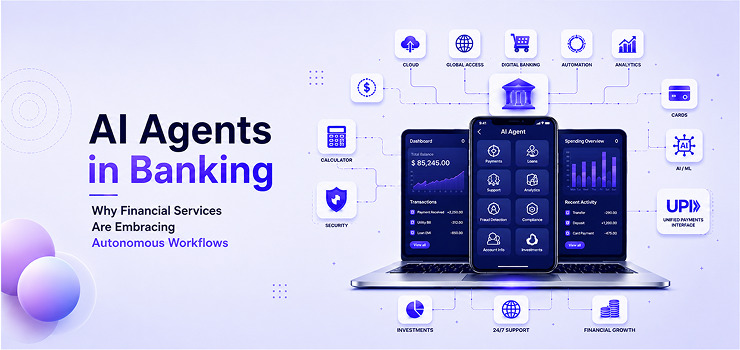
TL;DR
• Automates lending, fraud detection, compliance, and customer support.
• Improves efficiency and personalizes customer experiences.
• Streamlines loan processing and back-office operations.
• Enhances fraud detection with real-time AI insights.
• Supports secure, compliant banking with human oversight.
• Powers the future of autonomous banking with AI agents.
The banking industry is entering a new era of artificial intelligence. While AI has already transformed fraud detection, credit scoring, and customer support, financial institutions are now adopting AI agents to automate complex workflows and improve decision-making across the organization.
Unlike traditional chatbots or AI assistants that respond to individual queries, AI agents can execute multi-step tasks, interact with multiple banking systems, analyze large volumes of financial data, and make context-aware decisions with minimal human intervention. From onboarding new customers and processing loans to detecting fraud and managing compliance, these intelligent systems are becoming an essential part of modern banking operations.
The business case for AI agents is becoming increasingly compelling. According to Kore.ai, global fraud losses exceed $190 billion annually, while compliance teams spend up to 42% of their budgets investigating false positives and performing manual reviews. At the same time, a leading U.S. regional bank using AI agents handled more than 2.6 million customer sessions and over 5 million minutes of automated voice interactions annually without increasing customer support headcount. These outcomes highlight why financial institutions are moving beyond simple automation toward autonomous AI-driven workflows.
As banks continue their digital transformation, AI is becoming a strategic investment rather than an experimental technology. If you’re exploring how artificial intelligence is reshaping the financial sector, check out our guide on AI in FinTech to discover the latest trends, use cases, and opportunities driving innovation across modern financial services.
What Are AI Agents in Banking?
AI agents are intelligent software systems capable of understanding context, retrieving information, interacting with multiple applications, and completing end-to-end workflows independently. They combine technologies such as generative AI, machine learning, natural language processing (NLP), and workflow automation to perform tasks that traditionally required multiple employees and disconnected systems.
Unlike rule-based automation, AI agents can reason through complex scenarios, adapt to changing inputs, and collaborate with both employees and customers. Rather than simply answering a customer’s question, an AI agent can verify identity, retrieve account information, analyze transaction history, initiate service requests, and provide personalized recommendations within a single interaction.
This enables banks to improve productivity while delivering faster and more consistent customer experiences.
Why Financial Services Are Adopting Autonomous Workflows
Banks process millions of transactions, customer requests, compliance checks, and operational activities every day. Managing these processes manually is expensive, time-consuming, and prone to errors.
Several factors are accelerating AI adoption across the financial services industry:
- Rising customer expectations for instant, personalized service
- Increasing fraud and cybersecurity threats
- Complex regulatory and compliance requirements
- Growing operational costs
- Large volumes of financial and customer data
- Pressure to improve productivity without increasing workforce size
Autonomous workflows allow banks to automate repetitive processes while enabling employees to focus on strategic decision-making, customer relationships, and high-value financial services.
Key Use Cases of AI Agents in Banking
1. Intelligent Customer Support
AI agents are transforming customer service by providing personalized, 24/7 assistance. They can authenticate customers, answer account-related questions, process service requests, explain financial products, dispute transactions, and escalate complex cases when necessary.
Unlike traditional chatbots, AI agents maintain context throughout the conversation, reducing customer effort and improving resolution times.
2. Loan Processing and Credit Assessment
Loan approvals involve document verification, financial analysis, risk assessment, and compliance checks.
AI agents automate much of this workflow by collecting required documents, validating applicant information, analyzing credit history, identifying missing data, and preparing recommendations for loan officers. This reduces processing times while improving consistency and operational efficiency.
3. Fraud Detection and Risk Management
Fraud prevention remains one of banking’s highest priorities.
AI agents continuously monitor transaction patterns, customer behavior, login activity, and device information to detect suspicious activity in real time. When unusual behavior is identified, the system can temporarily pause transactions, notify customers, request additional verification, or escalate the case to fraud investigators.
This proactive approach helps reduce financial losses while strengthening customer trust.
4. Compliance and Regulatory Reporting
Financial institutions operate under strict regulatory frameworks, making compliance both essential and resource-intensive.
AI agents help automate Know Your Customer (KYC) checks, Anti-Money Laundering (AML) monitoring, transaction screening, audit preparation, and regulatory reporting. By continuously monitoring transactions and generating accurate documentation, AI reduces manual workloads while improving compliance accuracy.
5. Personalized Financial Advisory
AI agents analyze customer spending patterns, investment portfolios, savings goals, and financial behavior to deliver personalized recommendations.
For example, they can recommend investment opportunities, identify refinancing options, suggest budgeting improvements, or notify customers about unusual spending activity. Rather than replacing financial advisors, AI enhances advisory services with data-driven insights that support more meaningful customer interactions.
6. Back-Office Operations
Many of banking’s most repetitive tasks occur behind the scenes.
AI agents streamline customer onboarding, document verification, payment reconciliation, invoice processing, workflow approvals, and account maintenance. Automating these activities improves operational efficiency while reducing manual errors and processing delays.
7. Employee Productivity
AI agents also serve as intelligent assistants for banking employees.
They help staff retrieve internal policies, summarize customer histories, search enterprise knowledge bases, generate reports, and automate administrative work. This allows relationship managers, compliance officers, and operations teams to focus on complex decision-making instead of repetitive tasks.
Benefits of AI Agents in Banking
The adoption of AI agents delivers measurable business value across financial institutions.
Improved customer experiences through faster responses and personalized interactions.
Greater operational efficiency by automating repetitive workflows and reducing manual effort.
Enhanced fraud prevention through continuous monitoring and real-time risk detection.
Stronger regulatory compliance with automated reporting, transaction monitoring, and audit support.
Lower operating costs by improving productivity across customer service, operations, and compliance.
Smarter decision-making through AI-powered insights generated from large volumes of financial and operational data.
Together, these benefits enable banks to improve agility while delivering secure, customer-centric financial services.
Challenges Financial Institutions Must Address
Despite its advantages, implementing AI agents requires careful planning.
Banks must protect sensitive financial data through strong cybersecurity measures, encryption, and regulatory compliance. AI recommendations should remain transparent and explainable, particularly for lending decisions, fraud investigations, and financial advice.
Integration with legacy banking systems is another challenge, as many institutions still rely on decades-old infrastructure. Additionally, successful adoption depends on employee training and governance frameworks that ensure AI complements human expertise rather than replacing it.
The Future of AI in Banking
The future of Banking AI lies in collaborative, multi-agent systems capable of managing entire financial workflows.
Instead of relying on a single AI application, banks will deploy specialized AI agents that work together. One agent may verify customer identity, another assess credit risk, another monitor transactions for fraud, while another prepares regulatory documentation. Together, these agents create intelligent workflows that improve speed, accuracy, and scalability.
AI agents will also play an increasingly important role in wealth management, treasury operations, insurance, investment services, and enterprise risk management. As generative AI continues to mature, financial institutions will move beyond automation toward autonomous operations that deliver personalized customer experiences while maintaining strong governance and regulatory compliance.
The banking industry is part of a broader shift toward autonomous AI systems capable of collaborating across complex business workflows. To learn more about how AI agents are evolving beyond financial services, explore our article on Multi-Agent AI Systems, which explains how multiple AI agents work together to automate enterprise operations and decision-making.
Conclusion
AI agents are redefining how banks operate by enabling autonomous workflows that improve efficiency, strengthen compliance, and enhance customer experiences. Unlike traditional automation tools, these intelligent systems can coordinate end-to-end processes across customer service, lending, fraud detection, compliance, and back-office operations.
As financial institutions continue their digital transformation, AI agents will become strategic assets rather than experimental technologies. Organizations that invest in responsible AI adoption today will be better positioned to reduce operational complexity, improve decision-making, and meet the evolving expectations of customers in an increasingly competitive financial landscape.
Frequently Asked Questions
1. What are AI agents in banking?
AI agents are intelligent software systems that automate complex banking workflows such as customer service, loan processing, fraud detection, compliance, and account management using generative AI, machine learning, and workflow automation.
2. How are AI agents different from chatbots?
Traditional chatbots primarily answer questions, while AI agents can execute multi-step workflows, interact with multiple banking systems, analyze financial data, and make context-aware decisions with minimal human intervention.
3. What are the benefits of AI agents for financial institutions?
They improve operational efficiency, enhance customer experiences, strengthen fraud prevention, automate compliance, reduce operational costs, and support faster, data-driven decision-making.
4. Can AI agents replace banking employees?
No. AI agents are designed to automate repetitive and data-intensive tasks while supporting employees in making strategic, customer-focused, and regulatory decisions.
5. What is the future of AI in banking?
The future involves autonomous, multi-agent AI systems that collaborate across departments to streamline operations, improve risk management, personalize financial services, and deliver more efficient banking experiences.
Frequently Asked Questions
What are AI agents in banking?
AI agents are intelligent software systems that automate complex banking tasks such as customer support, fraud detection, loan processing, and compliance using AI technologies like machine learning and generative AI.
How are AI agents different from chatbots?
Unlike chatbots that answer simple queries, AI agents can complete multi-step workflows, interact with banking systems, and make context-aware decisions with minimal human intervention.
What are the benefits of AI agents for banks?
AI agents improve operational efficiency, reduce costs, strengthen fraud detection, automate compliance, and deliver faster, more personalized customer experiences.
Are AI agents secure for financial services?
Yes. When deployed with strong security, encryption, and regulatory controls, AI agents help banks protect sensitive financial data while supporting compliance requirements.
What is the future of AI in banking?
The future lies in autonomous, multi-agent AI systems that streamline operations, improve decision-making, enhance customer service, and support secure digital banking at scale.
