
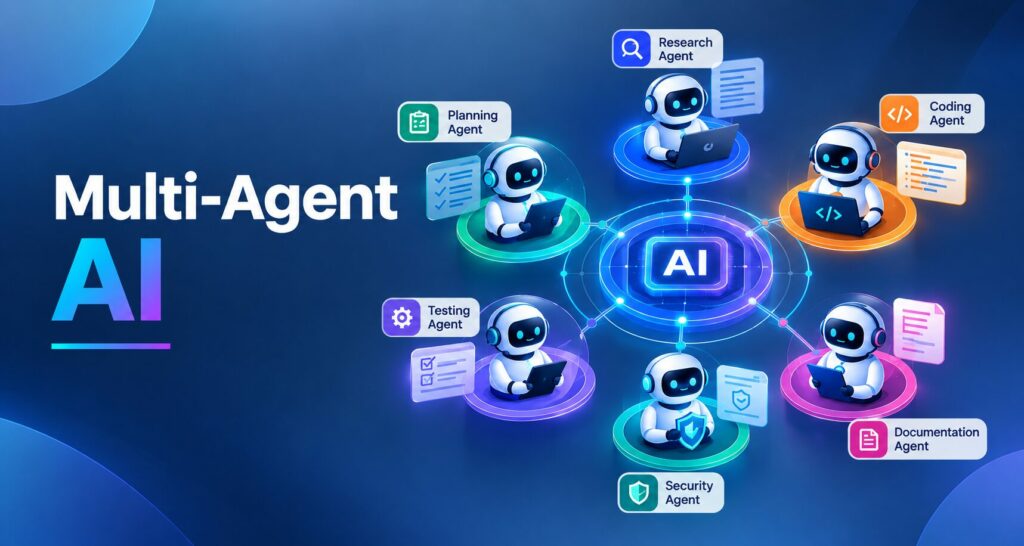
Multi-Agent AI
TL;DR
• Multi-Agent AI uses multiple AI agents to solve complex tasks.
• Each agent handles a specific responsibility.
• Agents collaborate by sharing information and coordinating tasks.
• Common architectures include supervisor, sequential, parallel, and swarm.
• Applications include software development, customer service, research, and automation.
• Key challenges include cost, coordination, security, and accuracy.
• Start with a clear goal and use multiple agents only when needed.
Artificial intelligence is moving beyond systems that simply answer questions or generate content. A new approach enables multiple AI agents to collaborate, divide responsibilities, exchange information, and work toward a shared objective. This approach is known as Multi-Agent AI.
From software development and business automation to research and customer service, multi-agent systems can help organizations tackle tasks that require several different skills. Instead of relying on a single AI model to handle every step, businesses can build a coordinated team of specialized AI agents.
But how does Multi-Agent AI work? What makes it different from traditional AI automation, and when should businesses use it?
This guide explains the fundamentals of multi-agent systems, their architecture, practical applications, advantages, limitations, and future potential.
What Is Multi-Agent AI?
Multi-Agent AI is an artificial intelligence approach in which multiple AI agents collaborate to complete a complex task or achieve a shared goal. Each agent can have a specific responsibility, set of instructions, tools, and level of autonomy.
For example, an AI-powered business research system might use one agent to gather information, another to analyze competitors, a third to identify market opportunities, and a final agent to prepare a report.
The agents work as a coordinated team rather than functioning as completely separate tools. Depending on the architecture, they may operate sequentially, work in parallel, or exchange feedback to improve their results.
A multi-agent system typically includes:
- Specialized AI agents: Individual agents assigned specific tasks.
- An orchestration layer: A coordinator that delegates work and manages execution.
- Communication mechanisms: Methods for exchanging information and task results.
- Shared context or memory: Information that helps agents maintain consistency.
- Tools and integrations: APIs, databases, software applications, and other resources.
- Evaluation mechanisms: Checks that assess quality, accuracy, and task completion.
These components allow multiple agents to contribute their capabilities to a larger workflow.
How Do Multi-Agent AI Systems Work?
Multi-agent systems generally follow a structured process that transforms a broad objective into smaller, manageable tasks. The precise workflow depends on the application, but the following steps illustrate a common approach.
1. Understand the Goal
The process starts when a user or business system provides a goal. For example, a company might ask an AI system to research a new market and prepare a competitor analysis.
A coordinating agent interprets the request, identifies the required outcomes, and determines which tasks need to be completed.
2. Break the Task Into Smaller Responsibilities
The coordinator divides the main objective into subtasks. A market research workflow might require data collection, competitor analysis, customer research, and report preparation.
Each responsibility is assigned to an appropriate agent based on its capabilities and available tools.
3. Assign Tasks to Specialized AI Agents
Every agent performs a defined role. A research agent may collect relevant information, while an analysis agent identifies patterns and a writing agent organizes the findings.
Specialization helps keep complex workflows manageable. Agents can also use different models, instructions, or tools when the application requires them.
4. Exchange Information and Collaborate
Agents share findings through messages, shared state, or other communication mechanisms. One agent’s output can become another agent’s input.
Some systems allow agents to work simultaneously, while others require one agent to finish before the next begins. The workflow determines how information moves between them.
5. Review and Improve the Results
A reviewer or evaluator agent can examine the output for missing information, contradictions, formatting issues, or other quality problems.
If the result does not meet predefined requirements, the system can request corrections or repeat selected steps. This process continues until the output meets the defined criteria or reaches a stopping limit.
6. Deliver the Final Result
Finally, the coordinator combines the relevant outputs into a report, recommendation, completed workflow, or other deliverable.
Human approval may be required before sensitive actions, such as modifying production systems, sending external communications, or approving financial transactions.
A Practical Example: Multiple AI Agents Working as a Team
Imagine a software company wants to develop a new customer-support application. The project involves research, planning, development, testing, and documentation.
A Multi-Agent AI system could organize the work as follows:
| AI agent | Responsibility |
| Research agent | Studies customer needs and competing products. |
| Planning agent | Converts requirements into features and development tasks. |
| Coding agent | Generates or modifies code for approved requirements. |
| Testing agent | Checks functionality and identifies defects. |
| Security agent | Reviews potential security weaknesses. |
| Documentation agent | Prepares technical documentation and user guides. |
| Coordinator agent | Assigns tasks, tracks progress, and consolidates results. |
The coordinator manages dependencies between tasks. For example, the testing agent may need to wait until a working code component is available. If a defect is identified, the coding agent can receive a correction request before testing resumes.
This example demonstrates how AI agents collaborating on complex tasks can support a workflow that requires multiple capabilities. However, the agents still need clear instructions, suitable permissions, reliable context, and measurable acceptance criteria.
Common Multi-Agent AI Architecture Patterns
Not every multi-agent system needs the same structure. Developers can select an architecture according to task complexity, coordination requirements, and business objectives.
1. Supervisor-Based Architecture
A supervisor agent manages the workflow and delegates subtasks to specialized agents. It collects their outputs and decides what should happen next.
This pattern is useful when a process needs centralized coordination, clear task ownership, and consistent reporting.
2. Sequential Agent Workflow
Agents complete tasks in a predefined order. One agent’s output becomes the input for the next agent.
For example, a research agent gathers information, an analysis agent evaluates it, and a reporting agent produces the final document.
Sequential workflows work well when tasks depend on the results of earlier steps.
3. Parallel Agent Workflow
Multiple agents work on independent subtasks simultaneously. Their results are combined after the tasks finish.
A business intelligence system might ask separate agents to analyze customer feedback, sales performance, and market trends at the same time.
Parallel execution can reduce waiting time, provided the tasks can be performed independently and the system has sufficient resources.
4. Collaborative or Swarm Architecture
Agents exchange ideas, critique results, or hand work to other agents as the task evolves. Coordination may be distributed rather than controlled entirely by one supervisor.
This pattern can support exploratory research and problems that benefit from multiple perspectives. However, it can also introduce additional communication overhead and make behavior harder to predict.
The right architecture depends on the problem. A straightforward workflow may only need one agent, while a complex process involving independent specialties may benefit from multiple agents.
Key Benefits of Multi-Agent AI
Improved Task Specialization
A multi-agent system allows individual agents to focus on specific responsibilities rather than handling every part of a problem through one general-purpose workflow.
This can make system design more modular and easier to maintain.
Better Support for Complex Workflows
Some business processes involve research, reasoning, data processing, decision support, and reporting. Dividing the work into manageable stages can make these processes easier to organize.
Parallel Processing
When subtasks are independent, multiple agents can work simultaneously. This can improve turnaround time, although coordination and model latency may reduce the overall benefit.
Flexible System Design
Developers can add, replace, or improve individual agents without necessarily redesigning the entire application. A company could introduce a compliance-review agent or improve its reporting agent as requirements evolve.
Opportunities for Quality Control
A dedicated evaluation agent can review outputs produced by other agents. Independent checks may help identify errors that would otherwise go unnoticed, although an AI reviewer can also make mistakes.
Business Process Automation
Multi-agent systems can coordinate activities across business applications, databases, and APIs. With appropriate safeguards, they can support workflows that involve several dependent steps rather than a single automated action.
Real-World Applications of Multi-Agent AI
1. Customer Service and Support
Customer service systems can use different agents to classify incoming requests, retrieve relevant knowledge, troubleshoot problems, and prepare responses.
A human representative can handle escalations or cases that require judgment, empathy, or special authorization.
2. Software Development and Testing
AI agents can assist with requirement analysis, code generation, test creation, debugging, documentation, and code review.
For production software, developers should retain code review, testing, access controls, and deployment approval rather than assuming agent-generated code is automatically safe.
3. Business Research and Decision Support
Research agents can collect information from approved sources, analysis agents can compare findings, and reporting agents can present the results in a structured format.
This can help teams prepare market assessments and business reports more efficiently, provided the information is verified.
4. E-Commerce and Retail
A multi-agent system might coordinate product recommendations, inventory analysis, customer inquiries, order-status checks, and demand forecasting.
Agents can work with business data and operational tools, but actions involving orders, refunds, or customer records should follow strict authorization rules.
5. Financial Operations
Specialized agents can help organize financial documents, categorize transactions, detect unusual patterns, and prepare reports for human review.
Financial decisions and regulated activities require appropriate controls, traceability, privacy protections, and expert oversight.
6. Healthcare Administration
Multi-agent workflows can assist with administrative tasks such as organizing documents, checking records for missing information, and routing requests to the appropriate team.
Clinical decisions, sensitive patient data, and high-impact recommendations require rigorous validation and appropriate professional oversight.
Multi-Agent AI vs. Single-Agent AI
A single-agent system uses one primary agent to perform a task, potentially with access to several tools. A multi-agent system distributes responsibilities across multiple agents that coordinate their work.
| Feature | Single-agent AI | Multi-agent AI |
| Structure | One primary agent | Multiple cooperating agents |
| Task allocation | Managed by one agent | Distributed across agents |
| Specialization | Roles handled within one workflow | Roles can be assigned to separate agents |
| Coordination | Usually simpler | Requires agent communication and orchestration |
| Operational cost | Often lower | Can be higher due to additional model calls |
| Best suited for | Focused, manageable tasks | Complex tasks with distinct responsibilities |
Multi-agent AI is not automatically better. A single agent may be faster, cheaper, and easier to evaluate for a straightforward task. Multiple agents are most useful when specialization, parallel execution, or independent review offers a meaningful advantage.
Challenges and Limitations of Multi-Agent Systems
Despite their potential, multi-agent systems introduce technical and operational challenges.
Higher operating costs: Multiple agents may require additional model calls, infrastructure, storage, and monitoring.
Coordination complexity: Agents can misunderstand instructions, produce incompatible outputs, or become stuck in repeated handoffs.
Error propagation: An incorrect result from one agent can affect several downstream tasks.
Security and privacy risks: Agents connected to business systems may expose sensitive information or perform unauthorized actions if permissions are poorly designed.
Evaluation difficulties: A workflow can appear successful while producing incomplete or incorrect results. Testing individual agents is not enough; the entire workflow must also be evaluated.
Unpredictable behavior: Agents may make unexpected tool calls, repeat tasks, or reach different conclusions across runs.
Businesses can manage these risks through least-privilege permissions, clear role definitions, bounded execution, logging, output validation, budget limits, and human approval for consequential actions.
How Businesses Can Get Started With Multi-Agent AI
Organizations considering multi-agent systems should begin with a specific business problem rather than adding agents simply because the technology is available.
- Identify a suitable workflow. Choose a process that involves multiple distinct tasks or capabilities.
- Establish measurable objectives. Define success using metrics such as accuracy, completion time, cost, and error rate.
- Start with a simple architecture. Test whether one agent can solve the problem before introducing additional agents.
- Define agent responsibilities. Specify each agent’s inputs, outputs, tools, permissions, and boundaries.
- Choose an orchestration approach. Decide whether the workflow should be sequential, parallel, supervisor-based, or collaborative.
- Test realistic scenarios. Include incomplete information, incorrect outputs, tool failures, and unexpected user requests.
- Monitor and improve. Track performance, operational costs, reliability, and security after deployment.
For organizations exploring these capabilities, AI development and custom software engineering can be relevant starting points for assessing integration requirements and building tailored solutions. The appropriate implementation depends on the organization’s existing systems, data, security needs, and expected return on investment.
The Future of Multi-Agent AI
Multi-Agent AI is an important direction in the evolution of agentic AI. As tools for orchestration, agent communication, evaluation, and system integration mature, businesses may be able to automate more complex workflows involving several applications and specialized capabilities.
Interoperability will also matter. Standards and protocols designed for agent-to-agent communication and agent-to-tool integration can help systems exchange information more consistently, although compatibility and security still require careful engineering.
The future will not necessarily belong to systems with the largest number of agents. Practical success will depend on assigning the right tasks to the right agents, coordinating them reliably, and proving that the system delivers measurable value.
For many organizations, the best approach is to start with a focused use case, validate the results, and expand only when additional agents improve performance enough to justify the added complexity.
Conclusion
Multi-Agent AI is transforming how artificial intelligence can support complex tasks by enabling multiple specialized agents to work together toward a shared goal. From software development and customer service to business research, e-commerce, and workflow automation, these systems offer opportunities to improve task coordination, flexibility, and productivity. However, successful implementation requires more than simply adding multiple AI agents.
Businesses must define clear responsibilities, establish reliable communication, protect sensitive data, and evaluate the accuracy and performance of the entire workflow. Human oversight also remains essential for sensitive decisions and high-impact actions.
Organizations should begin with a specific business problem, measure the results, and introduce additional agents only when they provide clear benefits. With thoughtful planning, strong security controls, and continuous monitoring, Multi-Agent AI can become a valuable part of modern business operations.
Frequently Asked Questions
What is Multi-Agent AI in simple terms?
Multi-Agent AI is a system in which multiple AI agents work together to complete a task. Each agent can handle a particular responsibility, share information, and contribute to a combined result.
How do AI agents communicate with each other?
AI agents can exchange messages, pass outputs between workflow stages, access shared memory, or communicate through APIs and orchestration frameworks. The communication method depends on the system architecture.
What is the difference between agentic AI and Multi-Agent AI?
Agentic AI refers to AI systems that can pursue goals through actions, tool use, and multi-step workflows. Multi-Agent AI is an approach that coordinates multiple agents. A system can be agentic without using multiple agents.
What are the main benefits of multi-agent systems?
Key benefits include task specialization, parallel processing, modular design, support for complex workflows, and opportunities for independent output review. Actual results depend on the implementation and task.
Can Multi-Agent AI automate business processes?
Yes. Multi-agent systems can coordinate activities such as research, document processing, customer support, and software testing. Sensitive or high-impact actions should use appropriate permissions, validation, monitoring, and human oversight.