
TL;DR
• AI startups are moving beyond chatbots
• Vertical AI targets specific industries
• Industry data creates a competitive edge
• AI automates real business workflows
• AI agents perform multi-step tasks
• Vertical AI improves business ROI
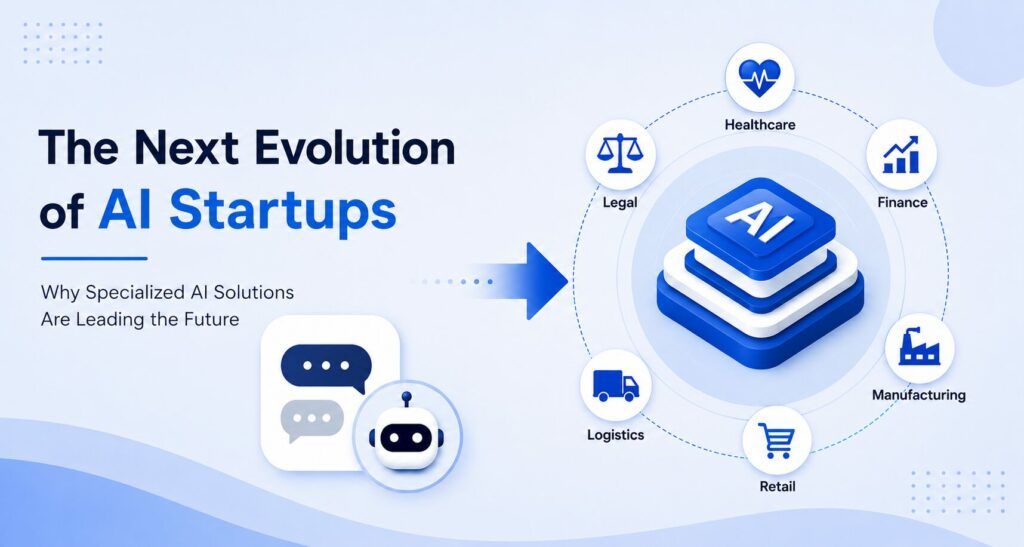
• Key sectors include Healthcare, Finance, Legal, Manufacturing & Logistics
• The future is AI agents + workflow automation
Artificial intelligence has entered a new stage of commercialization. The first major wave of enterprise AI was dominated by chatbots, generative AI assistants, and general-purpose tools capable of answering questions, generating content, summarizing information, and supporting customer service. These applications proved that AI could become a mainstream business technology.
AI startups are increasingly focusing on Vertical AI solutions specialized AI products designed for particular industries, professions, workflows, and business problems. Instead of creating an AI assistant that can theoretically serve everyone, startups are building solutions specifically for healthcare providers, financial institutions, law firms, manufacturers, logistics companies, retailers, and other specialized sectors.
This evolution reflects a broader shift in what businesses expect from AI. Enterprises are no longer interested only in AI that can generate an impressive answer. They want technology that can understand their industry, work with their existing systems, automate complex processes, comply with regulations, and deliver measurable business outcomes.
At the same time, the broader AI ecosystem is expanding beyond purely digital experiences. MarketsandMarkets highlights the growing movement from software-based AI toward robotics and Physical AI, where AI systems interact with real-world environments across manufacturing, logistics, agriculture, healthcare, and infrastructure.
What Is Vertical AI?
Vertical AI refers to artificial intelligence solutions built specifically for a particular industry, profession, or business function.
Traditional or horizontal AI platforms are designed for a broad audience. A general-purpose chatbot can answer questions about marketing, programming, education, travel, finance, or countless other topics.
A Vertical AI platform, by contrast, is designed around a specific domain.
For example:
- A healthcare AI platform can assist with clinical documentation and patient workflows.
- A legal AI platform can analyze contracts and legal documents.
- A financial AI platform can support compliance and financial analysis.
- A manufacturing AI solution can optimize production and predictive maintenance.
- A logistics AI platform can optimize routes, inventory, and warehouse operations.
- An insurance AI platform can support claims processing and underwriting.
This specialization allows AI startups to combine foundation models with proprietary data, industry knowledge, business rules, integrations, and workflow automation.
For businesses researching this transition, the recent analysis on Vertical AI companies and industry-specific AI solutions provides additional context on why specialized AI is becoming
increasingly important.
From Chatbots to Business Outcomes
The popularity of ChatGPT demonstrated how powerful conversational AI could be. Businesses quickly adopted chatbots for customer support, content generation, internal knowledge access, marketing, and productivity.
But conversational capability alone has limitations.
A chatbot can answer a customer’s question, but a business may actually need an AI system to:
- Understand the customer’s request.
- Retrieve information from internal systems.
- Validate the information.
- Make a decision based on business rules.
- Update a CRM or ERP.
- Trigger another workflow.
- Notify the appropriate employee.
- Monitor the result.
This is where the next generation of AI solutions becomes more valuable.
The evolution from chatbots to AI agents represents an important step because AI systems are increasingly expected to perform actions rather than simply provide responses. Yellow.ai notes that enterprise AI is moving toward systems capable of reasoning, orchestration, and execution across business processes.
For startups, this means the opportunity is shifting from “build a better chatbot” to “solve a valuable business problem with AI.”
Why AI Startups Are Choosing Vertical Markets
1. Generic AI Is Becoming Increasingly Competitive
One of the biggest reasons startups are moving toward Vertical AI is competition.
The general-purpose AI market already includes powerful foundation models and large technology companies. Building another generic chatbot can be difficult to differentiate because customers can access increasingly capable AI assistants from multiple providers.
Startups therefore need a stronger competitive advantage.
Specialization provides one.
A startup that develops an AI platform specifically for insurance claims, for example, can focus on the industry’s terminology, regulations, workflows, documents, integrations, and customer requirements.
2. Industry-Specific Data Creates a Stronger Advantage
Data is one of the most important assets in AI development.
General-purpose models are trained to understand broad information. Vertical AI companies can build systems around highly specialized datasets and domain knowledge.
Consider a legal AI platform. Its advantage may not come from having a larger language model. Instead, its value could come from:
- Legal terminology
- Contract databases
- Regulatory information
- Case-related documentation
- Legal workflows
- Enterprise document systems
- Specialized retrieval systems
The same principle applies to healthcare, finance, manufacturing, logistics, and other industries.
Industry-specific data can help a startup create a product that is more relevant to a particular customer segment.
3. Businesses Want AI That Fits Existing Workflows
Another reason for the shift is integration.
Businesses rarely operate through standalone applications. They use CRM systems, ERP platforms, accounting software, communication tools, databases, cloud platforms, and specialized enterprise applications.
A chatbot that operates separately from these systems may have limited business value.
Vertical AI platforms can be designed around the workflows businesses already use.
For example, an AI system for a logistics company could connect with:
- Warehouse management systems
- Fleet management software
- Transportation management systems
- Inventory databases
- Customer portals
- Delivery tracking platforms
Instead of simply answering “Where is my shipment?”, the AI could retrieve the shipment information, identify delays, contact the relevant team, update records, and provide the customer with an actionable response.
This is the difference between AI as a conversational interface and AI as an operational layer.
4. Vertical AI Can Deliver Measurable ROI
Businesses ultimately need to justify technology investments.
A generic chatbot may improve user engagement, but executives increasingly want measurable results such as:
- Reduced processing time
- Lower operational costs
- Increased employee productivity
- Faster customer response
- Higher conversion rates
- Reduced errors
- Improved compliance
- Increased revenue
Vertical AI is well positioned to demonstrate these outcomes because it is built around specific business processes.
For example, an AI solution designed for invoice processing can be evaluated based on processing time and error reduction.
A healthcare documentation platform can be evaluated based on administrative workload.
A legal AI platform can be evaluated based on document review time.
This makes AI automation solutions for enterprises easier to connect with business KPIs.
5. AI Agents Are Strengthening the Vertical AI Model
The rise of AI agents is another major factor behind the transition.
Traditional chatbots generally followed predefined conversation flows. Modern AI agents can combine large language models, tools, memory, retrieval, APIs, business rules, and workflow orchestration.
This allows them to perform multi-step tasks.
For example, an AI agent for a sales organization could:
- Analyze incoming leads.
- Research customer information.
- Score the lead.
- Update the CRM.
- Draft a personalized email.
- Schedule a meeting.
- Notify the sales representative.
A Vertical AI startup can take this concept further by building agents specifically for a particular profession or industry.
This creates opportunities for AI agent development , enterprise AI automation, and AI-powered workflow automation.
The Role of Proprietary Workflows
One of the biggest potential advantages of Vertical AI is workflow specialization.
A general AI model understands language and broad concepts. A vertical platform understands how a particular business process works.
For example, an AI system for insurance could understand:
Claim submitted → documents collected → policy verified → claim assessed → fraud indicators checked → approval/rejection workflow → customer notification.
The AI is not simply answering questions. It is embedded into the operational process.
This workflow knowledge can become an important competitive moat.
As more startups enter the AI market, owning the workflow—and not just access to a foundation model—can become increasingly important.
Vertical AI Across Major Industries
- Healthcare
Healthcare is one of the strongest areas for specialized AI because the industry contains large volumes of complex information and highly specialized workflows.
Potential applications include:
- Clinical documentation
- Medical coding
- Patient engagement
- Appointment management
- Healthcare analytics
- Drug discovery
- Administrative automation
- Finance and Banking
Financial organizations can use Vertical AI for:
- Fraud detection
- Risk assessment
- Compliance monitoring
- Customer service
- Financial document analysis
- Loan processing
- Investment research
Because finance involves sensitive data and strict regulatory requirements, specialized AI systems can provide greater control than generic tools.
- Legal Services
Legal AI is another rapidly developing category.
AI systems can assist with:
- Contract analysis
- Legal research
- Document review
- Case preparation
- Compliance monitoring
- Legal knowledge management
The opportunity is particularly attractive because legal workflows involve large volumes of structured and unstructured information.
- Manufacturing
Manufacturing presents opportunities for AI-powered:
- Predictive maintenance
- Quality inspection
- Demand forecasting
- Production optimization
- Supply-chain management
- Computer vision
- Robotics
The broader AI market is increasingly connecting software intelligence with physical operations. MarketsandMarkets notes that advances in computer vision, edge computing, sensors, and AI processors are helping intelligent robots operate across industries.
- Logistics and Supply Chain
Logistics companies can use Vertical AI for:
- Route optimization
- Demand forecasting
- Warehouse automation
- Inventory management
- Shipment tracking
- Delivery prediction
- Fleet optimization
These applications can directly influence operating costs and customer experience.
Vertical AI vs. Generic Chatbots
| Feature | Generic Chatbots | Vertical AI Solutions |
| Target audience | Broad | Specific industry or profession |
| Knowledge | General | Domain-specific |
| Workflows | Limited | Specialized |
| Integrations | General-purpose | Industry-focused |
| Business objectives | Broad productivity | Specific KPIs |
| Data | General datasets | Proprietary/domain data |
| Compliance | Generic controls | Industry-specific requirements |
| ROI measurement | Often difficult | Easier to connect to workflows |
| Competitive advantage | Model/interface | Data + workflow + domain expertise |
The shift does not mean chatbots are disappearing.
Instead, chatbots are becoming one component of larger AI platforms.
A Vertical AI product may still have a conversational interface, but behind that interface can be retrieval systems, AI agents, workflow engines, APIs, databases, analytics, and industry-specific rules.
The Business Model Opportunity for AI Startups
Vertical AI also creates attractive opportunities for new business models.
Instead of charging users simply for chatbot access, startups can build subscription or usage-based platforms around business outcomes.
Potential models include:
- AI-as-a-Service
Businesses pay a recurring subscription to access specialized AI capabilities.
- Usage-Based AI
Customers pay based on documents processed, transactions completed, tasks executed, or AI agent activity.
- AI Automation Platforms
Companies pay to automate specific business processes.
- Outcome-Based Pricing
AI providers charge according to measurable outcomes, such as completed claims or successfully processed applications.
- Enterprise Licensing
Large organizations purchase customized AI platforms with advanced security, integrations, and governance.
These models allow startups to move closer to the economic value created by their technology.
Challenges of Building Vertical AI Solutions
Despite the opportunity, Vertical AI is not easy to build.
- Domain Expertise
Founders need a deep understanding of the industry they are targeting.
- Data Access
High-quality industry-specific data can be difficult to acquire, clean, and govern.
- Regulatory Requirements
Industries such as healthcare and finance have strict compliance requirements.
- Integration Complexity
Connecting AI to legacy enterprise systems can require significant engineering effort.
- Accuracy and Reliability
Businesses cannot tolerate hallucinations or unreliable recommendations in high-stakes workflows.
- Customer Acquisition
Selling specialized enterprise AI often requires industry relationships and longer sales cycles.
These challenges can actually become advantages for successful startups because they create barriers to entry.
Why This Matters for AI Development
For companies planning to build specialized AI products, choosing the right technology architecture is becoming just as important as choosing the right market.
A modern AI development company can help businesses combine:
- Large language models
- Machine learning
- Retrieval-augmented generation
- AI agents
- APIs
- Cloud infrastructure
- Data pipelines
- Knowledge bases
- Enterprise integrations
- Security and governance
For readers interested in broader developments across artificial intelligence, automation, emerging technologies, and enterprise innovation, AI Tech Updates can serve as a complementary technology resource.
What the Future Holds for Vertical AI Startups
The next stage of AI is likely to be less about asking, “Which chatbot should we use?” and more about asking, “Which business processes can AI fundamentally improve?”
That distinction is important.
The AI ecosystem is moving toward systems that can understand context, interact with enterprise software, make decisions, execute tasks, and operate within specialized environments.
At the same time, AI is expanding into physical operations. MarketsandMarkets projects strong growth in AI robotics and highlights applications across manufacturing, healthcare, logistics, agriculture, and other sectors.
This suggests that the future of AI may consist of several interconnected layers:
Foundation Models → Vertical Intelligence → AI Agents → Business Workflows → Physical/Real-World Automation
AI startups that understand this progression may have better opportunities to create defensible products.
Final Thoughts
The shift from chatbots to Vertical AI solutions is not simply another AI trend. It reflects a fundamental change in how businesses evaluate artificial intelligence.
Chatbots proved that people were ready to interact with AI.
Generative AI proved that machines could produce useful content and information.
AI agents are demonstrating that AI can perform multi-step tasks.
Vertical AI is taking the next step by embedding these capabilities directly into specific industries and business processes.
The startups most likely to stand out will not necessarily be the ones with the most impressive chatbot demos. They may be the companies that understand a particular industry better than anyone else and use AI to solve a problem that directly affects revenue, cost, productivity, compliance, or customer experience.
For businesses, the opportunity is equally significant. Instead of adopting AI simply because it is popular, organizations can identify high-value workflows and build specialized AI systems around them.
The future of AI may therefore be less about one AI for everyone and more about the right AI for every industry, workflow, and business problem.
FAQs
What is Vertical AI?
Vertical AI refers to AI solutions designed specifically for a particular industry, profession, or business function rather than for a general audience.
Why are AI startups moving away from chatbots?
AI startups are moving beyond generic chatbots because businesses increasingly want AI systems that can execute workflows, integrate with enterprise software, use specialized data, and deliver measurable business outcomes.
What is the difference between Vertical AI and Generative AI?
Generative AI describes AI capable of creating content such as text, images, audio, or code. Vertical AI focuses on applying AI capabilities to a specific industry or specialized business problem.
Are chatbots becoming obsolete?
No. Chatbots are still useful for conversational interfaces and customer service. However, they are increasingly becoming one component of broader AI platforms that include agents, workflow automation, enterprise integrations, and specialized intelligence.
Why is industry-specific data important for Vertical AI?
Industry-specific data helps AI systems understand specialized terminology, workflows, regulations, documents, and business requirements. It can also help companies create more differentiated products.