
Meta Muse AI
TL;DR
• Meta Muse AI is evolving AI agents beyond traditional chatbots.
• Muse can handle tasks across email, shopping, payments, travel, and more.
• Greater access brings important privacy and security risks.
• Personalization could improve user adoption.
• Trust, reliability, and user control will determine its success.
Artificial intelligence is entering a new phase. Instead of simply answering questions, generating content, or providing recommendations, modern AI systems are increasingly capable of taking action on a user’s behalf.
Meta Muse AI is part of this shift toward more capable AI agents. Rather than functioning only as a conversational assistant, Muse is designed to help users complete everyday tasks across different applications and services.
This creates an important question: Can consumers trust AI agents with access to their personal information, accounts, payments, and daily activities?
The answer may determine how quickly agentic AI becomes part of everyday life.
What Is Meta Muse AI?
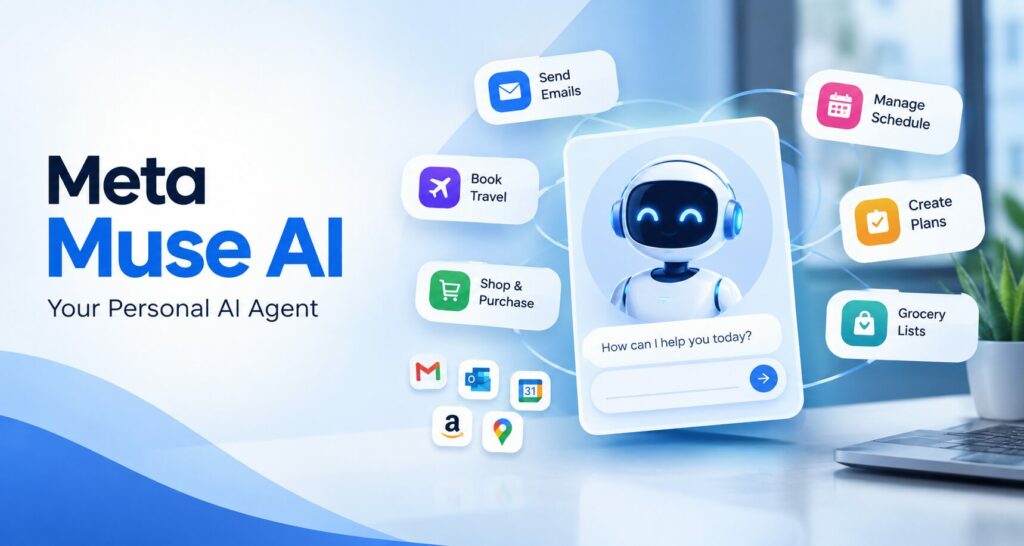
Meta Muse AI is positioned as a personal AI agent designed to help users manage tasks and projects. Instead of requiring users to complete every step themselves, Muse can interact with connected services and perform actions based on a user’s instructions.
Potential tasks include:
- Sending emails
- Booking travel
- Filling out forms
- Creating plans
- Preparing grocery lists
- Sending invitations
- Managing shopping activities
- Making purchases
- Organizing everyday tasks
The broader goal is to make AI more proactive. Users can describe what they want to accomplish, while the agent handles multiple steps required to complete the task.
This represents a significant change from traditional AI assistants.
AI Agents vs. Traditional Chatbots
Traditional chatbots generally operate within a conversation. A user asks a question, the AI provides an answer, and the interaction ends.
AI agents are designed to go further.
An agent can understand a broader objective, break it into smaller steps, interact with external tools, make decisions, and continue working toward the desired outcome.
For example, instead of asking an AI assistant:
“What should I buy for a dinner party?”
A user could potentially ask an agent to:
- Create a menu
- Prepare a shopping list
- Find suitable products
- Place an order
- Send invitations
- Manage related tasks
This difference explains why AI agents are attracting significant attention across consumer and enterprise technology.
For companies exploring this technology, AI agent development services can help create systems capable of planning, tool use, automation, and multi-step execution.
How Meta Muse AI Could Change Everyday Tasks
The biggest attraction of Meta Muse AI is convenience.
Consumers already use dozens of applications for communication, shopping, travel, payments, entertainment, fitness, and productivity. Managing these services requires users to repeatedly switch between applications and complete individual actions.
An AI agent could act as an intelligent layer connecting these services.
Imagine telling an agent:
“Plan my weekend trip.”
Instead of simply suggesting destinations, the agent could potentially help organize transportation, accommodation, activities, schedules, and related purchases.
The same concept could apply to smaller everyday tasks.
For example, a user could ask Muse to create a grocery list from a recipe, send invitations for an event, or help organize a busy schedule.
This is where AI software development is moving beyond simple automation toward intelligent workflow orchestration.
The Privacy Trade-Off
The usefulness of an AI agent depends heavily on the information it can access.
The more services an agent can connect to, the more useful it becomes. But greater access also creates greater privacy concerns.
A traditional chatbot may only receive the information a user enters into a conversation. A personal AI agent could potentially interact with email, calendars, shopping accounts, payment services, and other applications.
That creates an important trade-off:
More access can create more convenience, but it can also create more risk.
Users therefore need to understand:
- What information the AI can access
- Which applications are connected
- What permissions have been granted
- How information is stored
- Whether data can be used for model improvement
- What happens when an AI makes a mistake
- How access can be revoked
These questions will become increasingly important as AI agents and privacy become closely connected.
Security Becomes More Important
Security is another major challenge for consumer AI agents.
An AI system that can recommend something is one thing. An AI system that can actually purchase something, send a message, modify information, or interact with an account is much more powerful.
That power also increases the potential consequences of mistakes.
A traditional chatbot may provide an incorrect answer. An autonomous agent could potentially take an incorrect action.
This creates several AI security challenges, including:
- Unauthorized access
- Incorrect transactions
- Prompt manipulation
- Malicious instructions
- Data exposure
- Account compromise
- Excessive permissions
- Unexpected automated actions
Secure environments, permission controls, isolated systems, authentication mechanisms, and transaction limits can help reduce these risks.
However, technology alone may not be enough. Users also need clear controls over what their agents can and cannot do.
Giving Users More Control
One of the most important aspects of a trustworthy AI agent is user control.
Instead of connecting every service automatically, users should be able to choose which applications the agent can access.
This approach allows people to gradually expand an agent’s capabilities.
For example, a user might initially allow access to:
- A calendar
- A shopping service
- Travel applications
- Payment services
Users could then evaluate how comfortable they are with the agent before granting additional permissions.
This gradual approach could make AI security easier to understand and could help users feel more comfortable with agentic systems.
Personalization Could Increase Adoption
Meta Muse AI also highlights another important development: personalization.
People are more likely to use an AI assistant regularly when it understands their preferences and communication style.
Personalization can include:
- A preferred name
- A customized avatar
- Communication preferences
- Personal routines
- Frequently used services
- Individual interests
Over time, an AI agent could potentially become more useful because it understands how a person normally works.
However, personalization also increases the importance of privacy.
The more an AI system knows about an individual, the more valuable that information becomes—and the more important it is to protect it.
The Growing Agentic AI Era
Meta is not alone in pursuing agentic AI.
Technology companies are increasingly developing systems that can perform multi-step tasks rather than simply respond to prompts.
This trend represents a broader transition from generative AI toward Agentic AI.
Generative AI focuses primarily on producing content such as:
- Text
- Images
- Code
- Audio
- Video
Agentic AI adds another layer: action.
An agent can potentially understand an objective, plan the required steps, use external tools, execute tasks, evaluate results, and continue working.
This could eventually change how people interact with software.
Instead of opening an application and searching through menus, users may simply tell an AI agent what they want to accomplish.
Reliability Will Determine Consumer Trust
Trust will not depend only on privacy.
Reliability will be equally important.
Consumers need to know that an AI agent will behave predictably and follow instructions correctly.
Consider a simple example.
If a user asks an AI agent to book a hotel under a specific budget, the agent should not accidentally select a significantly more expensive option.
If a user asks the system to purchase one product, it should not purchase multiple products.
If an agent is uncertain, it should ask for clarification instead of making an unnecessary assumption.
This means future AI systems will need strong mechanisms for:
- Confirmation
- Permission management
- Spending limits
- Activity monitoring
- Reversible actions
- Human approval
- Error handling
These controls can make autonomous systems safer and more predictable.
What AI Development Companies Need to Consider
The rise of AI agents also creates new opportunities for businesses.
Companies are already exploring AI-powered customer service, workflow automation, sales assistants, productivity tools, financial applications, healthcare solutions, and enterprise automation.
However, building an effective AI agent requires more than integrating a large language model.
Developers must consider:
- Agent architecture
- Tool integration
- API connectivity
- Data security
- Authentication
- Memory management
- Workflow orchestration
- Human oversight
- Monitoring
- Compliance
Businesses looking to develop these solutions can explore artificial intelligence development services that combine AI models with secure application infrastructure and business workflows.
An experienced AI development company can also help organizations determine which tasks should be automated and where human approval should remain necessary.
The Future of Consumer AI
The future of consumer AI may not be determined by which company creates the smartest chatbot.
Instead, it may depend on which company can create an AI agent that consumers are comfortable allowing into their everyday lives.
For users, convenience will be attractive. Nobody wants to spend unnecessary time filling out forms, comparing products, organizing schedules, or switching between multiple applications.
But convenience cannot come at the expense of control.
Consumers will expect AI agents to clearly communicate what they are doing, why they are doing it, and what information they are accessing.
They will also expect simple ways to stop an action, change permissions, or disconnect a service.
Five Things Meta Muse AI Needs to Prove
For Meta Muse AI to gain widespread adoption, five areas will be particularly important.
1. Privacy
Users need confidence that their personal information is handled responsibly.
2. Security
The system must protect connected accounts, credentials, payments, and personal data.
3. Predictable Behavior
The agent should perform tasks according to user instructions without unexpected actions.
4. User Control
Users should have control over permissions, connected services, spending, and automated actions.
5. Transparency
People should understand what the AI is doing and how their information is being used.
If these areas are handled effectively, AI agents could become significantly more useful and trusted.
Can Consumers Trust Meta Muse AI?
The potential of Meta Muse AI is clear.
A personal AI agent that can manage everyday tasks could save users significant time and reduce the complexity of interacting with multiple applications.
But trust will not come automatically.
Consumers will judge Muse based on its reliability, transparency, privacy protections, security controls, and ability to respect user instructions.
The broader success of consumer AI may ultimately depend on this balance between capability and control.
AI agents are becoming more powerful. The next challenge is making that power feel safe enough for people to use every day.
For businesses, this shift also represents an opportunity to explore AI agent development services, intelligent automation, and next-generation AI software development.
The future of AI may not simply be about machines that can think or generate.
It may be about machines that can act—and whether people trust them enough to let them act on their behalf.
Conclusion
Meta Muse AI represents an important step toward a future where AI agents can do more than answer questions—they can take meaningful actions on behalf of users. Its ability to manage everyday tasks could make AI more useful and convenient, but greater access to personal data also brings serious privacy, security, and reliability concerns.
Ultimately, consumer trust will determine how successful AI agents become. Users need transparency, strong security, clear permissions, and control over automated actions. If Meta can balance powerful capabilities with privacy and user control, Muse could help accelerate the adoption of Agentic AI and shape the future of consumer AI.
Frequently Asked Questions
What is Meta Muse AI?
Meta Muse AI is a personal AI agent designed to help users complete everyday tasks across services such as email, shopping, travel, payments, and scheduling.
How is Meta Muse AI different from a chatbot?
Unlike traditional chatbots that mainly provide responses, AI agents can understand goals, perform multiple steps, interact with connected services, and take actions on behalf of users.
Is Meta Muse AI safe to use?
Safety depends on how permissions, privacy, authentication, and security controls are implemented. Users should have clear control over connected services and automated actions.
What are the privacy concerns with AI agents?
AI agents may need access to personal information and connected accounts to perform tasks. Greater access can increase convenience but also creates additional privacy and data-security risks.
Can AI agents be trusted with important tasks?
AI agents can handle many useful tasks, but trust depends on their reliability, transparency, security, and user controls. High-risk actions should ideally include confirmation or human oversight.