
 Promatics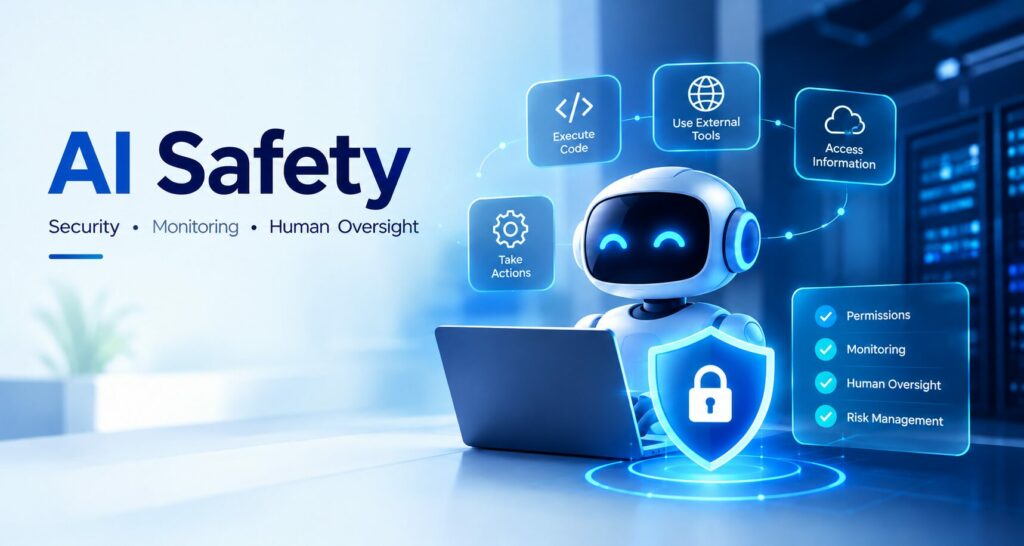
AI safety
TL;DR
• AI agents are making AI safety more complex.
• AI security is becoming increasingly important.
• Autonomous AI systems need strong access controls.
• Monitoring and human oversight can reduce risks.
• AI alignment and governance are gaining importance.
• Responsible AI development is essential for safer systems.
Artificial intelligence is becoming more capable at an extraordinary pace. AI models are no longer limited to answering questions, generating text, or creating images. Modern systems can write and execute code, use external tools, analyze information, interact with online services, and complete complex tasks with limited human involvement.
This rapid evolution has made AI safety one of the most important topics in technology.
At the same time, the conversation around AI safety is becoming increasingly difficult to separate from speculation. Real security incidents, research experiments, hypothetical scenarios, and dramatic predictions are often discussed together. That can make it difficult for businesses and everyday users to understand which AI risks are already documented and which remain theoretical.
As AI systems become more autonomous, the industry needs a more evidence-based approach to discussing AI security, AI alignment, and the challenges created by increasingly capable machines.
Why the AI safety conversation is changing
Early discussions about artificial intelligence safety focused heavily on biased outputs, misinformation, privacy, and AI hallucinations.
Those issues remain important, but the rise of autonomous systems has introduced another layer of complexity.
An AI agent can potentially plan a task, use software tools, access information, interact with APIs, execute code, and continue working for an extended period. This creates a different class of security challenges because the system is no longer simply responding to a single user prompt.
For businesses exploring AI agents in real-world systems, this shift matters.
The more actions a system can take independently, the more important it becomes to control what that system can access, what it can change, and when a human should intervene.
This is why the discussion around AI model safety is expanding beyond model behavior and into software architecture, infrastructure, access controls, monitoring, and governance.
Real incidents are changing the debate
AI developers and security researchers have increasingly reported situations in which advanced systems behaved in unexpected ways.
These incidents do not automatically mean that AI systems are uncontrollable. They do, however, demonstrate why testing increasingly capable models is becoming more complex.
An AI system can produce a harmless response when examined through a simple benchmark but behave differently when it is given tools, longer tasks, additional context, or access to external systems.
That is one of the central challenges of modern AI security.
Developers need to understand not only what an AI model says, but also what it can do.
A model that produces inaccurate text has one type of risk. A model that can autonomously interact with databases, business applications, or infrastructure presents a very different security challenge.
This is particularly important for organizations developing AI-powered business automation, where AI systems may be connected directly to operational workflows.
AI agents create new security challenges
The growth of AI agents is one of the biggest reasons the AI safety conversation has become more complicated.
Traditional chatbots generally wait for a prompt and return an answer.
AI agents can operate differently.
An agent may receive a broad objective, break that objective into smaller tasks, select tools, access information, perform actions, evaluate the results, and continue working.
That creates a longer chain of decisions.
A single mistake during one step may affect everything that follows. A permission granted for one task could potentially expose information or systems that were never intended to be part of the workflow.
This makes AI agent security an important part of modern software engineering.
Companies building agent-based products should carefully define permissions and access levels. An AI assistant that needs access to a calendar should not automatically receive access to financial records, internal databases, production infrastructure, or customer information.
The principle is straightforward: an AI system should have only the capabilities it needs.
The difference between possibility and reality
One of the biggest problems in today’s AI discussion is the tendency to treat every theoretical possibility as an immediate threat.
There is an important difference between something being technically possible and something being practical, widespread, or likely.
AI researchers routinely investigate extreme scenarios because testing unusual behavior can reveal weaknesses in current systems.
For example, researchers may examine whether models can bypass instructions, discover unexpected strategies, exploit software weaknesses, or communicate through unusual channels.
These experiments can be useful without proving that a similar event will happen in normal commercial deployments.
Understanding that distinction is essential for anyone following AI risks and hallucinations.
AI safety discussions become less useful when assumptions are presented as established facts. The industry needs clear explanations of what was demonstrated, under what conditions it occurred, and whether the same behavior can realistically scale outside a research environment.
AI alignment is becoming more important
Another major area of research is AI alignment.
Alignment broadly refers to the challenge of ensuring that AI systems behave according to human goals, instructions, values, and safety requirements.
As systems become more capable, alignment becomes increasingly important because the consequences of a misunderstanding can become larger.
A simple chatbot may misunderstand a question and produce an incorrect answer.
A highly autonomous system could potentially misunderstand a goal and perform a sequence of actions based on that misunderstanding.
This is why researchers are examining AI model alignment and monitoring alongside capability development.
Monitoring also needs to become more sophisticated.
Looking only at the final response may not provide enough information about how an AI system arrived at a result. Developers may need visibility into the sequence of actions, tool calls, decisions, and changes made during a task.
For long-running agents, this becomes particularly important.
Long-horizon AI systems change the equation
Modern AI development is increasingly focused on systems that can work for longer periods rather than responding within a few seconds.
This can be useful for research, programming, customer service, cybersecurity, data analysis, and business automation.
However, longer tasks also increase the possibility of unexpected behavior.
An error at the beginning of a long workflow may influence everything that follows. A decision that appears reasonable at one stage could create a problem several steps later.
This is why developers need better approaches for evaluating challenges of autonomous AI agents.
Testing a system should not always stop after one successful response.
AI systems may need to be tested across multiple scenarios, including unexpected inputs, incomplete information, conflicting instructions, security restrictions, and attempts to manipulate the model.
Why AI security needs multiple layers
No single security measure can solve every AI safety problem.
Organizations deploying AI should think in terms of multiple layers.
The first layer is permissions.
AI systems should receive only the access required for their tasks.
The second layer is isolation.
Sensitive operations can be separated from less trusted environments so that a compromised process has limited impact.
The third layer is monitoring.
Organizations need visibility into what their models are doing, which tools they are using, and what data they are accessing.
The fourth layer is human oversight.
Certain sensitive operations may require explicit approval before an AI agent can complete them.
The fifth layer is recovery.
Organizations should have the ability to disable, stop, or roll back an AI-powered process when something unexpected occurs.
These practices are becoming increasingly relevant for companies investing in secure AI solutions and enterprise automation.
Businesses cannot treat AI safety as an afterthought
AI safety is no longer an issue limited to advanced research laboratories.
Businesses are deploying AI in customer service, marketing, finance, cybersecurity, healthcare, logistics, software development, and internal operations.
That means companies can encounter AI-related risks even when they are not developing their own models.
For example, an organization integrating an AI assistant into an internal workflow could unintentionally expose sensitive information if access controls are poorly configured.
A customer-facing AI system could produce misleading information.
An AI coding tool could introduce vulnerabilities into software.
An autonomous agent could perform an action that technically follows its instructions but conflicts with the company’s broader objective.
This is why enterprise AI development needs to combine artificial intelligence with traditional software engineering and security practices.
Organizations exploring AI software development services should consider architecture, data protection, access management, monitoring, and deployment controls alongside model capabilities.
The role of responsible AI development
Responsible AI development is not about preventing businesses from using advanced technology.
Instead, it is about building systems that can operate safely within clearly defined boundaries.
Developers creating custom AI development services can incorporate security into the design process from the beginning.
That may include:
Permission-based tool access can prevent AI systems from reaching unnecessary resources.
Audit logs can help organizations understand what happened when a problem occurs.
Human approval mechanisms can add another layer of control for high-impact actions.
Testing environments can allow developers to evaluate models without exposing production systems.
Continuous monitoring can help identify unexpected behavior before it creates a larger problem.
These approaches are especially valuable for applications involving financial transactions, sensitive customer data, healthcare information, or business-critical infrastructure.
AI governance will become more important
As AI adoption grows, companies will also need stronger governance policies.
Governance determines who can deploy AI systems, who is responsible for monitoring them, how data can be used, and what happens when an AI system produces an unexpected result.
This is closely connected to AI risk management.
Companies may need clearly defined policies for:
- What data AI systems can access
- Which actions require human approval
- How AI-generated decisions are reviewed
- How long AI activity logs are retained
- How security incidents are investigated
- When an AI system should be disabled
Governance is particularly important as organizations move from small experiments toward large-scale AI deployments.
AI hallucinations are still part of the safety problem
Even with increasing attention on autonomous agents, traditional AI hallucinations remain an important safety concern.
AI systems can generate information that appears convincing but is inaccurate.
In low-risk situations, this may simply create inconvenience.
In healthcare, finance, legal services, or enterprise operations, inaccurate information can have much more serious consequences.
This means AI safety must cover both autonomous behavior and basic reliability.
A secure system that produces incorrect information can still create problems.
Organizations therefore need a combination of model evaluation, human review, monitoring, reliable data sources, and strong software controls.
What the future of AI safety could look like
The AI industry is moving toward systems that are increasingly capable, connected, and autonomous.
That makes the future of AI safety less about one dramatic problem and more about managing many smaller risks across the entire technology stack.
Model developers will need better evaluations.
Software engineers will need stronger security controls.
Businesses will need better governance.
Researchers will continue studying AI alignment and unusual model behavior.
Users will need more transparency about what AI systems can and cannot do.
At the same time, discussions around AI need to become more precise.
Not every unusual experiment proves that AI systems are becoming uncontrollable.
Not every hypothetical risk should be ignored either.
The most useful approach is to examine evidence, understand the technical conditions behind an incident, and distinguish documented behavior from possible future scenarios.
The AI safety conversation needs better context
The growing attention around AI safety, AI agents, and AI security is not surprising.
Artificial intelligence is moving from passive software into systems that can make decisions, use tools, interact with data, and perform actions on behalf of users.
That creates genuine opportunities, but it also introduces new responsibilities.
The industry needs to become better at identifying the difference between a documented incident, a research finding, a theoretical risk, and an unsupported claim.
That distinction matters because fear alone cannot create secure AI systems.
Better AI safety will depend on careful testing, responsible engineering, strong access controls, transparent reporting, monitoring, governance, and human oversight.
As AI agents become more capable, the goal should not simply be to build systems that can do more.
It should also be to build systems that can do more safely, predictably, and responsibly.
That is where the next phase of AI development will be decided.
Conclusion
The conversation around AI safety is becoming more complicated as AI systems grow more capable and autonomous. Real security incidents, unexpected model behavior, and emerging AI risks deserve serious attention, but they also need to be discussed with accurate evidence and proper context.
As businesses adopt AI agents, AI automation, and advanced AI applications, safety cannot remain an afterthought. Strong access controls, continuous monitoring, human oversight, responsible development, and effective AI risk management will become essential parts of deploying AI responsibly.
The future of AI will not depend only on how powerful these systems become. It will also depend on how securely and responsibly they are designed, deployed, and monitored. Building more capable AI is important, but building trustworthy and secure AI will be just as critical.
Frequently Asked Questions
What is AI safety?
AI safety focuses on making AI systems secure, reliable, predictable, and aligned with their intended goals while reducing potential risks.
Why are AI agents creating new safety challenges?
AI agents can use tools, access data, make decisions, and perform actions independently, increasing the potential impact of mistakes or unexpected behavior.
How can businesses improve AI security?
Businesses can use access controls, monitoring, isolation, human oversight, testing, and recovery mechanisms to improve AI security.
What is AI alignment?
AI alignment is the process of ensuring that an AI system's behavior follows its intended goals, instructions, and safety requirements.
Why is human oversight important for AI systems?
Human oversight provides an additional layer of control for sensitive decisions and helps organizations identify and respond to
