
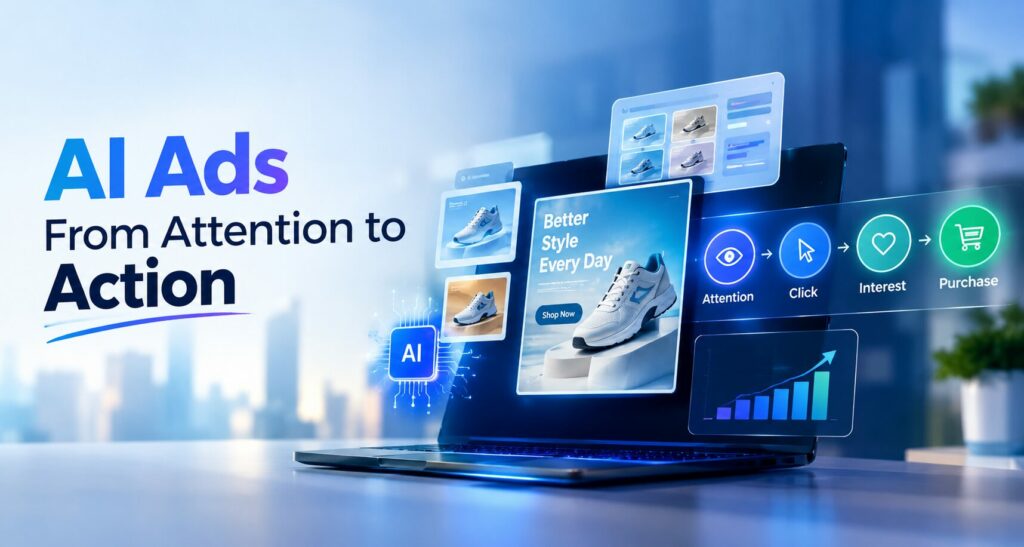
AI-generated ads
TL;DR
• AI is making advertising creative faster and easier to produce.
• More impressions and clicks do not automatically mean more sales.
• Personalization works best when it provides genuine relevance.
• Too much similar AI content can contribute to creative fatigue.
• Human strategy remains important for originality, trust, and brand positioning.
• Advertisers should measure conversions, profitability, and customer value beyond CTR.
Artificial intelligence is changing advertising at a speed that would have seemed unrealistic only a few years ago. Brands can now generate images, videos, headlines, product variations, audience segments, and campaign assets in minutes rather than waiting days or weeks for traditional production cycles.
But faster production creates a new question for marketers: Can AI-generated ads turn attention into action?
Getting an advertisement seen is only one stage of the customer journey. A campaign may generate millions of impressions, strong engagement, impressive click-through rates, and high levels of interaction without necessarily producing more purchases, qualified leads, or long-term customers.
This distinction is becoming increasingly important as generative AI becomes part of mainstream advertising workflows. Google, for example, is introducing new AI-powered advertising formats and tools designed to help brands create and deliver more relevant commercial experiences. Its advertising products increasingly use AI across creative production, targeting, search, and campaign optimization.
For marketers, the challenge is no longer simply creating more advertising. It is creating advertising that remains relevant, credible, distinctive, and persuasive.
AI has solved much of the advertising production problem
Traditional advertising production can involve multiple stages. A marketing team may need a creative brief, copywriter, designer, photographer, video editor, agency review, brand approval, and platform-specific adaptation before a campaign is ready.
Generative AI compresses many of these steps.
A single product concept can be transformed into dozens of visual variations. A campaign can be adapted for different audiences, locations, formats, and stages of the customer journey. AI can also help marketers generate alternative headlines, descriptions, product backgrounds, video concepts, and calls to action.
This matters because digital advertising increasingly depends on experimentation.
Instead of producing one or two creative concepts and waiting for campaign results, advertisers can test many variations and identify which combinations attract attention.
The commercial value of this approach is already visible in real-world campaigns.
An Amazon Ads case study involving Indian appliance brand Usha reported a 2.4x increase in branded searches, a 36% increase in ad-driven page views, and a 32% improvement in return on advertising spend after using AI-powered image generation as part of a broader full-funnel campaign. The campaign also reported more than 50% quarter-over-quarter sales growth. However, the campaign included targeting and other advertising changes, meaning the results cannot be attributed to AI-generated creative alone.
The example illustrates an important point: AI can contribute to commercial performance, but its impact depends on how it is integrated into the larger marketing strategy.
More clicks do not automatically mean more customers
One of the biggest misconceptions surrounding AI-generated advertising is the assumption that better engagement automatically means better business performance.
It does not.
Consider the typical advertising funnel:
Impression → Attention → Click → Interest → Consideration → Conversion → Purchase → Retention
AI can potentially improve several early stages of this journey. It can create more visual variations, personalize messages, optimize targeting, and identify patterns in campaign data.
But the final stages are more complicated.
A consumer may click an advertisement because the image is attractive. They may watch a video because the opening seconds are engaging. They may visit a website because the product looks interesting.
None of those actions guarantee a purchase.
Conversion depends on factors such as price, product quality, trust, brand reputation, customer reviews, convenience, competition, timing, and the consumer’s actual need.
This is why marketers need to move beyond surface-level engagement metrics.
CTR can tell a business whether people clicked. ROAS can indicate the revenue attributed to advertising spend. But neither metric alone provides a complete picture of incremental sales, profitability, customer lifetime value, or brand loyalty.
AI-generated advertising can attract attention without creating preference
Recent research is adding another layer to this discussion.
A September 2026 working paper from researchers at Columbia Business School examined more than 16 billion display advertising impressions and 116 million clicks across more than two million ad-day observations and thousands of advertisers.
The researchers found that display advertisements using AI-generated images could achieve higher click-through rates than ads using human-generated images, but the advantage depended on the AI images not visibly appearing to be stereotypically AI-generated.
This finding is significant because it challenges the idea that simply labeling something as “AI-generated creative” tells us whether it will perform well.
The quality of the execution matters.
An AI-generated image that looks artificial, repetitive, overly saturated, or disconnected from the product may quickly become recognizable as synthetic content. On the other hand, an AI-assisted image that looks natural and fits the brand’s visual identity may attract attention without creating the same perception of artificiality.
In other words, AI is a production technology, not a substitute for creative judgment.
The danger of creating too much content
Generative AI makes content creation dramatically easier.
That is both its advantage and its problem.
When creating an advertisement requires significant time and money, marketers naturally limit the number of campaigns and variations they produce.
When AI reduces the cost of production, businesses can create hundreds or thousands of variations.
The result can be creative overload.
Consumers already encounter advertisements across search engines, social media, streaming platforms, websites, shopping applications, and mobile apps. Increasing the volume of advertisements does not necessarily increase the amount of attention available.
Instead, repetitive AI-generated creative may contribute to advertising fatigue.
A consumer who repeatedly sees similar AI-generated faces, backgrounds, product scenes, voices, and scripts may begin to ignore them.
The problem is therefore not necessarily too much AI. The problem is too much sameness.
Brands need AI to create meaningful variation rather than simply increasing the number of assets.
Personalization is useful only when it feels relevant
Personalization is another major opportunity for AI advertising.
AI systems can analyze customer signals and help advertisers tailor messages to different audiences.
For example, an e-commerce company could potentially show different creative to:
- A first-time visitor
- A returning customer
- Someone who abandoned a shopping cart
- A customer searching for a particular product
- A user comparing different product categories
- A customer who previously purchased a related product
Instead of showing the same advertisement to everyone, AI can help marketers create messages that reflect different stages of intent.
However, personalization can become counterproductive when it feels excessive or irrelevant.
Consumers do not necessarily want an advertisement that knows everything about them. They want an advertisement that gives them a useful reason to pay attention.
That difference is important.
Effective AI advertising should therefore focus on contextual relevance rather than personalization for its own sake.
Human creativity still has an important role
AI can generate the execution, but humans still need to determine what the advertisement should communicate.
The strongest advertising concepts often come from understanding culture, consumer behavior, emotional motivations, product positioning, and brand identity.
These are difficult to reduce to a simple prompt.
AI can generate ten versions of a product image. It can write ten headlines. It can produce multiple video concepts.
But the marketing team still needs to determine:
Which idea is worth producing?
That is where human creative strategy remains important.
A useful model for modern advertising is therefore not “AI versus humans.”
It is:
Human strategy + AI production + human judgment + AI optimization
The human side establishes the idea, audience, positioning, tone, and boundaries.
AI accelerates production and experimentation.
Performance data identifies what is working.
Humans then interpret those results and make strategic decisions.
AI advertising is moving closer to the point of action
The next stage of AI advertising may go beyond generating creative.
Advertising platforms are increasingly trying to connect discovery directly with commercial action.
Google’s 2026 advertising developments demonstrate this shift. The company has been testing new ad experiences in AI-powered Search designed to connect conversational discovery with relevant products and businesses. It has also expanded AI capabilities for generating advertising assets.
This suggests a broader transformation in digital advertising.
Traditional advertising often follows a sequence:
See ad → visit website → search product → compare options → purchase
AI-powered commercial experiences could increasingly compress this journey.
A consumer might ask an AI system about a product, receive recommendations, compare alternatives, see sponsored options, and potentially move toward a purchase without navigating the traditional advertising funnel.
That makes relevance even more important.
When AI becomes part of the discovery process, brands are not competing only for impressions. They are competing for inclusion in the consumer’s decision-making context.
Transparency will become more important
The increasing use of generative AI in advertising also creates questions about transparency.
Consumers may want to know whether an image, video, or other creative asset was generated or modified using AI.
Google introduced additional AI transparency features in 2026, including a “How this ad was made” panel designed to indicate when generative AI was used to create or edit advertising content. Google has also introduced controls related to AI-generated or modified advertising assets.
This is part of a broader shift toward transparency in synthetic media.
For brands, transparency is not simply a compliance issue. It can become part of trust management.
If consumers feel that an advertisement is misleading, overly manipulated, or disconnected from reality, strong engagement numbers may not translate into long-term brand value.
What marketers should measure beyond clicks
As AI increases the volume of creative testing, businesses need to improve the way they evaluate advertising.
Instead of relying on a single metric, marketers can examine the complete customer journey.
Important measurements include:
1. Attention
Measure impressions, viewability, video completion, engagement, and other indicators of whether consumers actually noticed the creative.
2. Intent
Look at product searches, landing-page engagement, repeat visits, product comparisons, and other signals that indicate genuine interest.
3. Conversion
Measure purchases, qualified leads, registrations, bookings, or other meaningful business outcomes.
4. Profitability
ROAS is useful, but businesses should also consider acquisition cost, margins, customer lifetime value, and incremental revenue.
5. Retention
A successful advertisement should ideally contribute to customers who return, repurchase, recommend, or continue engaging with the brand.
This framework helps distinguish activity from business value.
What the future of AI-generated advertising could look like
AI-generated advertising is unlikely to disappear. Instead, it will become increasingly integrated into the advertising technology stack.
Future campaigns may use AI to coordinate creative generation, audience analysis, media buying, testing, personalization, and optimization.
The creative process could become increasingly dynamic.
An advertisement might change its visual composition based on audience context. Headlines could adapt to search intent. Product demonstrations could be generated for different customer segments. Campaign systems could automatically identify underperforming variations and create new alternatives.
But the central challenge will remain the same.
Can the advertisement give consumers a compelling reason to act?
That question cannot be answered by impressions alone.
AI can make advertising faster.
AI can make advertising more scalable.
AI can make testing more efficient.
AI can help brands personalize campaigns and respond to changing customer behavior.
But AI does not automatically create trust, originality, product value, or emotional relevance.
Those elements still require strategy.
Conclusion: From attention to action
The advertising industry is entering a period in which creating content is becoming dramatically easier.
That changes the competitive landscape.
When every brand can generate high-quality images, videos, copy, and variations at scale, the advantage will not necessarily belong to the company producing the most content.
It may belong to the company that understands its audience most clearly and uses AI to turn that understanding into relevant experiences.
The real opportunity is therefore not simply AI-generated advertising.
It is AI-assisted advertising that connects attention with intent and intent with action.
Brands should use AI to accelerate creative production, test ideas, personalize experiences, and optimize campaigns. At the same time, they need human oversight to protect brand identity, originality, credibility, and strategic direction.
The future of advertising will not be measured by how much content AI can create.
It will be measured by what happens after someone sees it.
Because an impression is not a customer.
A click is not a conversion.
And attention is only valuable when it leads somewhere.
Frequently Asked Questions
What are AI-generated ads?
AI-generated ads are advertisements created or modified with artificial intelligence. AI can generate images, videos, copy, headlines, product scenes, and other creative assets.
Can AI-generated ads increase conversions?
They can contribute to higher conversions, but AI-generated creative does not guarantee better conversion rates. Performance depends on factors such as audience intent, creative quality, product value, targeting, and the overall campaign strategy.
Why can AI-generated ads get clicks without generating sales?
An advertisement can be visually interesting enough to attract a click without giving consumers enough motivation or trust to purchase. This creates a difference between attention metrics and conversion metrics.
Is AI replacing human advertising creatives?
AI is automating parts of the creative process, but human marketers continue to play an important role in strategy, storytelling, brand positioning, audience understanding, and creative decision-making.
How can businesses use AI effectively in advertising?
Businesses can use AI to generate creative variations, personalize campaigns, analyze performance, test messaging, optimize targeting, and speed up production while keeping human oversight over strategy and brand quality.