
Codex
TL;DR
• OpenAI Codex introduces reusable cloud development environments for AI coding tasks.
• Developers can prepare project environments once and reuse them across new cloud tasks.
• Codex tasks can continue running even when a developer’s computer is asleep.
• Developers can access and continue tasks across desktop, web, and mobile devices.
• Separate workspaces help keep individual coding tasks isolated from the reusable environment.
• Shared environments can help teams standardize tools, dependencies, and development workflows.
Artificial intelligence is changing software development from a task-by-task workflow into a more continuous, collaborative process. Developers no longer have to remain in front of a laptop to monitor every coding task, review changes, or guide an AI coding agent. The latest improvements to OpenAI Codex push this idea further by introducing reusable cloud development environments that can work across devices.
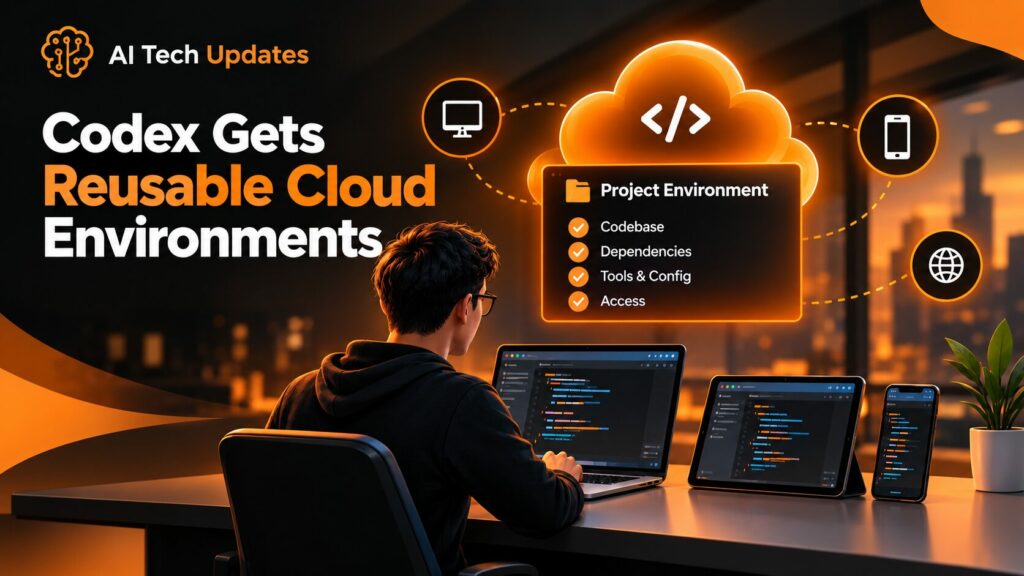
The new approach allows developers to prepare a project environment once and reuse that setup for different cloud coding tasks. Instead of rebuilding dependencies, tools, repositories, and configurations each time, developers can work from a prepared environment and continue tasks from desktop, web, or mobile devices.
This shift could make AI-assisted software development more flexible, particularly for teams working across multiple devices, distributed development environments, and long-running engineering projects.
What Are Reusable Codex Cloud Environments?
A cloud development environment provides the infrastructure an AI coding agent needs to work on a software project. This can include source-code repositories, development tools, dependencies, scripts, access settings, and other project-specific configurations.
Previously, cloud-based coding tasks could be treated more like individual remote sessions. The new Codex approach makes the environment itself reusable.
Developers can prepare an environment for a project, test the setup, and publish it. New cloud tasks can then use that prepared configuration rather than starting from scratch.
According to OpenAI’s current documentation, Codex Cloud runs coding tasks on OpenAI-managed computers. Once an environment has been prepared, developers can start and continue tasks from desktop, web, or mobile. Each task receives its own isolated workspace, helping separate working files and changes between tasks.
This creates an important distinction between the environment and the task. The environment acts as a reusable starting point, while individual tasks operate within their own workspace.
Why This Matters for AI Coding
Traditional software development is strongly connected to a developer’s physical or virtual machine. The machine contains the repository, dependencies, development tools, credentials, configurations, and other resources required to build the application.
That setup can become inconvenient when developers move between devices.
A developer might begin work on a desktop computer, check progress from a laptop, and later need to review a task from a smartphone. Recreating the same development setup on every device is inefficient.
Reusable cloud environments address part of this problem.
Instead of moving the entire development environment between devices, the developer can leave the coding workload in the cloud and access the task from supported devices.
This creates a more flexible model:
Prepare once → Start a task → Let Codex work → Review from anywhere → Continue when needed
For developers working with AI agents, this can be especially useful because coding agents increasingly perform work that takes longer than a typical chat interaction.
Coding Can Continue While the Laptop Is Closed
One of the most practical advantages of Codex Cloud is that cloud tasks can continue while a developer’s computer is asleep.
That changes how developers can organize their working day.
For example, a developer could start a debugging task before leaving the office. Codex can investigate the relevant code, make changes, and run tests in its cloud workspace while the developer is away. Later, the developer can open the task from another supported device and review the results.
OpenAI’s documentation confirms that cloud tasks can continue while the computer is asleep, while the same task can be reopened and continued across desktop, web, and mobile.
This is particularly relevant for long-running engineering tasks where the AI agent needs time to inspect code, execute tests, identify problems, or prepare changes.
The developer becomes less tied to the development machine and more focused on providing direction and reviewing results.
A More Flexible Multi-Device Development Workflow
The new Codex workflow also reflects a broader trend in software development: the development environment is becoming increasingly cloud-based.
Consider a typical workflow.
A developer starts a project on a desktop computer and asks Codex to investigate a performance issue. The cloud environment contains the required repository, tools, and dependencies.
Instead of waiting beside the computer, the developer can move to another task.
Later, they can check the progress from a phone or another computer. If Codex finishes the task, the developer can review the changes and test results. If additional instructions are needed, the developer can continue the same task.
This type of workflow makes AI coding more similar to project delegation than traditional autocomplete-based programming.
The AI agent handles portions of the execution while the developer remains responsible for decisions, verification, and final approval.
Reusable Environments Can Reduce Setup Work
Software projects often require complicated setup procedures.
A project may need a particular programming language, package manager, framework, database connection, testing tool, command-line utility, or build system. Teams can spend considerable time ensuring that these components are configured correctly.
A reusable environment can standardize much of this preparation.
Developers can configure the repositories, tools, dependencies, and access settings that Codex needs. Once the environment is tested and published, future tasks can start from that setup.
This can reduce repetitive configuration and help teams maintain a more consistent development workflow.
For organizations with multiple developers, standardized environments could also make AI-assisted coding easier to manage.
Instead of every developer configuring an AI coding environment independently, teams can establish approved configurations and make them available to authorized users.
OpenAI says enterprise environments can be shared with authorized workspace members, while access to the shared environment does not automatically give someone access to another user’s task or permission to edit the environment.
Isolation Is Still Important
Reusable environments do not mean that every task shares the same working directory.
Codex Cloud creates separate workspaces for individual cloud tasks. Changes made during one task do not automatically become changes to the reusable environment.
This separation is important for software engineering because developers may want to run several experiments without allowing unfinished changes to affect future tasks.
OpenAI’s documentation explains that an existing task keeps its own state, while updates to the published environment apply to new tasks.
This model provides a useful balance:
- The environment provides consistency.
- Individual tasks provide isolation.
- Developers can update the environment when project requirements change.
- Existing tasks can continue with their own state.
- New tasks can use the latest published configuration.
That structure could become increasingly important as companies use AI agents for more sophisticated engineering workloads.
Codex Is Expanding Beyond Simple Code Generation
The reusable environment update is part of a broader expansion of Codex.
At DevDay 2026, OpenAI announced several improvements around Codex, including a refreshed command-line interface, voice controls, a new code review experience, and security-focused capabilities.
The direction is significant.
AI coding tools started primarily as assistants that generated or explained code. Modern coding agents are moving toward systems that can investigate repositories, modify files, execute commands, run tests, review changes, and work on tasks with less continuous supervision.
The cloud environment becomes the infrastructure layer that allows these agents to perform longer-running work.
This makes the relationship between developer and AI agent more like manager and engineering assistant.
The developer defines the goal, constraints, and expected result. The agent performs parts of the implementation. The developer then reviews the output and decides what should happen next.
Codex Security Cloud Adds Another Layer
OpenAI is also expanding Codex into software security.
The company announced Codex Security Cloud, which is designed to scan GitHub repositories for vulnerabilities and investigate findings. It can also prepare potential fixes in the cloud. The workflow can operate on demand or on a recurring basis, meaning security analysis does not necessarily have to wait for a developer to manually initiate every review.
This is another example of why persistent cloud-based AI environments matter.
If AI agents can operate on software projects while developers are away from their computers, they can potentially support activities beyond coding itself.
Code review, security analysis, testing, dependency checks, debugging, and maintenance could increasingly become continuous AI-assisted processes.
However, human review remains important. Automated code changes should be tested and inspected before being merged into production systems.
What This Means for Development Teams
For development teams, reusable Codex environments could provide several practical advantages.
1. Less Repetitive Setup
Teams can establish project environments once instead of repeatedly configuring tools and dependencies.
2. Better Cross-Device Access
Developers can continue cloud tasks from supported computers, browsers, and mobile devices.
3. Longer-Running AI Tasks
Cloud execution allows Codex to continue working without keeping a developer’s laptop active.
4. More Consistent Team Workflows
Shared environments can provide standardized configurations for authorized team members.
5. Greater AI Agent Autonomy
With a prepared environment, Codex can perform more complex development tasks without requiring the developer to remain connected throughout the entire process.
These benefits point toward a future where software development is less dependent on a single machine.
Security and Governance Will Become More Important
The move toward autonomous cloud coding also creates new responsibilities.
A reusable development environment can contain access to repositories, services, dependencies, credentials, and other resources. That means organizations need clear policies around permissions and environment sharing.
OpenAI notes that connected repository permissions still matter even when an environment is shared. An environment does not replace the permissions associated with a developer’s connected GitHub account.
Organizations should therefore establish controls around:
- Repository access
- Cloud environment permissions
- Credentials and secrets
- Network access
- Environment sharing
- Code review
- Automated changes
- Production deployment
- Security testing
As AI agents become capable of taking more actions independently, governance becomes just as important as model capability.
The Bigger Shift: AI Development Becomes Continuous
The most important aspect of reusable cloud environments may not be the feature itself. It is the broader change in how developers interact with AI.
Instead of opening an AI coding tool only when they are sitting at their workstation, developers can delegate work to an agent and check back when their input is required.
That creates a continuous development loop.
Developer sets direction → AI investigates → AI implements → AI tests → Developer reviews → AI iterates
Cloud environments make this loop easier to maintain because the work does not have to remain tied to one physical computer.
This could eventually lead to software teams where AI agents handle multiple specialized tasks simultaneously while human developers focus on architecture, product decisions, security, quality, and complex problem-solving.
What Comes Next for AI-Powered Software Development?
Reusable Codex cloud environments represent another step toward more autonomous software engineering.
The technology is not simply about allowing developers to code from a phone. Its bigger significance is the separation of software development work from the developer’s physical device.
When repositories, dependencies, tools, permissions, and AI tasks can operate within reusable cloud environments, developers can interact with their projects from wherever they are.
The result is a development workflow that is more persistent, flexible, and agent-driven.
For startups and enterprises building modern applications, this trend also highlights the growing importance of cloud infrastructure, AI engineering, security, DevOps, and scalable software architecture.
As AI coding agents become more capable, the competitive advantage may increasingly come from how effectively companies integrate these agents into their existing development processes rather than simply which AI model they use.
Conclusion
OpenAI’s reusable cloud environments make Codex more than a coding assistant tied to a developer’s computer. They provide a foundation for cross-device, cloud-based AI software development, allowing developers to prepare environments once, launch isolated tasks, and continue their work from supported devices.
Combined with code review, voice controls, security scanning, and increasingly autonomous coding capabilities, Codex is moving toward a model where AI agents can take responsibility for larger portions of the software development lifecycle.
For developers, the biggest benefit may be simple: the work can keep moving even when they are not sitting at their desk.
For businesses, the larger opportunity is building development workflows where AI agents, cloud infrastructure, developers, and security systems work together continuously.
As this model matures, reusable environments could become an important building block for the next generation of AI-powered software engineering.
Frequently Asked Questions
What are OpenAI Codex reusable cloud environments?
OpenAI Codex reusable cloud environments are preconfigured development environments that developers can prepare once and reuse for multiple cloud-based coding tasks. They can include repositories, dependencies, tools, scripts, and project configurations.
Can Codex continue coding when my computer is turned off?
Yes. Codex Cloud tasks can continue running even when a developer’s computer is asleep, allowing AI coding agents to work on tasks without requiring the developer to remain connected.
Can developers access Codex tasks from different devices?
Yes. Developers can start and continue supported Codex Cloud tasks across desktop, web, and mobile devices, making AI-assisted development more flexible.
Are Codex cloud tasks isolated from each other?
Yes. Individual cloud tasks receive separate workspaces. Changes made during one task do not automatically modify the reusable environment used to start future tasks.
How could reusable Codex environments change software development?
Reusable environments can reduce repetitive setup, support longer-running AI coding tasks, improve cross-device workflows, and help teams standardize development environments. They could also enable AI agents to take on more continuous coding, testing, debugging, and security tasks while developers focus on review and decision-making.