
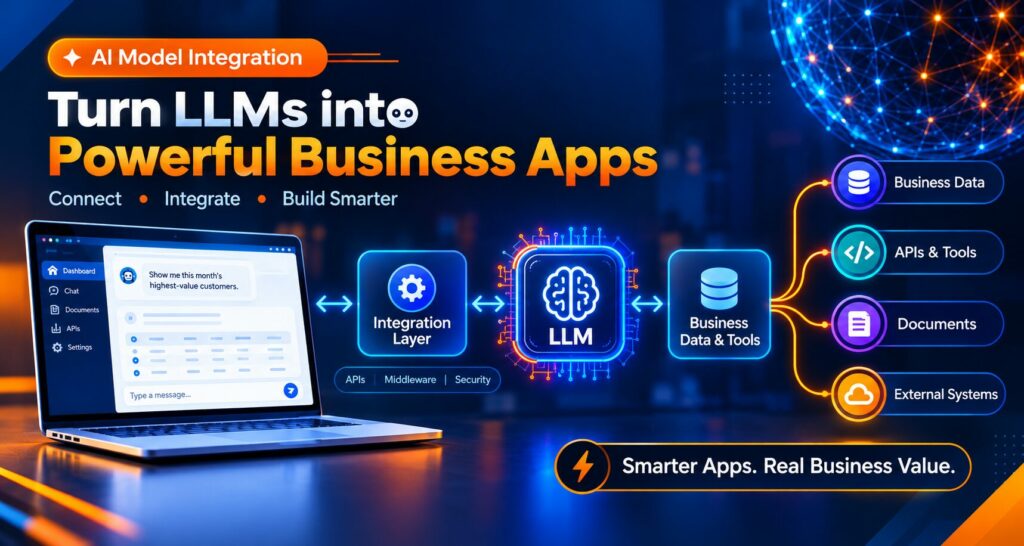
AI model integration
TL;DR
• AI model integration connects LLMs with existing business applications and workflows.
• Businesses can use APIs, databases, tools, and RAG to give AI access to relevant information.
• LLM integration can improve customer experiences, automate repetitive tasks, and make existing software smarter.
• Security requires access controls, data protection, input validation, output validation, and monitoring.
• A successful integration starts with the business problem and requires the right model, architecture, testing, guardrails, and ongoing improvement.
Artificial intelligence is moving beyond standalone chatbots and experimental tools. Businesses are increasingly integrating large language models (LLMs) directly into the applications, workflows, databases, and digital platforms they already use. This shift is making AI more practical because companies do not necessarily need to replace their existing software to benefit from generative AI.
AI model integration allows an organization to connect an LLM with an existing application through APIs, middleware, databases, business logic, retrieval systems, and external tools. Once connected, the model can understand natural-language requests, retrieve relevant information, generate content, summarize documents, classify data, answer customer questions, or even trigger actions inside business systems.
Modern model APIs can also use function calling to connect AI models with external systems and application-defined tools. This makes it possible for an AI assistant to retrieve information or perform actions rather than simply generate text.
For businesses, the result is a more intelligent software ecosystem where AI becomes part of existing operations instead of remaining an isolated technology experiment.
What Is AI Model Integration?
AI model integration is the process of connecting an artificial intelligence model, such as an LLM, to an existing software application or business environment.
Instead of creating an entirely separate AI product, developers add AI capabilities to software that employees or customers already use.
For example, an e-commerce company could integrate an LLM into its customer service platform. When a customer asks about an order, the AI does not have to guess the answer. It can use an application-defined function to retrieve order information from the company’s existing database and then generate a natural-language response.
Similarly, a healthcare application could use an LLM to summarize approved medical documents, while a financial platform could use AI to classify documents or explain financial information.
A typical architecture may look like:
User → Existing Application → AI Integration Layer → LLM → Business Data/Tools → Application
The integration layer is particularly important because it controls how information moves between the application and the AI model.
Why Are Businesses Integrating LLMs Into Existing Applications?
The biggest advantage is that businesses can add AI capabilities without rebuilding their entire technology stack.
Most organizations already have CRM platforms, ERP systems, customer portals, mobile applications, databases, internal dashboards, and workflow software. These systems contain valuable business data and processes.
AI integration connects intelligence to those existing resources.
1. Better Customer Experiences
Businesses can add conversational interfaces to websites, mobile applications, and customer portals.
Instead of navigating multiple menus, customers can ask questions naturally.
For example:
“Where is my order and when should I expect it?”
The AI can interpret the request, call an order-status function, retrieve the relevant information, and provide a concise response.
This type of workflow demonstrates why LLM integration is different from simply adding a chatbot. The model becomes connected to real application functionality.
2. Automation of Repetitive Work
LLMs can help automate tasks involving documents, emails, support tickets, reports, and other unstructured information.
For example, an application can use AI to:
- Classify incoming support requests
- Extract information from documents
- Summarize long reports
- Generate customer responses
- Categorize feedback
- Convert natural-language requests into structured data
- Create internal knowledge summaries
This allows employees to spend more time on complex work rather than repetitive processing.
3. Making Existing Software More Intelligent
Companies often do not need another application. They need their current software to become easier to use.
An AI model can provide a natural-language interface over existing functionality.
For example, an employee could type:
“Show me this month’s highest-value customers.”
Instead of manually navigating reports, the application could interpret the request, retrieve the appropriate information, and present the result.
This approach can make complex enterprise applications more accessible to nontechnical users.
How Does LLM Integration Work?
Although implementations differ between businesses, most LLM application integration projects contain several important components.
1. Existing Application
The existing application is where users interact with the AI functionality.
This could be:
- A web application
- Mobile application
- SaaS platform
- Customer support system
- Enterprise dashboard
- E-commerce platform
- Internal business software
The application sends the user’s request to the AI integration layer.
2. Integration Layer
The integration layer acts as a bridge between the application and the AI model.
It can handle:
- Authentication
- Prompt construction
- Data retrieval
- API requests
- Context management
- Tool calling
- Output validation
- Logging
- Security controls
This layer prevents the AI model from having unrestricted access to the application’s internal systems.
3. LLM API
The integration layer communicates with an LLM through an API.
Depending on the application, businesses can select different models based on factors such as:
- Accuracy
- Cost
- Response speed
- Context requirements
- Privacy
- Reasoning capability
- Structured output support
The model processes the request and determines what response or action is appropriate.
4. Business Data
An LLM becomes considerably more useful when it can access relevant business information.
However, businesses generally should not simply provide unrestricted access to all internal data.
Instead, applications can retrieve only the information required for a particular request.
For knowledge-intensive applications, this can involve retrieval-augmented generation (RAG), where relevant information is retrieved from an organization’s data sources and supplied to the model as context.
This allows businesses to build AI systems around proprietary information without necessarily retraining a model on every piece of company data.
5. Tools and APIs
Tool calling allows an AI model to interact with functions provided by the application.
For example, an application could expose functions such as:
- get_customer
- check_inventory
- get_order_status
- create_ticket
- schedule_meeting
- search_products
The model can determine when one of these functions is needed, while the application remains responsible for actually executing the operation.
OpenAI’s current developer documentation describes function calling as a mechanism for connecting models to application-defined tools and external systems.
The Role of Structured Outputs
One of the challenges with LLM integration is that traditional AI-generated text is not always predictable enough for software systems.
An application may require a specific structure such as:
{
“customer_name”: “…”,
“order_id”: “…”,
“status”: “…”,
“estimated_delivery”: “…”
}
If the model returns unexpected formatting, the application may struggle to process the result.
Structured Outputs address this problem by allowing developers to define a schema that the model should follow. OpenAI’s documentation distinguishes structured responses from function calling: structured outputs are useful when the application’s response itself needs to follow a defined format, while function calling is useful when the model needs to interact with tools or application functionality.
This is especially important for production applications where AI-generated information needs to flow into databases, dashboards, workflows, or other software components.
AI Integration With Existing Databases
Databases are another major part of enterprise AI integration.
Businesses may have years of information stored across:
- SQL databases
- NoSQL databases
- CRM systems
- ERP platforms
- Data warehouses
- Document repositories
- Cloud storage
An LLM should not automatically receive unrestricted database access.
Instead, developers can create controlled services that retrieve specific information based on the user’s request.
For example:
Customer → AI assistant → application API → database → application API → AI assistant → customer
The model interprets the request, while the application’s backend controls what data can be accessed.
This separation helps improve security, reliability, and governance.
RAG and AI Model Integration
Retrieval-augmented generation has become an important architecture for connecting LLMs with company-specific information.
Imagine an employee asks:
“What is our current remote-work policy?”
The answer may not exist in the model’s general knowledge.
A RAG system can search the company’s approved documents, retrieve the relevant policy, and provide that content to the LLM as context.
The model can then generate an answer based on the retrieved information.
This approach can be useful for:
- Internal knowledge assistants
- Customer support
- Technical documentation
- Product information
- Legal document search
- Employee portals
- Research platforms
The important principle is that retrieval and access control should remain part of the application’s architecture rather than relying on the model alone.
Security Challenges in LLM Integration
Integrating an AI model into business software also introduces new security considerations.
A poorly designed integration could expose sensitive information or allow inappropriate actions.
Businesses should consider:
Access Control
AI users should only be able to access information they are authorized to see.
Data Protection
Sensitive customer, financial, employee, or business information should be handled according to the organization’s security and compliance requirements.
Tool Permissions
An AI model should not automatically receive permission to perform high-impact operations.
A useful approach is to separate read operations from actions that modify business data.
Input Validation
Applications should validate user input and tool parameters before allowing operations to execute.
Output Validation
AI-generated output should be checked before it is stored in a database, displayed to users, or passed into another system.
Monitoring
Businesses should maintain logs and monitoring around important AI interactions, especially when AI can call external tools.
These controls become even more important as businesses move from simple AI assistants toward agentic systems that can perform multi-step actions.
Common AI Model Integration Use Cases
AI integration can be applied across many industries.
E-commerce
LLMs can help customers search products, understand product information, track orders, and receive personalized recommendations.
Healthcare
AI can assist with document summarization, patient-facing information, administrative workflows, and knowledge retrieval, subject to appropriate privacy and clinical controls.
Banking and Finance
Financial applications can use AI for document processing, customer support, information retrieval, and workflow automation.
Software Development
Development platforms can integrate LLMs for code generation, documentation, debugging, testing, and developer assistance.
Customer Support
AI can classify tickets, retrieve relevant knowledge, draft responses, and route complex issues to human agents.
Enterprise Operations
Companies can connect LLMs to internal systems to help employees search information and interact with business workflows using natural language.
Steps to Integrate an LLM Into an Existing Application
Businesses can approach LLM integration systematically.
Step 1: Identify the Business Problem
Do not begin with the model. Start with the business problem.
Determine whether AI can genuinely improve the workflow.
Step 2: Select the Right Model
Compare models based on performance, cost, latency, context capabilities, privacy requirements, and integration requirements.
Step 3: Define the Integration Architecture
Determine how the application, APIs, AI model, databases, retrieval systems, and tools will communicate.
Step 4: Connect Business Data
Identify which data sources the AI needs and implement controlled retrieval mechanisms.
Step 5: Add Tools and Functions
If the AI needs to perform actions, expose carefully defined application functions.
Step 6: Implement Guardrails
Add authentication, authorization, input validation, output validation, monitoring, and human approval where appropriate.
Step 7: Test With Realistic Scenarios
AI applications should be tested against normal, unusual, ambiguous, and adversarial inputs.
Step 8: Monitor and Improve
After deployment, track accuracy, latency, costs, user feedback, failures, and security events.
AI Model Integration vs Building a Standalone AI Application
There is an important difference between integrating AI into an existing application and building a standalone AI product.
A standalone application is designed around AI from the beginning.
An integrated AI solution adds intelligence to an existing workflow.
For many businesses, integration can be more practical because it preserves existing infrastructure while improving specific parts of the user experience.
The key is to treat AI as another software component rather than allowing it to become an uncontrolled layer sitting above the entire technology stack.
The Future of AI Model Integration
AI integration is likely to become increasingly sophisticated as businesses move toward agentic workflows.
Instead of simply responding to questions, AI systems can increasingly interpret intent, retrieve information, use tools, and coordinate multiple steps.
Recent enterprise adoption illustrates this broader shift. Indian companies are already experimenting with agentic AI across areas including customer interaction, HR, maintenance, and financial workflows, highlighting the growing importance of connecting AI with existing business systems.
However, successful implementation will depend less on simply selecting the newest model and more on architecture, data quality, security, evaluation, and governance.
The winning strategy for many businesses will be to connect AI carefully to the systems they already trust.
Conclusion
AI model integration is becoming one of the most practical ways for businesses to introduce generative AI into their existing technology environments.
Instead of replacing established applications, organizations can connect LLMs with existing interfaces, APIs, databases, knowledge repositories, and workflows.
The combination of LLM APIs, retrieval systems, function calling, structured outputs, and secure application architecture can turn traditional software into more intelligent and conversational experiences.
For businesses planning an AI initiative, the goal should not simply be to “add an AI chatbot.” The bigger opportunity is to identify valuable workflows and connect AI to the data and tools required to make those workflows faster, smarter, and easier to use.
Frequently Asked Questions
What is AI model integration?
AI model integration is the process of connecting an AI model, such as an LLM, with an existing application or business environment. It allows software to use AI for tasks such as answering questions, retrieving information, generating content, processing documents, and interacting with application functions.
How do businesses integrate LLMs with existing applications?
Businesses can connect LLMs to existing applications through APIs, integration layers, databases, retrieval systems, and application-defined tools. The integration layer manages communication between the application, AI model, business data, and external systems.
Why is RAG important for LLM integration?
Retrieval-augmented generation (RAG) allows an AI application to retrieve relevant information from approved business data sources and provide it to the LLM as context. This can help businesses build AI applications around company-specific information without relying only on the model's general knowledge.
What are the security challenges of LLM integration?
Key security considerations include access control, data protection, tool permissions, input validation, output validation, and monitoring. Businesses should ensure that AI systems only access authorized information and that high-impact actions are properly controlled.
What are the benefits of integrating AI into existing business software?
AI integration can improve customer experiences, automate repetitive tasks, simplify access to business information, and make existing applications more intelligent. It can also allow businesses to add AI capabilities without completely replacing their existing technology infrastructure.