
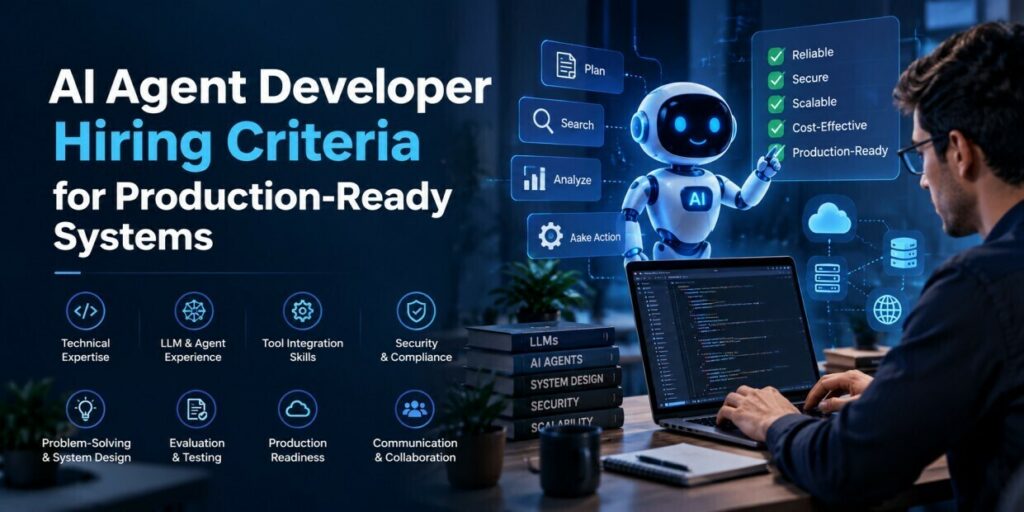
AI Agent Developer
TL;DR
• Hiring an AI Agent Developer requires evaluating software engineering, LLM expertise, and production system design skills.
• Developers should understand tool calling, API integration, authentication, authorization, and secure data handling.
• Human approval workflows, automated evaluations, and observability help make AI agents safer and more reliable.
• Failure recovery, cost optimization, and latency management are essential for scalable AI agent systems.
• Candidates should demonstrate practical experience building, testing, deploying, and monitoring production-ready AI agents.
AI agents are moving beyond experimental chatbots and proof-of-concept demonstrations. Businesses are increasingly using agentic systems to retrieve information, interact with enterprise applications, automate workflows, analyze documents, support employees, and execute multi-step tasks.
That shift changes what organizations should look for when hiring AI agent developers.
A developer who can connect an LLM to an API and create an impressive demo is not necessarily equipped to build a production system.
Production AI agents operate with real users, real business data, real permissions, and real consequences. They need software engineering discipline around model behavior, tool execution, security, observability, testing, and failure recovery.
Recent production-architecture discussions increasingly treat the model as only one component of the overall system. The surrounding orchestration, tools, data, memory, controls, evaluation, and infrastructure determine whether an agent can operate reliably at scale.
What Makes an AI Agent Production-Ready?
A production-ready AI agent should be treated as a software system rather than simply an intelligent prompt.
A typical architecture can include:
- A foundation model or model-routing layer
- Agent orchestration and workflow logic
- Tool and API integrations
- Enterprise data and retrieval systems
- Short-term and long-term memory where appropriate
- Authentication and authorization
- Guardrails and policy enforcement
- Evaluation and testing infrastructure
- Observability and logging
- Error handling and recovery mechanisms
- Deployment and infrastructure management
The important point is that each layer introduces engineering requirements.
For example, an agent that can retrieve customer information may be relatively low risk. An agent that can modify customer records, issue refunds, send emails, or execute financial transactions requires considerably stronger controls.
This is why hiring criteria should be based on production responsibilities, not simply familiarity with a particular AI framework.
1. Strong Software Engineering Fundamentals
The first hiring criterion should be conventional software engineering ability.
AI agents still need clean architecture, maintainable code, API design, version control, automated testing, database knowledge, deployment practices, and effective debugging.
Look for developers who understand:
- Python, TypeScript, Java, or another appropriate production language
- REST and event-driven APIs
- SQL and NoSQL databases
- Authentication and authorization
- Asynchronous processing
- Queues and background jobs
- Containerization
- CI/CD
- Cloud infrastructure
- Automated testing
This matters because the LLM is only one component of the application.
A technically strong AI agent developer should be able to explain what happens when the model is unavailable, a downstream API times out, a database contains incomplete information, or an agent attempts an invalid operation.
2. Practical LLM and Model Experience
An AI agent developer should understand how modern language models behave in real applications.
Experience should go beyond writing prompts. Developers should understand:
- Structured outputs
- Function and tool calling
- Context-window limitations
- Token usage
- Model latency
- Model selection
- Embeddings
- Retrieval-augmented generation
- Streaming
- Model fallbacks
- Prompt and configuration versioning
The developer should also understand that model quality alone does not guarantee application quality.
For example, a more capable model may produce better reasoning but introduce higher latency or cost. A smaller model may be sufficient for classification, routing, extraction, or simple workflow decisions.
Good engineering involves choosing the appropriate model for each task rather than treating one model as the answer to every problem.
Also Read : Meta Muse AI: How AI Agents Help Small Businesses Grow
3. Tool-Calling and Integration Expertise
Tool use is what gives many AI agents their practical value.
An agent may need to interact with CRMs, ERP systems, ticketing platforms, databases, search systems, payment platforms, calendars, internal APIs, or document repositories.
The developer should therefore understand how to design tools with:
- Clear input schemas
- Typed parameters
- Predictable outputs
- Validation
- Authentication
- Permission boundaries
- Timeouts
- Retry policies
- Idempotency
- Audit logging
Tool design should also be intentionally narrow.
If an agent only needs to read customer records, it should not automatically receive permissions to modify or delete them.
OWASP identifies excessive agency as a major risk in LLM applications. The underlying problem can come from excessive functionality, excessive permissions, or excessive autonomy.
That makes permission-aware tool design an important hiring criterion.
4. Security and Identity Management
Security cannot be added after an autonomous agent has already been connected to business systems.
Developers should understand authentication, authorization, secrets management, data isolation, API security, and least-privilege access.
Particular attention should be given to prompt injection and indirect prompt injection.
An agent might consume information from an email, webpage, uploaded document, or knowledge base. If that information contains malicious instructions, the model may interpret those instructions as part of its operating context.
A production developer therefore needs to distinguish between:
Data the agent should read
and
Instructions the agent is authorized to follow.
The OWASP GenAI Security Project continues to identify prompt injection, sensitive information disclosure, insecure output handling, excessive agency, and other risks as important concerns for LLM-powered applications. Its 2026 Top 10 represents the current community-driven security guidance for LLM applications.
5. Human-in-the-Loop Design
Not every action should be fully autonomous.
A production AI agent should have clearly defined boundaries for when it can act independently and when it must request human approval.
For example:
Low-risk action:
Retrieve an order status.
Moderate-risk action:
Draft a customer response.
High-risk action:
Issue a refund or permanently modify a customer account.
The developer should be capable of implementing approval workflows, escalation paths, confidence thresholds, and action policies.
The objective is not maximum autonomy.
The objective is appropriate autonomy.
6. Evaluation and Testing Skills
Traditional software testing is not enough for AI agents because model behavior can vary across inputs.
Developers should be able to create evaluation datasets representing realistic production scenarios.
These can include:
- Normal user requests
- Ambiguous requests
- Invalid requests
- Adversarial inputs
- Prompt-injection attempts
- Missing data
- Tool failures
- Incorrect tool parameters
- Long conversations
- Conflicting information
- Unauthorized actions
Evaluation should measure more than whether the final answer “looks good.”
Useful metrics can include task completion rate, tool-selection accuracy, factual accuracy, escalation rate, latency, cost, and failure recovery.
NIST’s AI Risk Management Framework emphasizes managing AI risks throughout the lifecycle, including design, development, deployment, use, and evaluation. Its Generative AI Profile provides additional guidance for identifying and managing risks associated with generative AI systems.
7. Observability and Debugging
One of the most overlooked hiring criteria is the ability to debug agent behavior.
When a conventional application fails, developers can often follow a predictable execution path.
An agent may instead perform several model calls, retrieve information, select tools, receive tool results, revise its plan, and make additional calls.
Production observability should therefore capture useful traces such as:
- User request
- Model invocation
- Prompt or configuration version
- Retrieved context
- Tool selected
- Tool arguments
- Tool response
- Latency
- Token usage
- Final response
- Error or escalation
This allows engineering teams to answer a critical question:
Why did the agent make that decision?
Without sufficient traces, diagnosing failures becomes expensive and slow.
8. Failure Recovery and Resilience
AI agents should be designed around failure rather than assuming successful execution.
A developer should know how to handle:
- Model timeouts
- API failures
- Rate limits
- Invalid tool calls
- Partial workflow completion
- Duplicate actions
- Missing information
- Service outages
- Unexpected model responses
Useful techniques include retries with appropriate limits, circuit breakers, fallbacks, idempotent operations, transaction boundaries, queues, and human escalation.
For business-critical workflows, recovery should be designed before deployment rather than added after the first production incident.
9. Cost and Latency Awareness
An agent can be technically impressive and still be commercially impractical.
Developers should understand the relationship between model calls, context size, tool usage, latency, infrastructure, and operating cost.
A workflow that requires seven model calls for every customer request may work in a prototype but become expensive at high volume.
Strong candidates should be able to identify opportunities to:
- Reduce unnecessary model calls
- Route simple tasks to smaller models
- Cache suitable results
- Limit context
- Parallelize independent operations
- Set execution budgets
- Stop runaway loops
- Monitor cost per task
Production engineering is ultimately about balancing capability, reliability, latency, security, and cost.
10. How to Evaluate Candidates During Interviews
Instead of relying entirely on theoretical questions, give candidates a realistic system-design exercise.
For example:
“Design an AI customer-support agent that can read a knowledge base, check order status, create support tickets, and escalate sensitive cases to human agents.”
Ask the candidate to explain:
- Which model or models they would use.
- How tools would be exposed to the agent.
- How authentication would work.
- Which actions require human approval.
- How customer data would be protected.
- How prompt injection would be handled.
- How the system would be evaluated.
- How failures would be recovered.
- What would be logged.
- How cost and latency would be controlled.
The strongest candidates will discuss constraints and failure modes without being prompted.
A weak candidate will often focus primarily on prompts, model selection, or the user interface.
Production Readiness Checklist
Before hiring an AI agent developer, organizations should assess whether the candidate can contribute across the complete lifecycle:
| Capability | What to Look For |
| Software engineering | Maintainable production code |
| LLM engineering | Models, structured output, context management |
| Agent orchestration | Planning, routing, state and workflow control |
| Tool integration | Secure APIs and typed tools |
| Security | Least privilege, authentication and data protection |
| Evaluation | Automated and scenario-based testing |
| Observability | Tracing, logs and metrics |
| Reliability | Retries, fallbacks and recovery |
| Human oversight | Approval and escalation workflows |
| Cost optimization | Model routing, caching and execution controls |
| Deployment | Cloud, containers and CI/CD |
| Governance | Policies, auditability and risk management |
Final Takeaway
Hiring for AI agent development should not be reduced to finding someone who knows the latest AI framework.
Production-ready agent development sits at the intersection of AI engineering, backend development, security, systems architecture, testing, and operations.
The right experts should be able to build an agent that does more than produce an impressive demonstration. They should be able to explain what the system is allowed to do, how it behaves when something goes wrong, how its decisions are evaluated, how access is controlled, and how the system can be monitored after deployment.
That distinction is becoming increasingly important as organizations move agentic AI from experimental environments into workflows where reliability, security, and accountability directly affect business operations.
For organizations evaluating external engineering support or looking to expand an internal AI team, the hiring process should therefore prioritize production experience, system-design ability, security awareness, evaluation discipline, and operational thinking alongside AI expertise.
Frequently Asked Questions
What skills should you look for when hiring an AI Agent Developer?
Look for strong software engineering fundamentals, LLM integration, agent orchestration, API development, database management, security, automated testing, and cloud deployment experience.
What is the difference between an AI developer and an AI Agent Developer?
An AI developer may focus on machine learning models, data processing, or AI-powered applications. An AI Agent Developer specializes in building systems that use models, tools, workflows, and contextual information to perform multi-step tasks.
Why is security important in AI agent development?
AI agents may access sensitive business information and execute actions through connected tools. Developers must implement authentication, least-privilege permissions, prompt-injection defenses, data protection, and human approval for high-risk actions.
How can companies evaluate an AI Agent Developer during an interview?
Companies can use practical system-design exercises that assess tool integration, workflow orchestration, security, testing, error handling, observability, and cost optimization. Candidates should explain how they would build and maintain a reliable production system.
What makes an AI agent production-ready?
A production-ready AI agent combines reliable model integration, secure tool access, automated evaluation, monitoring, failure recovery, controlled autonomy, and cost management. It should perform consistently under realistic business conditions and provide clear mechanisms for oversight and debugging.