
AI-Generated Music
TL;DR
• YouTube Music introduces labels to identify AI-generated music.
• Labels help listeners understand how AI contributes to song production.
• The system combines music partner disclosures with AI detection tools.
• AI labels aim to improve transparency without automatically banning AI-created songs.
• Copyright, artist rights, and streaming fraud remain important industry challenges.
Artificial intelligence is transforming the music industry by making it easier to compose songs, generate vocals, create melodies, and experiment with new sounds. What once required professional recording equipment, experienced musicians, and hours of production can now be accomplished with AI-powered tools.
However, the rapid growth of AI-generated music is creating new challenges for streaming platforms. Listeners may not know whether a song was performed by a human artist, generated by artificial intelligence, or created through a combination of both methods. This raises important questions about transparency, copyright, artist recognition, and the future of digital music.
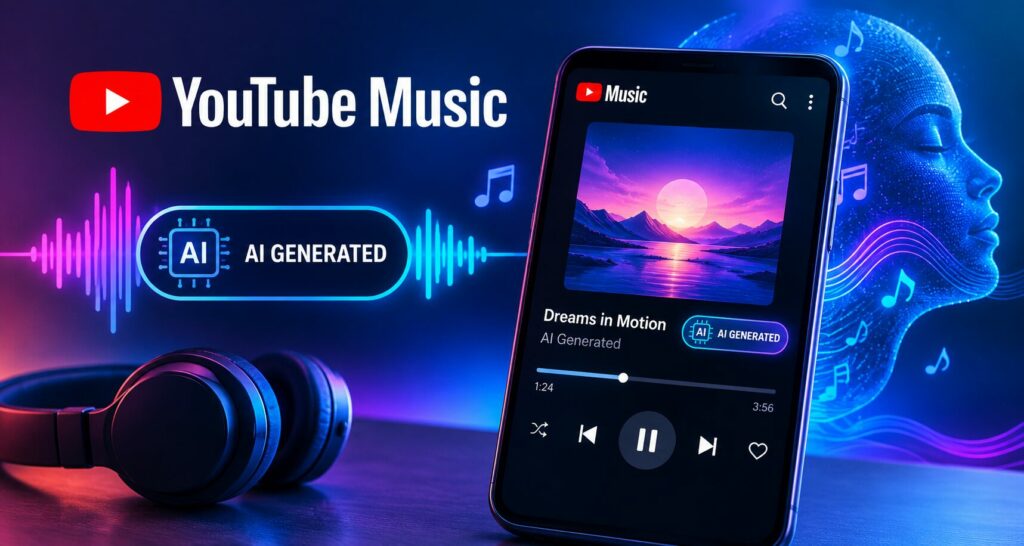
On October 14, 2026, YouTube Music introduced new labels designed to help listeners identify tracks created primarily using generative AI. The labels appear directly on the music player page, allowing users to access additional information about AI’s role in a track’s production. The labeling system is also planned to expand to the main YouTube app.
The development marks an important step toward greater transparency in the music streaming industry. Rather than automatically prohibiting AI-created songs, the platform is focusing on helping users understand how music is made.
What Are YouTube Music’s New AI Labels?
YouTube Music’s new AI labels are designed to identify songs in which generative artificial intelligence played a significant role. These labels provide listeners with additional context about the origin of a recording.
For example, a song created using AI to generate both its composition and vocals may qualify for an AI label. When listeners encounter a labeled track, they can tap the label on the player page to learn more about the content.
The system uses information supplied by music partners alongside the platform’s own detection tools. This combination is intended to help identify AI-generated music while improving transparency for listeners.
The labels do not necessarily mean that a track lacks artistic value or that it was produced without human involvement. Instead, they indicate that AI played a significant role in the creative process.
This distinction matters because musicians increasingly use AI as a creative assistant. Some rely on it to generate initial musical ideas, while others combine AI-generated elements with traditional instruments, vocals, and production techniques.
By providing more information about how songs are created, streaming platforms can help audiences make informed listening decisions.
How Does the AI Music Labeling System Work?
The labeling process combines creator disclosures with technology designed to identify AI-generated content.
1. Information From Music Partners
Music partners can declare the role of generative AI in their uploaded recordings. The platform’s disclosure framework distinguishes between fully AI-generated content, partly AI-generated content, and music without generative AI involvement under the applicable criteria.
Fully AI-generated tracks are created entirely through AI systems. Partly AI-generated recordings contain AI-created elements alongside human contributions. Traditional production methods that do not involve generative AI, such as conventional pitch correction, are not automatically classified as generative AI music.
These distinctions help separate genuinely AI-generated content from music that simply uses digital production software.
2. AI Detection Technology
Creator disclosures are not the only source of information. YouTube also uses its own detection tools to help identify AI-generated tracks.
Detection is important because not every creator will necessarily provide complete or accurate information about a recording. Technical analysis can provide additional signals that help the platform decide whether a track needs an AI label.
However, identifying AI-generated music is not always straightforward. Different models produce different sounds, and human artists may incorporate generated elements into otherwise traditional recordings.
For this reason, combining creator disclosures with detection tools can offer a more comprehensive approach than relying on a single identification method.
3. Labels on the Music Player
When a track qualifies for labeling, listeners can see an AI disclosure directly on the player page. Tapping the label provides additional information about the song’s creation.
This placement makes the information accessible without requiring listeners to search through lengthy descriptions or policy documents.
The same labeling principles are expected to extend to the main YouTube app, bringing AI music transparency to a broader audience.
Why Is AI-Generated Music Becoming a Major Issue?
The availability of generative AI tools has dramatically reduced the time and expertise required to create music. Anyone with access to suitable software can experiment with melodies, vocals, arrangements, and complete compositions.
This accessibility creates opportunities for independent musicians and new creators. At the same time, it introduces several challenges for streaming services.
The Rapid Growth of Music Uploads
AI tools allow users to generate music at a scale that would be difficult to achieve through conventional production alone. A creator can experiment with numerous compositions and produce multiple versions of a track in a short period.
For streaming platforms, this creates a growing content-management challenge. Their catalogs must accommodate more recordings while maintaining useful search, recommendation, and quality-control systems.
A larger catalog can improve music discovery, but a high volume of repetitive or low-quality uploads can make it harder for listeners to find meaningful content.
AI labels provide one way to add useful context to this expanding catalog.
Concerns About Human Artists
Musicians invest time, skill, and resources in creating original work. As AI-generated music becomes more common, artists may worry about increased competition for listeners, playlist placements, and revenue.
There are also concerns about unauthorized voice imitation and AI systems trained on existing creative works.
These issues require careful consideration. Not all AI-generated music is harmful, and many artists use AI as part of a legitimate creative workflow. The challenge is to encourage innovation while respecting creators’ rights and making the production process more transparent.
Music Streaming Fraud
Another concern is the potential misuse of large volumes of AI-generated tracks to manipulate streaming systems.
Fraudulent uploads and artificial listening activity can undermine royalty distribution and distort popularity metrics. AI makes it easier to produce large quantities of audio, but the technology itself is not evidence of fraud.
Streaming platforms must distinguish legitimate AI-assisted creativity from activities designed to exploit recommendation algorithms or payment systems.
AI disclosure, content verification, and fraud detection can play complementary roles in addressing these risks.
How AI Labels Could Change Music Streaming
The introduction of AI labels could influence how people discover, evaluate, and interact with music online.
Greater Transparency for Listeners
Some listeners prefer music created primarily by human performers, while others are curious about AI-generated compositions. Labels can help both groups understand the content they are hearing.
Transparency also helps audiences distinguish between a fully generated song and a recording in which a musician used AI for a limited task.
Over time, this information could become an increasingly familiar part of the digital listening experience.
Improvements to Music Discovery
Recommendation systems help streaming platforms suggest songs based on listening history, preferences, and other signals. As AI-generated music expands, platforms may need more detailed content classifications to maintain useful recommendations.
In the future, streaming services could offer controls that allow users to adjust how much AI-generated music appears in their recommendations or playlists.
Such features would give listeners greater choice without necessarily preventing AI-assisted creators from publishing their work.
Better Content Management
Labels may also help platforms manage large catalogs more effectively. Identifying the role of generative AI can support content classification and provide additional context for moderation and quality-control processes.
However, labels should not replace assessments of originality, licensing, or content quality. A song made with AI can be creative and legitimate, just as a traditionally produced recording can violate another creator’s rights.
How Other Streaming Platforms Are Handling AI Music
YouTube Music’s approach is part of a wider industry response to the growing volume of AI-generated audio.
Spotify has introduced AI-related labeling measures and tools aimed at addressing music spam. Apple Music has announced plans for AI transparency tags, while Deezer has taken additional steps to label detected AI-generated tracks and limit their visibility in certain recommendation and editorial areas.
Deezer reported receiving nearly 90,000 fully AI-generated tracks per day in July 2026, illustrating the scale of the challenge facing music platforms.
Other services have adopted their own approaches to identifying and managing synthetic recordings. Some focus primarily on disclosure, while others offer filtering features or impose stricter distribution rules.
These differences reflect an ongoing debate about how AI-generated music should be treated.
Should platforms simply tell listeners when AI was involved? Should users be allowed to filter such tracks from recommendations? Or should services introduce stronger restrictions on distribution and monetization?
YouTube Music’s current approach emphasizes transparency. AI involvement alone does not automatically make a track ineligible for monetization, although creators must still meet the platform’s applicable requirements.
What Do AI Music Labels Mean for Artists and Businesses?
The new labeling system creates important considerations for musicians, record labels, music distributors, and technology companies.
Opportunities for Independent Creators
AI tools can help independent musicians experiment with new genres, develop musical ideas, and accelerate certain production tasks.
Clear labeling does not have to prevent these creators from reaching audiences. Instead, it can help establish more transparent expectations about how their recordings were made.
Creators should understand the disclosure requirements that apply to their distribution channels and provide accurate information about their use of generative AI.
Copyright and Licensing Challenges
AI labels cannot resolve every legal question associated with music production.
Copyright ownership, training data, voice imitation, licensing agreements, and unauthorized use of existing recordings remain separate concerns. A label that identifies AI involvement does not establish whether a track complies with every relevant law or agreement.
Artists, distributors, and AI developers will need to continue addressing these issues as regulations and industry standards evolve.
Opportunities for AI Technology Providers
The demand for music transparency also creates opportunities for companies developing AI detection, digital content verification, rights management, and media production technologies.
Businesses exploring these opportunities may benefit from AI and machine learning development solutions to build intelligent systems for digital products and content workflows.
Likewise, companies that want to incorporate intelligent features into their existing platforms can explore software development solutions for building scalable applications and technology products.
These opportunities extend beyond music to video, digital publishing, advertising, and other industries where AI-generated content is becoming more common.
What Challenges Could Limit AI Music Labels?
Although labeling is a useful step, its effectiveness will depend on how accurately the system identifies AI involvement.
Incorrect or Incomplete Labels
A detection system may fail to identify some AI-generated recordings or incorrectly classify music produced through traditional methods.
Incorrect labels could confuse listeners and unfairly affect artists’ reputations. Platforms therefore need reliable verification processes and ways for creators to correct inaccurate information.
Different Definitions of AI Music
The distinction between human-created and AI-generated music is becoming less straightforward.
A musician might use AI to generate a backing track, modify a vocal, suggest a melody, or create a complete composition. These examples involve different levels of AI participation.
Clear definitions and consistent disclosure rules will be important if listeners are expected to understand what a label means.
Limited Listener Control
Labels provide information, but they do not necessarily give users the option to remove AI-generated tracks from their listening experience.
Some listeners may eventually want additional controls over recommendations and playlists. Whether platforms introduce such options will depend on user demand and their individual product strategies.
The Future of AI-Generated Music
The introduction of AI labels signals a shift toward greater transparency as generative AI becomes more integrated into music production.
Future developments may include more detailed disclosure systems, improved AI detection, better content provenance, and additional listener controls. Platforms may also explore clearer standards for distinguishing fully generated recordings from music created through human-AI collaboration.
For artists, the priority will be to understand platform policies and protect their creative work. For streaming services, the challenge will be to maintain useful catalogs, trustworthy recommendations, and fair distribution systems.
For technology companies, the opportunity lies in developing tools that make AI-powered creativity more transparent and responsible.
Readers can follow further developments in artificial intelligence, digital platforms, and emerging technology through AI Tech Updates.
Conclusion
YouTube Music’s new AI labels represent an important development in the evolution of digital music. By making significant generative AI involvement more visible, the platform is giving listeners additional information about the songs they hear.
The system combines music-partner disclosures with detection tools and is expected to expand to the main YouTube app. Its focus is transparency rather than an automatic ban on AI-generated music.
However, the long-term success of this approach will depend on accurate identification, consistent labeling standards, and continued attention to copyright, fraud, and artist rights.
As AI-generated music becomes more common, transparency will be essential for maintaining trust between creators, streaming platforms, and listeners. The goal is not simply to identify machine-generated songs, but to create a music ecosystem where technological innovation and responsible creative practices can coexist.
Frequently Asked Questions
What are YouTube Music's new AI labels?
YouTube Music's AI labels identify tracks in which generative AI played a significant role, helping listeners understand how the music was created.
How does YouTube Music identify AI-generated music?
The platform combines information provided by music partners with its own detection tools to help identify AI-generated tracks.
Will AI-generated music be removed from YouTube Music?
No. AI involvement alone does not automatically mean a song will be removed or become ineligible for monetization. Creators must still follow the platform's applicable policies.
Why is AI-generated music labeling important?
AI labels improve transparency, help listeners make informed decisions, and support efforts to manage the growing volume of AI-generated content.
How could AI labels affect musicians?
AI labels may help musicians communicate how their tracks were produced. However, copyright, licensing, voice imitation, and competition remain important concerns for artists.