
AI-powered factory robot programming
TL;DR
• AI is making factory robot programming faster and easier.
• AI tools help robots learn tasks using natural language instructions.
• Manufacturers can reduce manual programming and setup time.
• AI-powered systems make robot deployment more flexible.
• Faster programming helps factories improve productivity.
• AI can make automation more accessible to small and medium-sized businesses.
• Human supervision remains important for safety and quality.
Factory automation has played an important role in modern manufacturing for decades. Industrial robots help companies improve productivity, maintain product quality, reduce repetitive manual work, and increase production efficiency. From automotive assembly lines to electronics manufacturing facilities, robotic systems have become essential for performing repetitive and precision-based tasks.
However, traditional industrial robots still face a significant limitation. Most are designed and programmed to perform specific operations under controlled conditions. When a manufacturer introduces a new product, changes a component design, or modifies a production process, the existing robotic system may require extensive reprogramming and physical adjustments. In some cases, manufacturers must modify equipment or redesign entire sections of a production line, resulting in costly downtime.
Artificial intelligence is beginning to change this approach. Instead of depending entirely on predefined instructions, modern robotic systems can use AI models to interpret visual information, understand tasks, and coordinate physical movements. These capabilities could help robots adapt to new products and manufacturing requirements without requiring engineers to rebuild every workflow from scratch.
This development highlights a broader transformation in industrial technology. With advances in physical AI, realistic simulations, and intelligent robotic control, manufacturers are exploring new ways to automate complex operations and respond more quickly to changing production demands.
Why Traditional Factory Robot Programming Takes So Long
Conventional industrial robots are designed to perform repetitive tasks with precision and consistency. They can weld automotive components, assemble electronic devices, move materials, package products, and carry out other operations with limited variation.
These systems work particularly well when the product, environment, and production process remain stable. However, their limitations become more noticeable when manufacturers need to change a product or introduce a new manufacturing task.
For example, a factory producing smartphones might use a robotic arm to insert a small connector into a particular device. If the connector changes shape, its position shifts, or the manufacturer introduces a new phone model, the existing robot may no longer perform the task correctly.
Engineers may need to adjust movement instructions, modify fixtures, replace gripping tools, and test the revised process before production can resume.
Several factors contribute to these challenges.
Fixed programming: Traditional robots often rely on predefined movement sequences. They may struggle when components appear in unexpected positions or when manufacturing requirements change.
Physical retooling: Different products may require specialized grippers, fixtures, sensors, or other equipment. These changes can increase the cost and time needed to modify a production line.
Testing and validation: Every significant adjustment must be tested to ensure the robot performs the task accurately and safely.
Production downtime: Manufacturing equipment may remain inactive while engineers configure, test, and validate the new workflow.
Limited adaptability: Frequent product changes can make conventional automation difficult to maintain, particularly for manufacturers producing several product variations.
These challenges can prevent companies from automating delicate or complicated processes, even when automation could improve productivity.
This is where AI in manufacturing becomes valuable. By combining perception, task understanding, and motion planning, AI-driven systems aim to make robots more adaptable to different production requirements.
How AI Is Changing Factory Automation
Artificial intelligence is introducing a different approach to industrial robot programming. Instead of relying exclusively on manually defined instructions, AI-powered systems can use learned patterns, visual information, and task demonstrations to determine how to complete an operation.
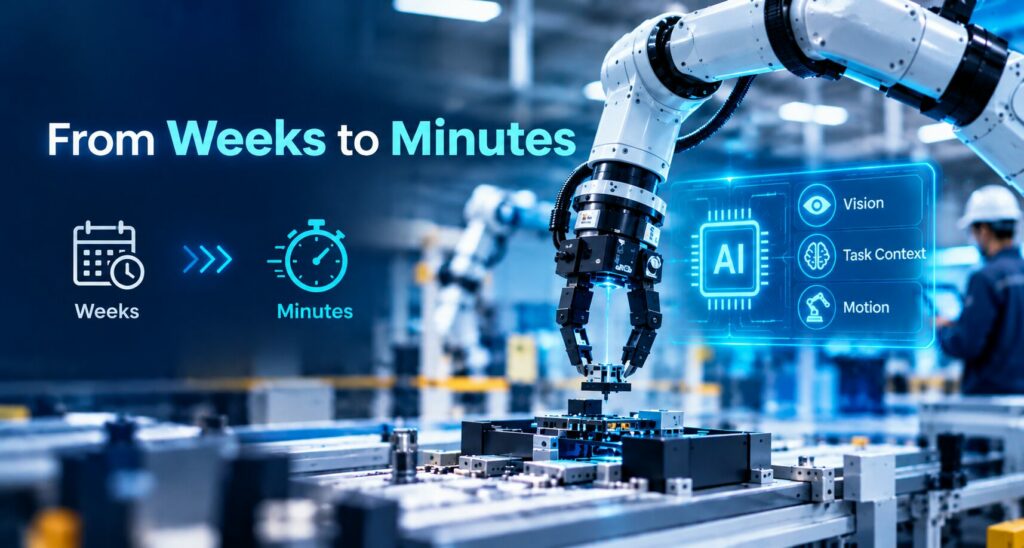
Industrial Next is developing self-contained robotic stations powered by proprietary foundation models. These systems are designed to connect three important capabilities: vision, task context, and motion.
Vision allows the robot to process information about its surroundings and identify relevant objects. Task context helps the system interpret what it needs to accomplish. Motion capabilities allow it to coordinate the physical actions required to complete the operation.
Together, these capabilities can help create more flexible manufacturing workflows.
Imagine a factory switching from manufacturing one electronic device to another. With conventional automation, engineers might need to rewrite robot instructions and make extensive adjustments to the production equipment.
An AI-driven robotic station could instead be trained or demonstrated the new task, tested in a simulated environment, and deployed after appropriate validation. The exact process would depend on the system, the complexity of the task, and the changes required.
The Role of Foundation Models in Industrial Robotics
Foundation models are AI models trained to recognize patterns and perform tasks across a range of situations. In robotics, specialized models can help connect information from sensors, visual observations, task instructions, and physical actions.
Traditional industrial robot programming typically focuses on defining how a machine should move through a particular sequence. AI-driven robotics aims to give the system a greater ability to interpret the task and adapt its actions to changing conditions.
For example, a robot assembling a product may need to identify a component, determine its orientation, align it with another part, and perform a controlled movement to complete the assembly.
A system that combines visual perception with task understanding could help manage some of these steps more flexibly than a workflow based entirely on fixed coordinates.
However, industrial applications require more than general intelligence. A model must also operate within the physical limits of the robot, meet precision requirements, and respond predictably to different operating conditions.
Manufacturers must consider factors such as component dimensions, movement constraints, gripping force, operating speed, and potential safety risks.
As AI models become more capable, their integration with robotic hardware could support more adaptable automation. The practical value will depend on how consistently these systems perform in real manufacturing environments.
Why Simulation Is Essential for Intelligent Robots
One of the biggest challenges in robotics is training machines to perform complex physical tasks reliably.
AI models can learn from large collections of digital information, but robots need to interact with the physical world. They must understand positioning, contact, movement, force, and the consequences of their actions.
A robot might successfully pick up a large object but struggle to insert a thin cable into a small connector. The operation requires precise alignment, controlled movement, and an understanding of how the components interact.
This is why simulation-based robot training is becoming an important area of development.
Simulation allows developers to create virtual environments where robots can practice tasks before attempting them in a real factory.
How simulation-based robot training works
Step 1: Create a realistic virtual environment
Engineers build a simulated environment representing the robot, its tools, the target components, and relevant physical conditions. The closer the simulation matches reality, the more useful it can be for training and testing.
Step 2: Train the robot to perform complex movements
The robot practices manipulating components in the virtual environment. Developers can evaluate positioning, movement, and task execution without relying entirely on physical trial and error.
Step 3: Improve the task through repeated testing
Different approaches can be evaluated in the simulation. Developers can identify potential errors and refine the workflow before deploying it on physical equipment.
Step 4: Validate the system in the real world
The trained workflow is transferred to physical equipment and tested under actual operating conditions. Engineers verify that the robot meets the necessary precision, reliability, and safety requirements.
Industrial Next has emphasized the use of high-fidelity simulation to support delicate, high-precision robotic tasks. Its approach aims to help robots develop an understanding of physical processes rather than depending exclusively on predefined movements.
Real-World Applications of AI-Powered Factory Robots
AI-powered industrial robots could have applications across several manufacturing sectors. Their greatest potential may lie in operations that require precision, adaptability, and frequent changes to production requirements.
Smartphone and Electronics Manufacturing
Electronics manufacturing involves small components, delicate cables, compact connectors, and tightly controlled assembly processes. These operations can be difficult to automate using conventional systems, particularly when components vary between product models.
Industrial Next has described robotic applications involving threading delicate flex cables, positioning small connector caps, and removing protective film from camera modules and buttons.
The company has also reported a film-removal application that operates at or above human speed with 100% accuracy, including after being moved to a new phone model and production line. These are company-reported performance claims rather than independently verified results.
Such applications illustrate how flexible robotics could help manufacturers automate tasks that previously required specialized programming or manual handling.
Automotive Manufacturing
Automotive production involves assembling components of different sizes, shapes, and levels of complexity. Manufacturers also need to accommodate changes in vehicle designs and production requirements.
AI-powered robots could potentially support component handling, precision assembly, and other operations that require flexible movement.
If robots can adapt to new tasks with less reprogramming, automotive manufacturers may find it easier to introduce product variations while maintaining production efficiency.
Packaging and Product Handling
Packaging facilities frequently handle products with different dimensions, weights, and configurations. Traditional automation may require adjustments when the product range changes.
AI-enabled systems could help robots identify products, adjust handling strategies, and switch between certain packaging tasks with less manual intervention.
The practical benefits would depend on the robot’s capabilities, the variety of products, and the complexity of the packaging process.
Precision Manufacturing
Precision manufacturing often involves delicate materials and components that must be positioned accurately. Examples include small mechanical parts, electronic connectors, and fragile assemblies.
Simulation-trained robots could help automate some of these tasks by combining visual recognition, controlled movement, and task-specific training.
These applications show how AI robotics could extend automation into areas where traditional systems have struggled to achieve the required flexibility.
Why Automotive Manufacturers Are Exploring AI Robotics
Automotive manufacturers must balance production speed, product quality, equipment reliability, and operational costs. They also need to adapt to changing vehicle designs and increasingly complex assembly requirements.
Such an evaluation can help determine whether robotic systems are suitable for demanding production environments. It can also identify practical challenges involving precision, integration, reliability, and operational requirements.
An evaluation partnership does not necessarily mean that the technology has been deployed across an entire manufacturing operation. Instead, it provides an opportunity to assess how well the system performs under relevant conditions.
The broader opportunity is to make industrial robots more adaptable without sacrificing the consistency required for manufacturing.
If AI-driven robotic stations prove reliable at scale, manufacturers may have more options for automating complex assembly tasks and smaller production runs.
This could be particularly valuable in industries where products change frequently and traditional reprogramming creates delays.
Key Benefits of AI-Powered Industrial Robots
The transition from fixed programming toward AI-driven task adaptation could offer several benefits for manufacturers.
Faster Production Changeovers
Reducing the time required to configure robots for new tasks could help manufacturers respond more quickly to product updates and changing customer requirements.
Shorter changeovers could also reduce the time equipment spends inactive between production runs.
Reduced Programming Effort
Traditional automation often requires specialists to define and adjust individual robot movements. AI-assisted workflows could reduce some of this repetitive programming work by allowing tasks to be learned through demonstrations and simulation.
Engineering oversight would still be necessary, particularly for complex or safety-critical operations.
Greater Manufacturing Flexibility
Flexible robotics could help manufacturers produce multiple product variations without redesigning their entire automation setup for every change.
This could be useful for businesses that need to respond to changing demand or manufacture smaller batches of customized products.
Automation of Delicate Operations
AI models trained through realistic simulation may help robots handle small, fragile, or complicated components that have historically been difficult to automate.
This could expand the range of tasks that manufacturers can consider for robotic automation.
Improved Equipment Utilization
Faster changeovers and more adaptable workflows could help manufacturers use existing equipment more effectively.
Actual improvements would depend on task complexity, system reliability, integration costs, and the amount of production downtime eliminated.
Support for Scalable Production
Businesses that expand their product lines often need automation systems that can accommodate new processes. Reconfigurable robotic stations could provide more flexibility than equipment designed for only one operation.
Companies exploring intelligent manufacturing software and AI-driven business solutions can also investigate artificial intelligence development and machine learning technologies to understand how intelligent systems can support digital transformation.
Challenges That AI Robotics Must Overcome
Despite the potential benefits, AI-powered industrial robotics still faces several technical and operational challenges.
Reliability and Accuracy
Manufacturing operations require consistent results. A robot must complete a task accurately across repeated production cycles rather than simply succeed during a demonstration.
Even small errors can damage components, interrupt production, or affect product quality.
Simulation-to-Reality Differences
Virtual environments cannot always reproduce every physical variable. Differences in friction, lighting, materials, component positioning, and equipment behavior can affect the performance of a trained robot.
Real-world testing remains essential for confirming that simulated training translates into reliable physical performance.
Integration with Existing Equipment
Factories frequently use a mixture of legacy machinery, sensors, industrial controllers, and manufacturing software.
Integrating AI-powered robots with these systems may require engineering work, infrastructure updates, and adjustments to existing production processes.
Safety and Human Oversight
Industrial robots must operate within appropriate safety requirements. Systems working near employees or handling expensive components need suitable safeguards, monitoring, and emergency procedures.
AI should not eliminate the need for responsible engineering and operational oversight.
Limited Training Data
Robotics requires relevant data about physical interactions. Collecting high-quality examples of complex assembly operations can be expensive and time-consuming.
Simulation can help address some data limitations, but developers must ensure that the simulated conditions are sufficiently realistic.
Investment and Return on Investment
Manufacturers must evaluate the cost of AI models, robotic hardware, integration, maintenance, and employee training.
The technology is most valuable when the improvements in productivity, flexibility, and reduced downtime justify the investment.
These challenges demonstrate that successful industrial automation requires more than advanced AI models. It depends on combining intelligent software with dependable hardware, realistic testing, effective integration, and manufacturing expertise.
Businesses developing connected AI platforms, industrial applications, or intelligent digital products can explore custom software development approaches that support scalable architecture, data integration, and AI-enabled workflows.
How AI Robotics Could Change the Role of Manufacturing Engineers
As AI becomes more integrated into factory automation, the responsibilities of manufacturing engineers may gradually change.
Traditional robot programming often involves defining movements, adjusting coordinates, configuring tools, and repeatedly testing predefined sequences.
In more adaptable AI-driven environments, engineers may spend more time defining task requirements, preparing training environments, demonstrating operations, evaluating performance, and validating safety.
This does not mean that engineering expertise will become unnecessary. Instead, the skills required may expand to include simulation, robotics integration, AI system evaluation, and data-driven process optimization.
The Future of Factory Automation
The development of AI-powered robotic stations reflects a broader change in industrial technology.
For decades, manufacturers have optimized robots for repeatability: program a machine for a specific task, maintain stable operating conditions, and maximize output.
The emerging approach aims to make robots more adaptable.
Instead of treating every new product as a separate programming challenge, manufacturers may increasingly use AI models, simulation, demonstrations, and reusable robotic systems to teach new tasks.
This could support production environments where equipment adapts to product variations, smaller batches, and more frequent design changes.
The long-term vision for AI-driven manufacturing includes automating increasingly complex processes and connecting multiple stages of production through intelligent robotic systems.
Conclusion
AI is creating new possibilities for factory robot programming by connecting visual perception, task understanding, and physical movement. AI-powered robotic stations aim to replace rigid, task-specific automation with systems that can learn and adapt more quickly.
By combining foundation models with high-fidelity simulation, manufacturers may be able to teach robots delicate tasks and switch between production requirements with less traditional programming.
The technology still faces important challenges involving reliability, integration, safety, training data, and real-world validation. Even so, the possibility of reducing robot changeover times from weeks to minutes represents a compelling direction for industrial automation.
For manufacturers, the future may not be about installing a separate robot for every task. It may be about building intelligent production systems that can adapt as products, processes, and business needs evolve.
Frequently Asked Questions
What is AI-powered factory robot programming?
AI-powered factory robot programming uses artificial intelligence to help robots interpret tasks, process visual information, and coordinate movements. Depending on the system, it can reduce the need to manually program every movement for each new manufacturing task.
How can AI help robots switch manufacturing tasks faster?
AI models, simulation, and task demonstrations can help robots learn new workflows without relying entirely on fixed scripts. This may reduce reprogramming and changeover time, although physical testing, equipment adjustments, and validation may still be required.
What is simulation-based robot training?
Simulation-based robot training allows robots to practice tasks in a virtual environment designed to reproduce real-world physics and equipment behavior. Developers use these environments to train and evaluate robot actions before deploying them in physical settings.
Which industries can benefit from AI-powered industrial robots?
Automotive manufacturing, electronics assembly, packaging, precision engineering, and other industries with repetitive or delicate physical tasks could benefit from more adaptable robotic systems.
Can AI robots perform delicate assembly tasks?
AI-powered robots may be able to perform delicate assembly tasks by combining visual recognition, task-specific training, and precise movement control. Their suitability depends on the complexity of the task, the training method, and real-world performance validation.