
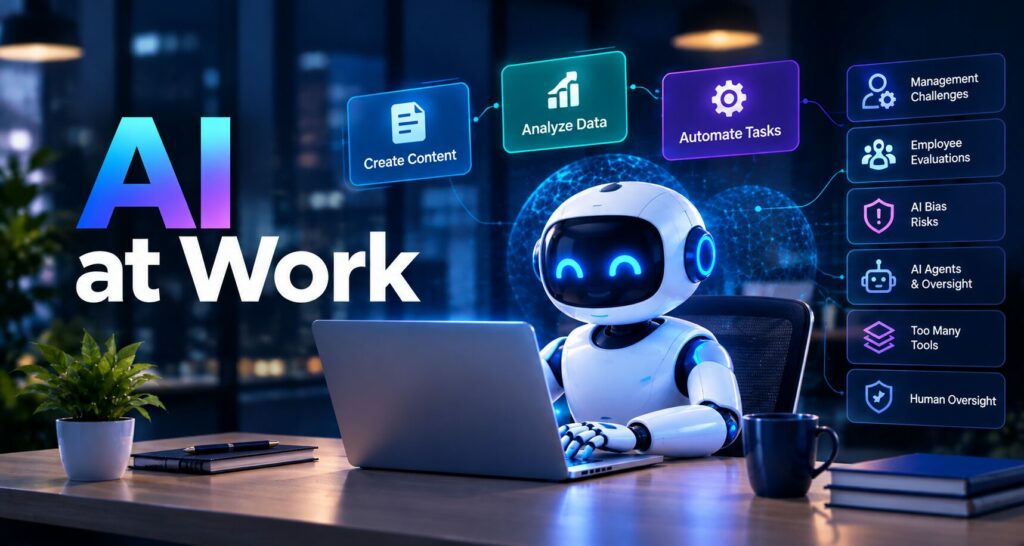
AI at Work
TL;DR
• AI automates repetitive tasks.
• Managers spend more time reviewing work.
• Employee evaluations need new standards.
• AI bias can cause unfair decisions.
• AI agents require human oversight.
• Too many AI tools increase complexity.
• Human judgment ensures responsible AI use.
Artificial intelligence is transforming how businesses operate, helping employees complete tasks faster, generate content, analyze information, and automate repetitive work. From AI-powered assistants to autonomous AI agents, organizations are adopting new technologies to improve efficiency and remain competitive. However, the growing use of AI is creating challenges that many businesses did not anticipate.
AI at Work is improving individual productivity, but it does not automatically make entire organizations more productive. Managers must now review AI-generated work, evaluate employee contributions, manage growing numbers of software tools, and ensure that automated systems operate responsibly. At the same time, questions about fairness, accountability, and human oversight are becoming increasingly important.
In 2026, businesses face a new challenge: learning how to balance the benefits of AI with the responsibilities that come with using it. The goal is no longer simply to introduce more AI tools but to integrate them into workflows in ways that produce measurable results without creating unnecessary complexity.
This article explores the major productivity gains, hidden workplace challenges, and practical strategies businesses can use to adopt AI more effectively.
1. How AI Is Changing Workplace Productivity in 2026
AI has moved beyond experimental technology and become a practical part of everyday business operations. Employees use AI assistants to prepare reports, generate ideas, write code, summarize meetings, organize information, and support customer interactions.
These capabilities can reduce the time required to complete repetitive tasks and help employees focus on activities that require creativity, judgment, and problem-solving.
For example, a marketing professional can use generative AI to develop an initial campaign outline. A software developer can use AI coding assistants to generate code suggestions and identify potential errors. Similarly, a business analyst can use AI to summarize large datasets and prepare preliminary reports.
Such applications demonstrate the potential of AI productivity tools to improve individual performance.
However, faster task completion does not always translate into better organizational performance. Employees may generate more content without improving its quality, while managers may spend additional time checking accuracy, correcting mistakes, and ensuring that outputs meet business requirements.
The real value of AI depends on how effectively businesses incorporate it into their existing processes.
Organizations should therefore measure more than the volume of AI-generated output. They should also consider accuracy, completion time, customer satisfaction, employee workload, and the amount of rework required.
Businesses exploring these opportunities can learn more about AI development and how intelligent software solutions can support practical business objectives.
2. Why AI Adoption Is Creating New Challenges for Managers
One of the biggest surprises associated with workplace AI is that managers may face additional responsibilities even when their teams become more productive.
AI can help employees prepare polished presentations, reports, emails, and project updates in less time. However, a finished document does not necessarily reveal how much research, reasoning, verification, or original work went into producing it.
Managers must determine whether the output is accurate, relevant, and aligned with organizational expectations.
A recent survey of 1,700 directors and senior managers across seven countries highlighted this growing challenge. More than half of the surveyed senior leaders said evaluating employees’ work had become harder following AI adoption. Nearly half also reported spending more time reviewing and guiding their teams’ output.
These findings illustrate an important distinction between individual efficiency and management efficiency.
An employee may save an hour by generating a report with AI, but the manager might need to spend additional time verifying the information, checking assumptions, and requesting revisions.
If this pattern occurs across an entire department, the expected productivity gains can become difficult to realize.
Why Managers Need New Workflows
Traditional management practices were designed around work produced primarily by people. AI changes this dynamic by allowing employees to generate larger volumes of content and complete certain tasks with less manual effort.
Managers must adapt by establishing clear review procedures, defining acceptable AI use, and focusing on the quality and impact of the final result.
Instead of checking every minor task manually, they can introduce risk-based review processes. Routine, low-risk outputs may require lightweight checks, while financial decisions, customer commitments, and sensitive business information should receive more rigorous human review.
The objective is to prevent AI from creating additional administrative work while maintaining quality and accountability.
3. Rethinking Employee Performance Evaluations
AI is changing how businesses measure employee performance.
Historically, managers have evaluated employees using factors such as project completion, communication, technical skills, reliability, collaboration, and the quality of their work.
With AI assistance, these traditional indicators may not provide a complete picture.
An employee who uses AI effectively might complete a task in significantly less time than a colleague who performs the same task manually. Another employee might generate impressive-looking work quickly but fail to verify its accuracy.
Consequently, businesses need evaluation systems that consider both outcomes and the way those outcomes are achieved.
These capabilities are becoming important components of modern workplace performance.
Skills Businesses Should Evaluate
Organizations should consider several factors when assessing employees in AI-enabled workplaces:
- Critical thinking: Can employees identify errors, question assumptions, and assess AI-generated recommendations?
- AI literacy: Do they understand the strengths and limitations of the tools they use?
- Problem-solving: Can they use AI to address genuine business problems rather than simply produce more content?
- Verification: Do they check important facts, calculations, and recommendations before submitting work?
- Collaboration: Can employees combine AI assistance with effective communication and teamwork?
- Accountability: Do they take responsibility for the final result?
Performance reviews should also recognize creativity, professional judgment, domain expertise, and contributions that cannot be measured through output volume alone.
Businesses must communicate these expectations clearly so employees understand how responsible AI use affects their roles and career development.
4. AI Bias and the Risks of Automated Performance Reviews
Another significant concern is the use of AI in employee assessments and management decisions.
AI systems can help organize performance information, summarize feedback, identify patterns, and prepare review drafts. These capabilities can reduce administrative work and help managers structure their evaluations.
However, AI-generated assessments are not automatically objective.
Large language models learn patterns from training data and may reproduce existing assumptions or biases. Their conclusions can also be influenced by incomplete information, ambiguous instructions, and the way a question is framed.
If a manager uses an AI-generated recommendation without examining its reasoning or supporting evidence, an inaccurate assessment could influence an employee’s promotion, compensation, or professional development.
This risk becomes more serious when AI-generated evaluations appear authoritative simply because they are presented in polished language.
How Businesses Can Reduce AI Bias
Organizations should introduce safeguards before using AI in decisions that affect employees.
Use objective evaluation criteria. Establish clear standards related to responsibilities, project outcomes, demonstrated skills, and agreed performance goals.
Require human review. Managers should independently examine AI-generated recommendations instead of accepting them without question.
Check the supporting evidence. Every significant performance claim should be connected to relevant, verifiable information.
Test systems for unfair outcomes. Organizations should periodically assess whether AI-assisted evaluations produce inconsistent results across employee groups.
Maintain transparency. Employees should understand when AI contributes to an evaluation and how they can question or appeal a decision.
Protect employee information. Sensitive performance records should only be processed through appropriately authorized systems with suitable privacy and security controls.
AI can assist with administrative work, but important employment decisions should not depend entirely on automated recommendations.
5. AI Agents Are Introducing a New Layer of Management
AI agents are extending automation beyond individual tasks. Unlike conventional AI assistants that primarily respond to prompts, AI agents can be configured to plan steps, use software tools, retrieve information, and carry out multistage workflows with varying levels of autonomy.
For example, a business might use an AI agent to collect information from internal systems, prepare a project status report, identify delayed tasks, and notify the appropriate team members.
Another agent might assist with customer support by classifying requests, retrieving relevant information, and preparing responses for human approval.
These capabilities can improve operational efficiency, but they also create new supervisory responsibilities.
Managers must decide which tasks agents can perform, what information they can access, and when they must request human approval.
A system that works well under normal conditions might still make an incorrect decision when it encounters incomplete information, conflicting instructions, or an unusual situation.
Why Human Oversight Matters
The survey found that 58% of managers expected to oversee more AI agents than human employees within the following year. Additionally, 46% expressed concern about losing control over agents’ actions.
These findings reflect the growing importance of AI governance.
Businesses should define clear boundaries for autonomous systems. For example, an AI agent might be allowed to prepare a purchase recommendation but require human approval before placing an order. It could draft a customer response independently but escalate complaints involving legal, financial, or sensitive issues.
Effective AI agent management should include:
- Clearly defined permissions and responsibilities.
- Human approval for high-impact decisions.
- Activity logs that record important actions.
- Monitoring for unexpected behavior.
- Escalation procedures for uncertain situations.
- Regular testing and performance reviews.
The goal is not to prevent automation. It is to ensure that AI agents operate within boundaries that protect business operations, customers, and employees.
Organizations developing advanced automation workflows can explore AI app development to understand how AI-powered applications can be designed around specific operational requirements.
6. The Hidden Cost of Too Many AI Tools
Many organizations initially adopt AI to simplify work, reduce manual processes, and consolidate software. Yet the growing availability of AI applications can produce the opposite result.
Different teams may introduce separate tools for writing, coding, meeting summaries, analytics, customer support, and workflow automation. Employees might also experiment with services that have not been formally approved by their organizations.
As the number of applications increases, businesses can encounter fragmented data, overlapping subscriptions, inconsistent processes, and complicated integrations.
The survey found that 57% of managers reported having more tools in circulation than before AI adoption. Approximately 51% said their tools had become more interconnected or clustered, while only 29% described their AI infrastructure as fully optimized and centralized.
These figures highlight a challenge that extends beyond technology selection.
Adding another AI application may improve one team’s workflow while creating integration problems for another. Information may be duplicated across systems, access permissions may become inconsistent, and employees may struggle to determine which tool contains the authoritative information.
How to Build a More Effective AI Technology Stack
Businesses should begin by identifying the problems they want to solve rather than adopting tools simply because they offer AI features.
A practical strategy includes:
- Audit existing software: Identify duplicate tools, unused subscriptions, and overlapping capabilities.
- Prioritize business needs: Select applications based on measurable operational requirements.
- Evaluate integrations: Ensure that new tools work with existing systems and established workflows.
- Establish approved tools: Provide employees with secure, supported options for common AI tasks.
- Manage access and data: Define who can use each system and what information can be shared.
- Measure business outcomes: Track productivity improvements, reliability, adoption, and total operating costs.
A well-designed technology environment should make work easier to coordinate, not simply increase the number of available applications.
7. Why AI Productivity Does Not Always Mean Business Growth
AI can reduce the time required to complete individual tasks, but organizations must distinguish between local efficiency and overall business performance.
For example, a marketing team may produce twice as many campaign drafts with AI. However, if the sales team receives more poorly qualified leads or customers experience inconsistent messaging, the additional output may not create meaningful business value.
Similarly, software developers might generate code faster, but the organization may see limited benefits if the code requires extensive testing, introduces defects, or creates maintenance problems.
These examples demonstrate why AI productivity should be measured across entire workflows rather than through isolated activities.
Measure the Outcomes That Matter
Businesses should identify clear indicators before implementing AI.
Useful measures include:
- Time saved on repetitive tasks.
- Reduction in errors and rework.
- Improvement in customer response times.
- Quality and reliability of completed work.
- Employee satisfaction and workload.
- Cost per completed task.
- Revenue or operational improvements attributable to the implementation.
Organizations should also account for the costs of subscriptions, integration, employee training, security, and human review.
The purpose is to determine whether AI delivers a meaningful improvement after all related costs are considered.
For companies investing in custom software development, connecting AI capabilities with measurable business objectives can help ensure that technology investments support long-term operational goals.
8. Building a Responsible AI Adoption Strategy
Successful AI adoption requires more than purchasing software and encouraging employees to experiment. Businesses need a coordinated strategy that addresses technology, people, processes, and accountability.
Without clear policies, employees may use AI inconsistently, managers may evaluate work using different standards, and departments may develop disconnected automation systems.
A structured approach helps organizations capture the benefits of AI while reducing these risks.
Step 1: Identify High-Value Use Cases
Start with tasks that are repetitive, time-consuming, and relatively easy to verify.
Examples include document summarization, internal knowledge searches, meeting notes, report preparation, and routine data classification.
More sensitive tasks should receive additional assessment before automation.
Step 2: Train Employees and Managers
AI literacy should extend across the organization.
Employees need to understand how to write effective prompts, verify outputs, protect confidential information, and recognize potential errors. Managers need additional training in evaluating AI-assisted work, assessing risks, and measuring productivity.
Step 3: Establish Clear AI Policies
Define which tools employees can use, what data they can share, and which decisions require human approval.
Policies should also address transparency, intellectual property, privacy, security, and accountability.
Step 4: Introduce Human Oversight
Determine where human review is necessary based on the potential consequences of an error.
Routine tasks may require limited supervision, while decisions affecting employment, finances, customer rights, or regulatory compliance should receive more careful scrutiny.
Step 5: Monitor and Improve
AI systems and business requirements change over time. Organizations should regularly review system performance, employee feedback, security controls, and business outcomes.
This ongoing process allows businesses to correct problems before they become widespread.
For organizations exploring broader AI initiatives, AI strategy consulting can be a useful starting point for aligning technology investments with business priorities and implementation requirements.
9. The Future of AI at Work: Collaboration Rather Than Replacement
The future of workplace AI will likely depend on how effectively people and intelligent systems work together.
AI can assist with information processing, repetitive tasks, research, and content generation. Human employees contribute contextual understanding, ethical judgment, relationship management, creativity, and responsibility for important decisions.
Rather than treating AI as a replacement for every existing process, businesses should identify where automation complements human expertise.
For managers, this means moving away from measuring success primarily through visible activity or the volume of completed work. Instead, they will need to evaluate outcomes, decision quality, collaboration, and the effective use of technology.
Employees will also need to adapt. The ability to use AI responsibly, evaluate its outputs, and solve problems that require independent judgment will become increasingly valuable.
Organizations that invest in these capabilities can build more flexible teams and create workflows in which AI handles appropriate routine tasks while people focus on higher-value responsibilities.
However, this transition will require continuous learning, transparent policies, and a willingness to redesign outdated processes.
Conclusion
AI at work in 2026 presents both a significant opportunity and a growing management challenge. Intelligent tools can help employees complete tasks faster, automate repetitive processes, and discover new ways to solve business problems. However, these benefits do not automatically translate into better organizational performance.
Managers must now address difficult questions about employee evaluations, AI bias, software complexity, autonomous agents, and accountability. Businesses that introduce AI without adapting their workflows may find themselves spending more time reviewing outputs and coordinating tools than they expected.
The solution is not to slow down every AI initiative or automate every available task. Instead, organizations should adopt AI strategically, establish measurable objectives, train employees, protect sensitive information, and maintain appropriate human oversight.
Ultimately, the most successful businesses will be those that treat AI as a tool for improving how people work rather than as a shortcut to productivity. By combining intelligent automation with human judgment and effective governance, organizations can turn AI’s potential into sustainable business value.
Frequently Asked Questions
How does AI improve workplace productivity?
AI can automate repetitive tasks, summarize information, generate content, assist with coding, analyze data, and support decision-making. Its effectiveness depends on the quality of the tools, the suitability of the tasks, and how well the technology is integrated into existing workflows.
Why is AI making management more complicated?
AI can increase the volume of work employees produce while making it harder to assess originality, accuracy, and individual contributions. Managers must also supervise AI agents, review automated outputs, coordinate software tools, and establish clear accountability.
Can AI be used for employee performance reviews?
Yes. AI can help summarize feedback, organize performance information, and prepare review drafts. However, managers should verify the evidence, check for bias, protect employee privacy, and retain responsibility for important employment decisions.
What are the biggest risks of AI in the workplace?
Major risks include inaccurate outputs, biased recommendations, privacy breaches, security vulnerabilities, excessive dependence on automation, unclear accountability, and the additional workload created by reviewing AI-generated work.
What is AI governance in business?
AI governance refers to the policies, processes, responsibilities, and technical controls organizations use to manage AI systems. It helps ensure that AI is used securely, transparently, fairly, and in accordance with business requirements.