
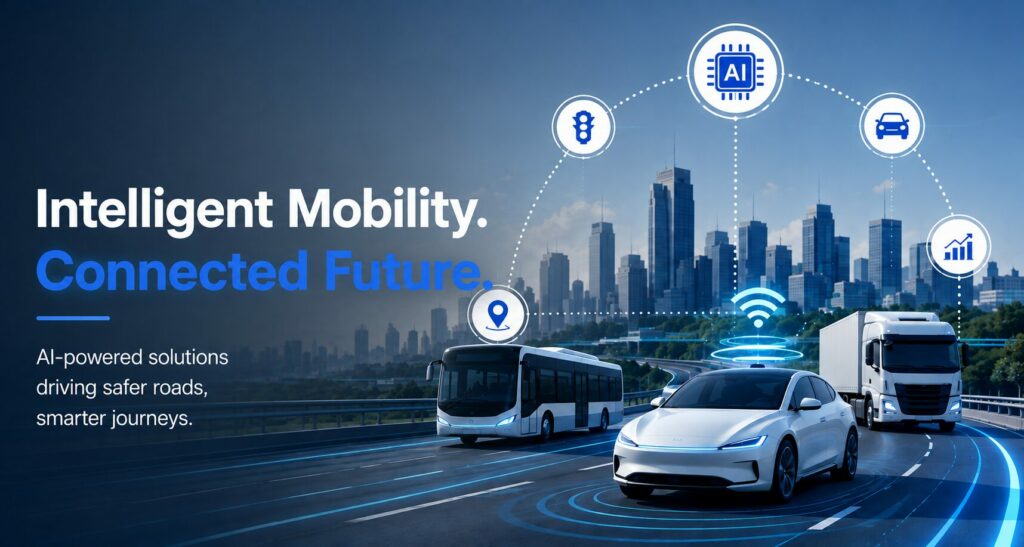
AI in Transportation
TL;DR
• AI makes transportation smarter, safer, and more efficient.
• AI traffic management reduces congestion and improves traffic flow.
• Autonomous vehicles use AI and computer vision for navigation.
• AI optimizes fleet routes, fuel, and maintenance.
• Predictive maintenance helps prevent vehicle downtime.
• AI improves logistics, delivery, and supply chain visibility.
• Smart systems connect vehicles, infrastructure, and real-time data.
Transportation is undergoing a major digital transformation. From autonomous vehicles and intelligent traffic management to predictive maintenance and AI-powered logistics, AI in transportation is changing how people and goods move around the world.
For decades, transportation systems relied heavily on fixed schedules, manual decision-making, traditional navigation systems, and historical data. Today, advances in Artificial Intelligence, machine learning, computer vision, predictive analytics, and real-time data processing are enabling transportation systems to become more intelligent, responsive, and efficient.
The future of transportation will not simply involve vehicles that can move from one location to another. It will increasingly involve connected ecosystems where vehicles, infrastructure, passengers, logistics networks, and transportation platforms communicate and make data-driven decisions. Businesses and governments are already exploring AI-powered transportation systems to improve safety, reduce congestion, optimize routes, lower operational costs, and deliver better experiences for passengers and customers.
What Is AI in Transportation?
AI in transportation refers to the use of artificial intelligence technologies to analyze data, automate decisions, predict events, optimize operations, and improve transportation-related services.
AI systems can process enormous amounts of information from sources such as:
- GPS devices
- Traffic cameras
- Vehicle sensors
- Mobile applications
- Weather systems
- Road infrastructure
- Fleet management platforms
- Public transportation networks
- Customer and passenger data
Machine learning algorithms can identify patterns within this information and use those patterns to support better decisions.
For example, an AI-powered traffic management system can analyze traffic conditions in real time and recommend changes to traffic signals or routes. Similarly, an AI-based fleet management platform can analyze vehicle data and identify potential maintenance requirements before a major breakdown occurs.
Why AI Is Important for the Future of Transportation
Transportation networks are becoming increasingly complex. Growing urban populations, rising eCommerce activity, increased vehicle ownership, and expanding logistics networks are creating new challenges.
Traditional transportation management methods may struggle to respond quickly to constantly changing conditions.
AI provides the ability to process real-time information and make intelligent predictions. This makes it an important technology for building more adaptive transportation systems.
Some of the major benefits of AI in transportation include:
- Improved road safety
- Reduced traffic congestion
- Better route optimization
- Predictive vehicle maintenance
- Lower fuel consumption
- Improved fleet utilization
- Faster logistics operations
- Better passenger experiences
- Automated transportation processes
- More accurate demand forecasting
AI-Powered Traffic Management
Traffic congestion is one of the biggest challenges facing cities around the world. Traditional traffic management systems often depend on fixed signal timings and historical traffic patterns.
AI can make traffic management more dynamic.
AI-powered traffic management systems can analyze information from cameras, sensors, GPS devices, and connected vehicles to understand current traffic conditions.
AI can identify:
- Traffic congestion
- Accidents
- Road blockages
- Vehicle density
- Traffic patterns
- Pedestrian movement
- Emergency situations
Based on this information, intelligent systems can recommend or automatically implement changes to traffic signals and routing strategies.
For example, if an AI system detects unusually heavy traffic on one road, it could recommend alternative routes or adjust signal timings to improve traffic flow.
This can help cities move toward smarter and more responsive transportation infrastructure.
Autonomous Vehicles
Autonomous vehicles are one of the most visible applications of AI technology.
Self-driving vehicles use a combination of AI, machine learning, computer vision, sensors, mapping technologies, and advanced decision-making systems to understand their surroundings.
An autonomous vehicle may need to identify:
- Vehicles
- Pedestrians
- Traffic lights
- Road signs
- Lane markings
- Obstacles
- Road conditions
The AI system processes this information and determines how the vehicle should respond.
Although fully autonomous transportation is still developing, AI is already being used in advanced driver-assistance systems and other vehicle technologies.
As the technology matures, autonomous vehicles could potentially transform personal transportation, public transit, delivery services, logistics, and freight operations.
AI for Fleet Management
Fleet operators manage large numbers of vehicles, drivers, routes, fuel requirements, and maintenance schedules. Managing these elements efficiently can be challenging without intelligent systems.
AI for fleet management can analyze vehicle and operational data to optimize transportation activities.
AI can help organizations with:
- Route optimization
- Driver behavior analysis
- Fuel management
- Vehicle utilization
- Maintenance scheduling
- Delivery planning
- Fleet monitoring
For example, machine learning models can analyze historical vehicle data and identify patterns associated with component failures.
This allows fleet managers to move from reactive maintenance toward predictive maintenance.
Predictive Maintenance
Vehicle downtime can be expensive for transportation companies.
Traditional maintenance schedules often rely on fixed intervals. While useful, they may not accurately reflect the actual condition of a vehicle.
AI-based predictive maintenance uses sensor data and machine learning to identify potential equipment problems.
A system can analyze factors such as:
- Engine performance
- Temperature
- Vibration
- Battery health
- Fuel consumption
- Brake performance
- Historical maintenance records
AI can then identify unusual patterns that may indicate an upcoming failure.
This approach can help transportation companies reduce unexpected downtime, improve vehicle availability, and potentially reduce maintenance costs.
AI in Logistics and Supply Chain Transportation
The logistics industry is another major area where AI is creating opportunities.
Modern supply chains generate large amounts of data related to orders, inventory, vehicles, warehouses, routes, customers, and delivery schedules.
AI can analyze this information to improve logistics operations.
AI in logistics and transportation can support:
- Delivery route optimization
- Demand forecasting
- Inventory planning
- Shipment tracking
- Warehouse automation
- Delivery time prediction
- Carrier selection
- Supply chain visibility
For example, an AI system can evaluate multiple delivery routes based on traffic, weather, distance, fuel consumption, and delivery priorities.
The result can be a more efficient transportation plan.
AI-Powered Public Transportation
Public transportation systems can also benefit significantly from artificial intelligence.
Buses, trains, metro systems, and other public transportation networks generate data about passenger demand, schedules, routes, delays, and vehicle locations.
AI can analyze this information to improve service planning.
Potential applications include:
- Passenger demand forecasting
- Dynamic scheduling
- Route optimization
- Delay prediction
- Predictive maintenance
- Smart ticketing
- Passenger assistance
- Real-time service information
Transportation authorities can use these insights to better align services with passenger demand.
For example, if an AI system predicts higher demand on a particular route during a specific period, transportation operators could adjust vehicle frequency accordingly.
Computer Vision and Transportation Safety
Computer vision is becoming an important component of intelligent transportation.
AI-powered cameras can analyze roads, vehicles, and surrounding environments.
Computer vision can help identify:
- Traffic violations
- Accidents
- Pedestrians
- Road hazards
- Lane violations
- Unsafe driving behavior
- Congested areas
In logistics and public transportation, computer vision can also support monitoring and security.
When combined with other AI technologies, computer vision can help transportation organizations create safer and more responsive environments.
AI for Route Optimization
Route planning is critical for transportation and logistics companies.
Traditional route planning may consider basic factors such as distance and destination. AI can consider many additional variables simultaneously.
An AI-powered route optimization system can evaluate:
- Current traffic
- Historical traffic patterns
- Weather
- Vehicle capacity
- Delivery priorities
- Road restrictions
- Fuel consumption
- Driver availability
This enables businesses to identify efficient routes based on real-world conditions.
For delivery businesses, better route optimization can potentially reduce travel time and fuel usage while improving delivery reliability.
AI and Smart Cities
The future of transportation is closely connected to the development of smart cities.A smart transportation ecosystem can connect vehicles, roads, traffic signals, public transportation, parking systems, and digital services.AI can act as an intelligence layer across these systems.
For example, connected transportation infrastructure could combine information about traffic, weather, public transportation demand, and road conditions to improve city-wide mobility.
This creates opportunities for smart transportation systems that respond dynamically to changing conditions rather than relying exclusively on fixed rules.
AI-Powered Transportation Apps
Mobile applications are becoming an important interface between transportation services and users.
Businesses can use mobile app development to create applications for:
- Ride booking
- Public transportation
- Vehicle tracking
- Delivery management
- Parking
- Fleet monitoring
- Logistics
- Navigation
AI can make these applications more intelligent by adding personalized recommendations, predictive features, intelligent chatbots, route optimization, and automated customer support.
For businesses planning AI-powered transportation applications, combining AI development with mobile application development can create a more comprehensive digital experience.
Generative AI in Transportation
Generative AI is expanding the possibilities of transportation software.
While traditional AI is often used for prediction, classification, and optimization, generative AI can create content and interact with users through natural language.
Transportation businesses can explore generative AI for:
- Customer support
- Driver assistance
- Transportation knowledge bases
- Internal documentation
- Intelligent search
- Report generation
- Operational assistants
- Data analysis
For example, a logistics manager could interact with an AI assistant using natural language to ask about delayed shipments, fleet performance, or route issues.
Generative AI can therefore make transportation software easier for employees and customers to interact with.
AI and Sustainable Transportation
Sustainability is becoming increasingly important for transportation companies and governments.
AI can contribute to sustainability by optimizing routes, reducing unnecessary vehicle movement, improving fleet utilization, and supporting predictive maintenance.
For example, optimized routes can reduce travel distances and fuel consumption. AI can also help organizations analyze transportation patterns and identify opportunities to improve operational efficiency.
Electric vehicle ecosystems can also use AI for charging optimization, battery monitoring, energy forecasting, and fleet management.
Challenges of Implementing AI in Transportation
Despite its benefits, implementing AI in transportation presents several challenges.
Data Quality
AI models depend on reliable data. Poor-quality, incomplete, or inconsistent data can affect system performance.
Cybersecurity
Connected vehicles and transportation infrastructure create additional cybersecurity considerations. Organizations need appropriate security measures to protect systems and data.
Privacy
Transportation platforms can process sensitive information about locations, users, vehicles, and journeys. Responsible data management is essential.
Infrastructure
AI-powered transportation solutions may require sensors, cloud infrastructure, APIs, connectivity, and data-processing systems.
Cost
Developing and maintaining advanced AI systems can require significant investment in technology and specialized expertise.
Human Oversight
AI should not always operate without supervision. Critical transportation applications require appropriate monitoring, testing, and human oversight.
The Future of AI in Transportation
The future of AI in transportation will likely involve increasing connectivity between vehicles, infrastructure, passengers, and logistics networks.
AI agents may assist transportation operators with complex workflows. Autonomous systems may become more capable. Multimodal AI could make transportation applications easier to interact with, while computer vision and predictive analytics may improve safety and operational efficiency.
Transportation will increasingly become a connected digital ecosystem rather than a collection of independent vehicles and services.
Organizations that invest in scalable AI solutions for transportation and logistics can position themselves to take advantage of these changes while improving existing operations.
How Businesses Can Prepare for AI-Driven Transportation
Organizations interested in adopting AI should begin with clearly defined business problems rather than simply adopting technology because it is trending.
A practical approach includes:
- Identify high-value use cases such as route optimization or predictive maintenance.
- Assess available data and identify gaps.
- Choose appropriate AI technologies based on business requirements.
- Develop a scalable technical architecture.
- Integrate AI with existing systems.
- Test AI models thoroughly.
- Monitor performance after deployment.
- Continuously improve the solution using new data and feedback.
Working with an experienced AI development company can also help organizations evaluate use cases, develop AI models, integrate intelligent features, and build scalable digital platforms.
Conclusion
The role of artificial intelligence in transportation is expanding rapidly. From autonomous vehicles and predictive maintenance to smart traffic management, intelligent logistics, route optimization, and AI-powered mobile applications, the technology is changing how transportation systems operate.The future will be defined by connected and intelligent transportation ecosystems capable of responding to real-time conditions and making data-driven decisions.
For transportation companies, logistics providers, technology businesses, and governments, AI represents an opportunity to improve efficiency, safety, sustainability, and customer experience.As AI technology continues to evolve, its role in transportation will likely become even more significant. Organizations that strategically adopt AI in the transportation industry can build smarter solutions today while preparing for the connected mobility systems of tomorrow.
Frequently Asked Questions
What is AI in transportation?
AI in transportation refers to using artificial intelligence, machine learning, computer vision, and predictive analytics to improve transportation operations, safety, route planning, traffic management, and logistics.
How is AI improving transportation and logistics?
AI helps optimize routes, predict demand, monitor fleets, reduce fuel consumption, improve delivery planning, detect potential vehicle failures, and provide better passenger and customer experiences.
How is AI used in autonomous vehicles?
AI enables autonomous vehicles to process data from cameras, sensors, maps, and other systems to identify vehicles, pedestrians, traffic signs, obstacles, and road conditions and make real-time driving decisions.
What are the benefits of AI in transportation?
Key benefits include improved safety, reduced congestion, predictive maintenance, optimized routes, lower operational costs, better fleet utilization, improved fuel efficiency, and more reliable transportation services.
What is the future of AI in transportation?
The future will involve increasingly connected transportation ecosystems where vehicles, roads, public transit, logistics networks, and passengers communicate through intelligent systems. AI agents, autonomous vehicles, computer vision, and predictive analytics are expected to play major roles in this transformation.