
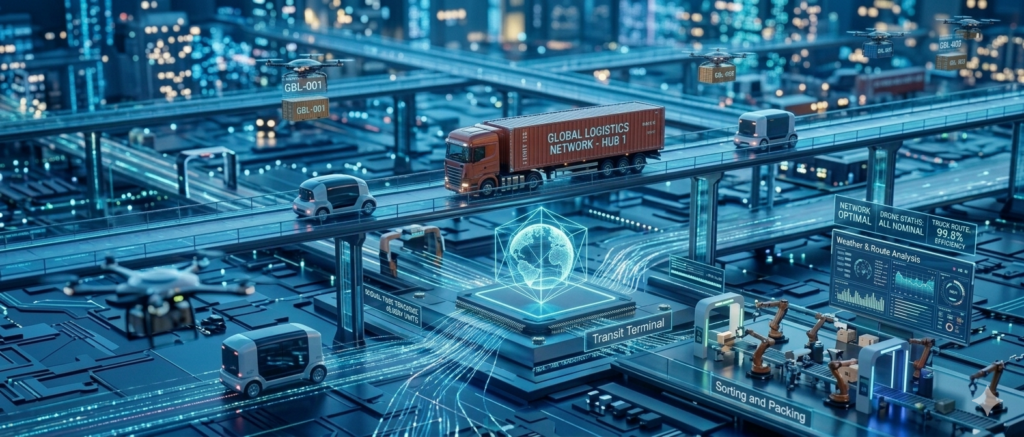
AI in Logistics
The logistics and supply chain industry is undergoing a major transformation. Rising customer expectations, global disruptions, and the rapid growth of eCommerce have created new challenges for businesses. Companies now need faster deliveries, real-time visibility, and smarter operations to remain competitive.
Artificial Intelligence (AI) is emerging as the technology driving this transformation. From predictive analytics and route optimization to warehouse automation and risk management, AI is helping businesses build smarter and more resilient supply chains.
The scale of logistics operations continues to grow rapidly. Over 100 billion parcels are handled globally every year, and this number is expected to nearly double by 2030, creating a growing need for automation and intelligent decision-making. AI is becoming essential to manage this complexity and improve operational efficiency.
As a result, AI is no longer just an emerging technology; it is becoming the backbone of modern logistics operations.
Why AI is Becoming Essential in Logistics
Logistics operations generate massive volumes of data across transportation, warehousing, demand forecasting, and supplier management. Managing this data manually is inefficient and often leads to delays, increased costs, and operational risks.
AI helps businesses analyze this data in real time and make smarter decisions. It improves accuracy and streamlines operations by supporting automated inventory management, smarter planning, and better warehouse operations.
For example, AI-powered systems can:
- Predict demand fluctuations
- Identify supply chain risks
- Optimize delivery routes
- Improve warehouse operations
- Automate repetitive tasks
These capabilities help businesses move from reactive logistics to predictive supply chain management.
AI also helps organizations build resilient supply chains. By analyzing trends and detecting disruptions early, businesses can take proactive action to minimize delays and reduce operational risks.
As supply chains become more complex and data-driven, AI is becoming essential for businesses looking to improve efficiency, reduce costs, and deliver better customer experiences.
Key Benefits of AI in Logistics
1. Smarter Demand Forecasting
Accurate demand forecasting is critical for supply chain efficiency. AI analyzes historical data, seasonal trends, and customer behavior to predict demand more accurately.
Machine learning algorithms can identify patterns across multiple data sources, including sales history, economic indicators, and even social media trends. This allows businesses to optimize inventory levels and reduce stock shortages.
Benefits include:
- Better inventory planning
- Reduced stockouts
- Lower operational costs
- Improved customer satisfaction
With AI-driven forecasting, businesses can make smarter decisions and reduce supply chain risks.
2. Intelligent Route Optimization
Transportation is one of the most expensive aspects of logistics operations. AI-powered route optimization helps companies determine the most efficient delivery routes by analyzing traffic, weather conditions, and delivery schedules.
Machine learning algorithms analyze transportation data and real-time traffic conditions to create more efficient and cost-effective logistics networks.
This leads to:
- Faster deliveries
- Reduced fuel costs
- Improved operational efficiency
- Lower carbon emissions
Smarter routing also helps businesses improve sustainability by reducing fuel consumption and optimizing fleet performance.
3. Warehouse Automation
AI-powered warehouse automation is transforming logistics operations. Robots and intelligent systems can handle tasks such as sorting, picking, and packing more efficiently.
Automation improves accuracy, reduces manual errors, and speeds up order fulfillment. AI also helps optimize warehouse layouts and inventory placement based on demand patterns.
This approach results in:
- Faster order fulfillment
- Reduced operational costs
- Improved warehouse efficiency
- Better inventory management
As automation continues to evolve, warehouses are becoming smarter and more efficient.
4. Real-Time Supply Chain Visibility
One of the biggest challenges in logistics is lack of visibility. AI helps businesses monitor shipments, inventory, and supplier performance in real time.
Advanced analytics and smart sensors provide real-time insights, helping businesses detect delays and optimize operations.
Real-time visibility helps:
- Improve decision-making
- Reduce disruptions
- Enhance customer experience
- Improve supply chain transparency
This visibility is essential for modern logistics operations.
Real-World Examples of AI in Logistics
Many global companies are already using AI to transform logistics operations.
- Bosch uses AI for quality control in logistics to reduce product returns
- L’Oréal uses AI for supplier risk assessment to strengthen supply chains
- Retail companies use AI for demand forecasting and delivery optimization
These examples highlight how AI is improving efficiency and reducing operational risks.
Challenges of AI in Logistics
While AI offers many advantages, businesses must address some challenges.
- Data Quality
AI systems require accurate data for reliable predictions.
- Integration Complexity
Integrating AI with existing systems can be challenging.
- Implementation Costs
Initial investment may be high for small businesses.
Despite these challenges, AI adoption continues to grow across industries.
The Future of AI in Logistics
The future of logistics is becoming more intelligent and automated. AI will continue to transform supply chains through:
- Autonomous vehicles
- Smart warehouses
- Predictive logistics
- AI-powered planning
- Real-time analytics
AI is expected to boost logistics productivity by up to 40% by 2035, highlighting its growing impact on the industry.
Businesses that adopt AI early will gain a competitive advantage and build more resilient supply chains.
Conclusion
AI is transforming logistics and supply chain operations through intelligent automation and predictive decision-making. Businesses can now improve efficiency, reduce costs, and deliver faster services.
As supply chains become more complex, AI will play a critical role in building smarter and more resilient logistics networks. The future of logistics is intelligent, and AI is leading the transformation.