
Meta Muse AI
TL;DR
• Meta expands Muse AI for small businesses.
• Muse connects with popular business tools.
• Supports Shopify, Slack, Canva, QuickBooks, and more.
• Helps with marketing, sales, finance, and productivity.
• AI agents use business context to complete tasks.
• Human oversight remains important.
Artificial intelligence is rapidly moving beyond traditional chatbots. Instead of simply answering questions, newer AI systems are being designed to understand context, connect with different applications, and help users complete tasks. Meta is taking another step in this direction with Muse for Small Business, an AI agent designed to help small businesses manage everyday operations and discover new growth opportunities.
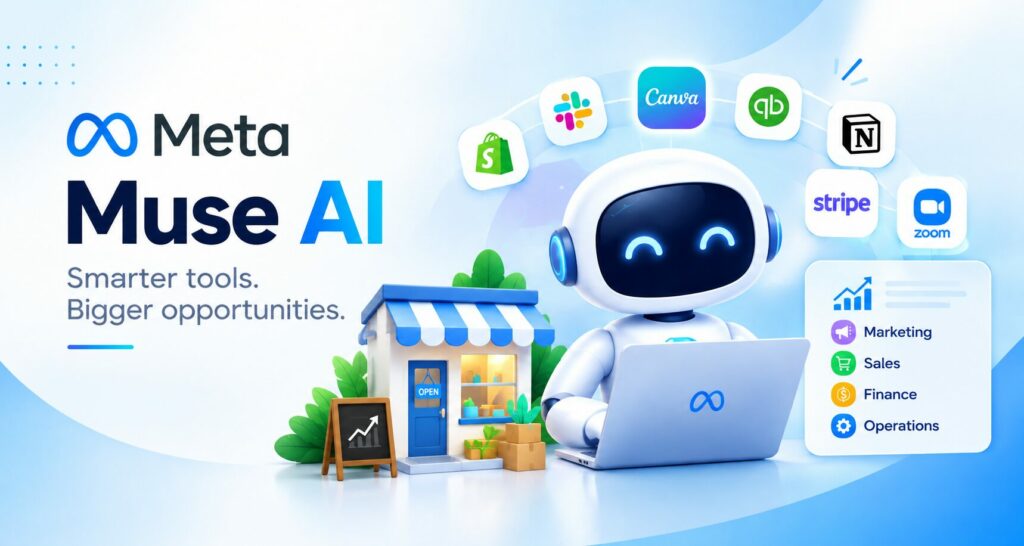
Meta announced the expansion of Muse to small businesses. The new offering includes integrations with popular business tools such as Shopify, Dropbox, Slack, Canva, QuickBooks, Notion, Stripe, Zoom, and several other platforms.
The development highlights a growing trend in business technology: AI agents are becoming more connected to the software businesses already use. Rather than functioning as standalone chatbots, these systems can use information from multiple applications to provide more context-aware assistance.
What Is Meta Muse AI?
Meta Muse AI is an AI agent developed by Meta to help users complete tasks and projects.
Unlike a conventional chatbot that primarily responds to individual prompts, an AI agent can work toward a broader objective by using connected tools and information. This makes agentic AI particularly interesting for businesses that need to manage multiple workflows at the same time.
With Muse for Small Business, Meta is extending this concept to business owners.
Muse can connect with business applications and Meta’s own business services. It can work with information related to a company’s products, brand communication, customer questions, social media activity, advertising, and other business operations.
Why Is Meta Expanding Muse to Small Businesses?
Small businesses frequently operate with limited staff and resources. Business owners may have to handle marketing, sales, customer service, accounting, advertising, operations, and administrative work simultaneously.
This creates a potential opportunity for AI agents.
Instead of requiring business owners to move manually between multiple applications, an AI agent can potentially bring information from different systems into a single workflow.
Meta’s Muse for Small Business supports integrations with platforms including Shopify, Dropbox, Slack, Asana, Box, Canva, Figma, Granola, HighLevel, Intuit QuickBooks, Klaviyo, Lovable, Notion, Stripe, and Zoom.
It can also connect with Instagram professional accounts, Facebook Pages, and Meta advertising accounts.
The objective is to give Muse greater business context.
For example, an AI system that knows what a company sells, how its brand communicates, what customers frequently ask, and how its advertising campaigns perform can potentially provide more relevant assistance than an AI system operating without that information.
How Can Meta Muse AI Help Small Businesses?
1. Marketing and Content Creation
Marketing is one of the most common areas where small businesses can potentially use AI.
Creating social media posts, developing campaign ideas, reviewing customer questions, and analyzing marketing activity can require significant amounts of time.
Muse can work with connected business and social media information to assist with these activities.
Potential applications include:
- Social media planning
- Content creation
- Marketing campaign ideas
- Advertising analysis
- Customer question analysis
- Brand messaging
- Promotional planning
- Marketing research
The ability to combine business context with AI-generated content could make AI marketing tools more useful for small businesses.
2. Sales and E-Commerce
E-commerce businesses generate information across multiple systems.
An online store may contain product and sales information, while advertising platforms provide campaign data and payment platforms contain transaction information.
Muse’s integration with Shopify and Stripe gives businesses an opportunity to bring some of these systems into an AI-assisted workflow.
Potential applications include:
- Sales analysis
- E-commerce performance analysis
- Product research
- Campaign planning
- Customer insights
- Business reporting
- Sales trend analysis
For small online businesses, these capabilities could make AI-powered e-commerce automation easier to explore.
3. Financial Analysis
Financial management is another area where AI agents could assist businesses.
Muse can connect with Intuit QuickBooks, allowing business information from accounting workflows to become part of an AI-assisted analysis.
Meta has highlighted the ability of Muse to review monthly financial performance and identify expenses that may appear unusual.
AI-generated financial analysis should still be reviewed carefully by people with appropriate financial knowledge. AI can assist with organizing and identifying information, but it does not eliminate the need for professional judgment.
4. Productivity and Operations
Small business owners often use several applications throughout the day.
One platform may be used for communication, another for project management, another for documents, and another for meetings.
Muse’s integrations with applications such as Slack, Asana, Dropbox, Notion, and Zoom are designed to make AI assistance available across these workflows.
This reflects a broader development in AI business automation.
Instead of creating another isolated application, AI agents are increasingly being designed as a layer that can work across existing software.
Meta Muse AI and Traditional Chatbots
One of the key differences between AI agents and traditional chatbots is their ability to work toward a task.
A traditional chatbot workflow may look like:
Question → AI response → Human completes the task
An AI agent workflow can be more like:
Goal → Understand context → Plan → Use connected tools → Complete task → Human review
This does not mean that AI agents should operate without supervision.
For business applications, human approval remains particularly important because AI-generated actions can affect customers, finances, marketing campaigns, and business operations.
Meta says users remain in control of Muse for Small Business, with actions such as publishing, sending, or spending requiring approval.
Why AI Integrations Matter
The growth of AI agents is closely connected to the growth of AI integrations.
An AI model can generate text, analyze information, and answer questions. But when that model is connected to business software, it can potentially work with much more relevant information.
Consider two different requests.
A standalone chatbot might receive:
“Create a marketing campaign for my business.”
A connected AI agent could potentially receive:
“Review my recent sales and advertising performance, analyze customer questions, and prepare ideas for next month’s campaign.”
The second request requires access to business information.
This is why APIs, integrations, connectors, databases, and secure permissions are becoming increasingly important in AI development.
Security and Human Oversight
As AI agents gain access to more business applications, security becomes an increasingly important consideration.
Business systems can contain sensitive information, including:
- Customer data
- Financial information
- Internal documents
- Business communications
- Advertising accounts
- Sales information
- Marketing data
Giving an AI agent access to these systems requires appropriate controls.
Businesses adopting AI agents for business automation should consider factors such as:
- Data permissions
- User authentication
- API security
- Human approval
- Access controls
- Audit trails
- Data privacy
- Error monitoring
- Integration security
Human oversight is particularly important when an AI agent can perform actions rather than simply provide information.
What Makes Muse Different for Small Businesses?
One of the notable aspects of Muse for Small Business is its focus on existing business software.
Small companies may already rely on several specialized tools. Replacing all of them with a single AI platform would not necessarily be practical.
Instead, connecting AI to those existing tools could provide another approach.
For example, a business owner could use different applications for:
- Online sales
- Accounting
- Communication
- Project management
- Social media
- Advertising
- Design
- Customer relationship management
- Video meetings
An AI agent that can work across these services could potentially help reduce repetitive work and make information easier to access.
Meta Muse and the Future of Business AI
The expansion of Muse reflects a larger shift toward agentic AI.
Earlier generations of business AI often focused on specific functions, such as chatbots, recommendation systems, analytics, or automated customer support.
AI agents are attempting to combine several capabilities into a broader workflow.
An AI agent can potentially:
- Understand a user’s objective.
- Collect relevant information.
- Analyze the available data.
- Plan a sequence of actions.
- Interact with connected applications.
- Produce an output or complete a task.
- Ask for human approval when necessary.
This approach could eventually change how businesses interact with software.
Instead of opening several applications and manually performing individual tasks, users could increasingly interact with AI systems that coordinate work across those applications.
How AI Agents Could Benefit Small Businesses
Large companies have historically had more resources to invest in automation, data systems, analytics, and specialized software.
AI agents could potentially make some advanced capabilities more accessible to smaller organizations.
A small company may not have separate employees dedicated to every business function.
An AI agent could potentially assist with repetitive tasks across marketing, sales, administration, customer service, and operations.
However, businesses still need to determine which activities are appropriate for automation.
Important questions include:
- Which tasks should AI handle?
- Which decisions require human approval?
- What information should the AI access?
- How should AI-generated results be checked?
- What happens when the AI produces an incorrect result?
- Which business processes can benefit most from automation?
The answers will vary depending on the size, industry, data, and operational requirements of each business.
Meta’s Broader AI Strategy
Muse for Small Business is also part of Meta’s wider push into business-focused artificial intelligence.
Meta recently announced its Meta Enterprise Platform, which is aimed at expanding the company’s AI technologies for businesses and developers.
The company’s broader AI ecosystem includes technologies such as Muse, Meta Business Agent, Muse API, and Muse Code.
This suggests that Meta’s AI strategy is expanding beyond consumer applications and into business software, development, automation, and enterprise workflows.
Muse for Small Business provides a practical example of how these technologies can be applied to smaller organizations.
What Does Meta Muse Mean for Small Businesses?
The expansion of Muse demonstrates how the role of AI in business is changing.
AI is no longer limited to generating text or answering questions. Increasingly, AI systems are being designed to understand business context, connect to software, analyze information, and assist with tasks.
For small businesses, this could provide new opportunities to automate repetitive work and improve productivity.
At the same time, AI adoption requires careful consideration of security, privacy, accuracy, permissions, and human oversight.
The success of AI agents will ultimately depend on how reliably they can perform useful tasks while keeping people in control of important decisions.
The Future of Meta Muse AI
Meta Muse AI is part of a broader movement toward connected and action-oriented artificial intelligence.
With integrations across e-commerce, accounting, communication, project management, design, marketing, and productivity platforms, Muse for Small Business is designed to work within the software environment that businesses already use.
The development also highlights an important direction for the future of AI automation for small businesses.
Rather than using AI as an isolated chatbot, businesses may increasingly use AI agents as an intelligent layer connecting their data, applications, and workflows.
As these systems become more capable, businesses will need to balance automation with human oversight.
The future of business AI may therefore not be about simply replacing existing software or employees. Instead, it could involve creating AI-assisted workflows where people define goals, review important decisions, and allow AI agents to handle appropriate repetitive tasks.
For small businesses, this could make advanced AI capabilities increasingly accessible while allowing owners and employees to spend more time on strategy, customers, products, and growth.
Final Thoughts
Meta Muse AI represents an important development in the growing use of AI agents for small businesses. By connecting with tools used for e-commerce, accounting, communication, marketing, project management, and productivity, Muse is designed to help businesses work with AI in a more connected way.
The biggest shift is that AI is moving beyond simply answering questions toward assisting with real business tasks. For small businesses with limited time and resources, AI agents could help reduce repetitive work, organize information, support decision-making, and improve everyday productivity.
However, effective AI adoption will require more than access to advanced technology. Businesses will need to consider data security, privacy, permissions, accuracy, and human oversight when integrating AI into important workflows.
As Meta continues developing Muse and expanding its business-focused AI capabilities, AI agents could become an increasingly common part of how small businesses manage operations, marketing, sales, and growth. The key will be finding the right balance between automation and human control.
Frequently Asked Questions
What is Meta Muse AI?
Meta Muse AI is an AI agent from Meta designed to help users complete tasks and projects using connected tools and business information.
How can Meta Muse AI help small businesses?
Meta Muse AI can assist with marketing, sales, e-commerce, financial analysis, productivity, and business operations.
What tools can Meta Muse AI connect with?
Muse for Small Business supports integrations with tools including Shopify, Slack, Dropbox, Canva, QuickBooks, Notion, Stripe, Zoom, and other business platforms.
Is Meta Muse AI different from a traditional chatbot?
Yes. An AI agent can work toward a broader task by using connected tools and information, rather than only responding to individual prompts.
Why is human oversight important when using AI agents?
AI agents can interact with business systems and perform tasks, so businesses need appropriate controls for permissions, security, privacy, accuracy, and human approval.