
RAG vs Fine-Tuning
TL;DR
• RAG retrieves relevant information from external knowledge sources to generate answers.
• Fine-tuning adapts an AI model for specialized tasks, formats, and behaviors.
• RAG is useful for frequently updated business information and internal documents.
• Fine-tuning helps improve consistency in repetitive, specialized workflows.
• Businesses can combine RAG and fine-tuning when both current knowledge and specialized behavior are needed.
Enterprise artificial intelligence is evolving beyond basic chatbots. Businesses now want AI systems that can answer questions using internal documents, understand industry-specific terminology, follow company workflows, and deliver reliable results. Two popular approaches for achieving these goals are Retrieval-Augmented Generation (RAG) and fine-tuning.
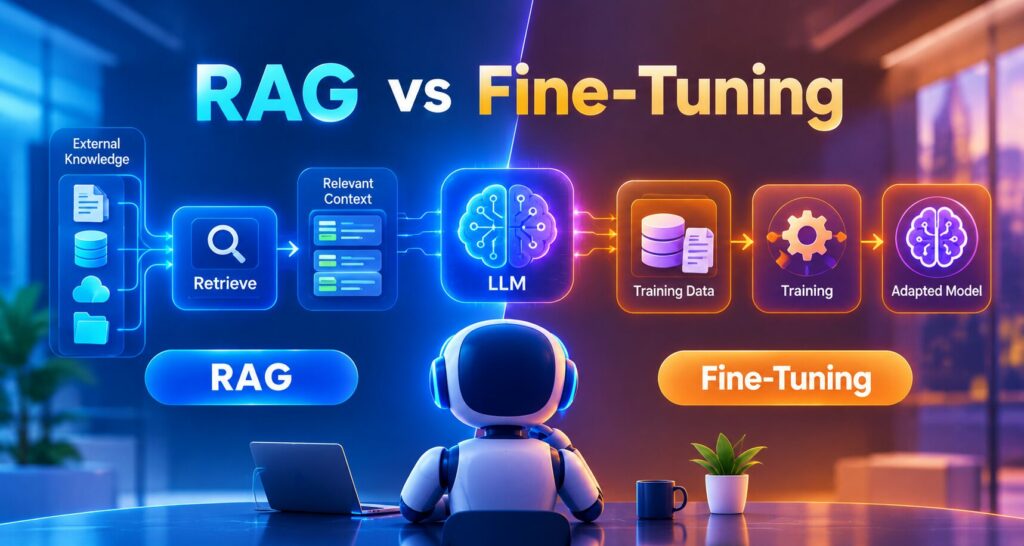
Understanding RAG vs Fine-Tuning is essential for organizations planning to integrate large language models (LLMs) into their existing applications and business processes. Both techniques can improve AI performance, but they solve different problems. RAG helps models retrieve relevant information from external knowledge sources, while fine-tuning adapts a model’s behavior through additional training.
Choosing the right approach depends on the business objective, data requirements, budget, technical infrastructure, and maintenance needs. Some organizations may benefit from RAG alone, while others may need fine-tuning or a combination of both.
In this guide, we explain how RAG and fine-tuning work, compare their advantages and limitations, and explore how enterprises can choose the right strategy for their AI projects.
What Is Retrieval-Augmented Generation (RAG)?
Retrieval-Augmented Generation, or RAG, is an AI architecture that combines a language model with an information retrieval system. Instead of relying exclusively on information learned during training, the model retrieves relevant content from an external knowledge source before generating an answer.
This makes RAG particularly useful when businesses need AI applications to work with internal documents, frequently updated information, product catalogs, support resources, and organizational knowledge.
How RAG Works
A typical RAG pipeline includes the following steps:
- Data collection: Business documents, databases, knowledge bases, and other relevant sources are collected.
- Data processing: Content is cleaned, divided into manageable chunks, and converted into numerical representations called embeddings.
- Indexing: The embeddings and associated content are stored in a vector database or another searchable retrieval system.
- Query processing: When a user submits a question, the system searches for relevant information.
- Context injection: The retrieved content is provided to the language model as context.
- Answer generation: The model uses the supplied context to generate a relevant response.
For example, an enterprise HR assistant could use RAG to retrieve the latest employee leave policy and answer a question about annual leave. When the policy changes, the organization can update the knowledge source without necessarily retraining the language model.
Benefits of RAG for Enterprises
RAG offers several advantages for business applications:
- Access to current information: Knowledge sources can be updated without retraining the underlying model.
- Internal knowledge integration: AI systems can retrieve information from company documents and databases.
- Improved traceability: Applications can provide references to the retrieved sources when the system is designed to support citations.
- Flexible knowledge management: Different teams can maintain their own searchable information sources.
- Reduced retraining requirements: Many content updates require only re-indexing or refreshing the retrieval system.
However, RAG also has limitations. Poor document quality, ineffective retrieval, missing context, and incorrect permissions can reduce answer quality. RAG does not automatically eliminate hallucinations, and its performance depends on the quality of the retrieval pipeline and the language model.
What Is Fine-Tuning in AI?
Fine-tuning is a process in which a pretrained language model undergoes additional training on a carefully selected dataset. The purpose is to adapt the model to a specific task, domain, output format, or communication style.
Unlike RAG, which supplies information at inference time, fine-tuning changes the model’s learned parameters or, in parameter-efficient methods, trains additional parameters associated with the model.
Businesses can use fine-tuning to improve consistency across specialized tasks, teach the model preferred response patterns, and help it follow domain-specific instructions.
How Fine-Tuning Works
A typical fine-tuning workflow involves these steps:
- Define the objective: Identify the task or behavior that needs improvement.
- Prepare the dataset: Collect high-quality examples that demonstrate the desired outputs.
- Clean and validate the data: Remove duplicates, errors, sensitive information, and inconsistent examples.
- Train the model: Apply full fine-tuning or a parameter-efficient technique such as Low-Rank Adaptation (LoRA), depending on the model and requirements.
- Evaluate performance: Test the model against representative tasks and compare its performance with the original version.
- Deploy and monitor: Integrate the adapted model into the application and monitor quality, cost, and reliability.
For example, a financial services company might fine-tune a model to classify customer support requests into predefined categories and produce structured outputs that follow its internal format.
Benefits of Fine-Tuning for Enterprises
Fine-tuning can be useful when a business needs:
- Consistent output formats: Generate structured responses, classifications, summaries, or reports.
- Specialized task performance: Adapt a model to recurring industry-specific tasks.
- A consistent communication style: Align responses with a company’s preferred tone and terminology.
- Better instruction following: Improve performance on well-defined tasks represented in the training data.
- Task-specific optimization: Potentially reduce reliance on long prompts for repeated workflows.
Fine-tuning also introduces challenges. Preparing reliable training data requires time and expertise, while training and evaluation can increase development costs. Fine-tuned models may need to be retrained or adapted when requirements change. Most importantly, fine-tuning does not guarantee that a model will remember new facts accurately or consistently.
RAG vs Fine-Tuning: Key Differences
The primary difference between RAG and fine-tuning is how they improve an AI application. RAG provides relevant external information to the model at runtime, whereas fine-tuning adapts how the model performs a task through additional training.
| Comparison factor | RAG | Fine-Tuning |
| Main purpose | Provide relevant external knowledge | Adapt model behavior or task performance |
| How it works | Retrieves information at inference time | Trains the model on additional examples |
| Updating information | Refresh or re-index knowledge sources | May require additional training or another update strategy |
| Internal documents | Well suited to searchable knowledge bases | Can learn patterns from representative examples |
| Output consistency | Depends on prompts, context, and model behavior | Can improve consistency on targeted tasks |
| Initial requirements | Data pipeline, retrieval system, and indexing | Quality training data and a training workflow |
| Infrastructure | Retrieval and inference infrastructure | Training and inference infrastructure, depending on the method |
| Source attribution | Can expose retrieved references | Does not inherently provide source citations |
| Best fit | Knowledge-intensive question answering | Repeated specialized tasks and behavior adaptation |
| Common limitation | Retrieval errors or irrelevant context | Data costs, training complexity, and limited factual updating |
Neither approach is universally superior. The best choice depends on whether the main challenge is giving the AI access to the right information or helping it perform a task in the desired way.
When Should Businesses Choose RAG?
RAG is often the stronger starting point when an enterprise needs AI to answer questions using information that changes frequently or must remain connected to an authoritative source.
1. Enterprise Knowledge Management
Large organizations maintain policies, technical documentation, internal guides, product information, and operational records. RAG can make this information easier to access through natural-language questions.
For instance, employees could ask an internal assistant about expense policies or onboarding procedures and receive answers grounded in approved documentation.
2. Customer Support Automation
Support teams frequently work with product manuals, troubleshooting guides, FAQs, and service policies. A RAG-powered assistant can retrieve relevant information to help answer customer questions.
When product documentation changes, the company can update the knowledge base instead of retraining the model for every content revision.
3. Document-Heavy Industries
Legal services, healthcare administration, insurance, and financial services often depend on large collections of documents. RAG can help retrieve relevant passages and summarize information for human review.
These applications still require appropriate privacy controls, access permissions, domain-specific evaluation, and human oversight where decisions are consequential.
4. Frequently Updated Information
Businesses that manage changing prices, inventory details, service terms, product specifications, or company policies may prefer RAG because the knowledge source can be refreshed independently of model training.
For these scenarios, retrieval quality and data freshness are central to the overall system’s performance.
When Should Businesses Choose Fine-Tuning?
Fine-tuning is more appropriate when the primary objective is to improve how a model performs a repeated task rather than simply provide it with additional information.
1. Industry-Specific Workflows
Enterprises may need AI systems that follow specialized classification rules, produce structured reports, or interpret domain-specific language. Fine-tuning can help when suitable training examples are available and the base model does not meet the required performance level.
2. Structured Output Generation
Applications may require responses in a consistent JSON structure, a particular schema, or a predefined classification format. Fine-tuning can improve consistency for some workloads, although schema-constrained decoding, validation, and clear prompting may also be effective alternatives.
3. Brand Voice and Communication Style
Businesses that generate large volumes of customer communications may want consistent terminology, tone, and formatting. Fine-tuning can help teach these patterns when prompt-based methods alone are insufficient.
4. Repetitive Specialized Tasks
Fine-tuning may benefit applications that perform the same narrow task at scale, such as ticket classification, document labeling, or extracting information into predefined fields.
Before investing in training, teams should compare fine-tuning with simpler approaches such as prompt engineering, structured output constraints, and model selection.
Can Businesses Combine RAG and Fine-Tuning?
Yes. RAG and fine-tuning are complementary techniques, and enterprises can combine them when their requirements justify the additional complexity.
RAG supplies relevant information, while fine-tuning can adapt the model’s behavior to the task. Together, they may support applications that need both access to changing knowledge and consistent domain-specific responses.
Consider an enterprise insurance assistant. RAG could retrieve the latest policy documents and approved claim guidelines, while a fine-tuned model could help classify requests or produce standardized summaries.
A combined architecture might follow this workflow:
- A user submits a question or task.
- The application identifies the user’s permissions and retrieves relevant information.
- The language model receives the retrieved context and task instructions.
- The model generates a response using its adapted behavior.
- The application validates the output and provides citations or routes the request for human review when necessary.
The combination is not automatically better. It introduces more components to test, secure, monitor, and maintain. Businesses should establish that each technique provides measurable value before adding it to the architecture.
Cost and Performance: What Enterprises Should Evaluate
The cost of RAG versus fine-tuning depends on the model, infrastructure, data volume, workload, and operational requirements. There is no universal rule that one approach is always cheaper.
RAG may require spending on document processing, embedding generation, vector storage, retrieval, and additional inference context. Fine-tuning may require dataset preparation, training compute, evaluation, model hosting, and ongoing model maintenance.
Enterprises should evaluate the total cost of ownership rather than compare training costs alone.
Important factors include:
- Development cost: How much engineering work is needed to build and test the solution?
- Inference cost: How many tokens, retrieval operations, and model calls are required per request?
- Data maintenance: How frequently must the knowledge base or training dataset be updated?
- Response quality: Does the system answer accurately on realistic business tasks?
- Latency: How quickly must the application respond?
- Security: Can the solution enforce document-level permissions and protect sensitive information?
- Scalability: Can the architecture handle growing usage and larger datasets?
- Monitoring: Can the business detect incorrect answers, retrieval failures, and performance changes?
A practical proof of concept should measure these factors using representative data before the company commits to a production architecture.
Security and Governance Considerations
Enterprise AI systems must protect sensitive information regardless of whether they use RAG, fine-tuning, or both.
RAG systems need access controls that prevent users from retrieving documents they are not authorized to view. Security teams should also evaluate prompt injection in retrieved content, data leakage, logging practices, and the risks of connecting AI applications to internal tools.
Fine-tuning datasets require careful handling because sensitive information may be exposed during data preparation or training. Organizations should assess data retention policies, model-provider terms, memorization risks, and procedures for removing or correcting problematic training examples.
Both approaches need testing for hallucinations, biased outputs, and task-specific failures. Businesses should define ownership, monitoring procedures, escalation paths, and human review requirements before deployment.
How to Choose the Right Enterprise AI Approach
Businesses can use the following decision framework to select an appropriate starting point.
Choose RAG when:
- Answers must reflect current internal documents.
- Information changes frequently.
- Responses should be grounded in approved knowledge sources.
- Users need references to supporting documentation.
Choose fine-tuning when:
- The application performs a narrow, repetitive task.
- Output patterns or specialized behavior need improvement.
- High-quality training examples are available.
- Prompt engineering and other simpler methods do not meet the performance target.
Consider both when:
- The application needs frequently updated knowledge and specialized behavior.
- RAG alone does not provide sufficient task consistency.
- Fine-tuning alone cannot reliably supply current business information.
- Evaluation shows that the combined architecture improves results enough to justify its cost.
A sensible implementation strategy is to start with a baseline model, establish a measurable evaluation set, and test prompt engineering and RAG where relevant. Fine-tuning can then be evaluated if the system still falls short on clearly identified tasks.
Final Thought
The choice between RAG and fine-tuning depends on the problem a business is trying to solve. RAG is generally a strong option for connecting language models to changing company knowledge, while fine-tuning can help adapt models to specialized tasks, output formats, and communication patterns.
For many enterprise knowledge applications, RAG is a practical starting point because organizations can manage information separately from model training. Fine-tuning becomes worth considering when measurable behavioral or task-specific improvements are needed. In more advanced applications, a combination of both may offer the best results.
Ultimately, successful enterprise AI depends on more than selecting a technique. Data quality, security, evaluation, integration, and continuous monitoring are equally important. Businesses should choose the simplest architecture that meets their requirements and expand it only when testing demonstrates a clear benefit.
Frequently Asked Questions
What is the difference between RAG and fine-tuning?
RAG retrieves external information at runtime to help an AI model answer questions. Fine-tuning uses additional training data to adapt the model's behavior, style, or task performance.
Is RAG better than fine-tuning for enterprise AI?
Neither approach is always better. RAG is useful for accessing current business information, while fine-tuning is suitable for specialized tasks and consistent output patterns.
When should businesses use RAG?
Businesses should consider RAG when AI applications need to answer questions using internal documents, company policies, product information, or frequently updated knowledge bases.
When is fine-tuning useful?
Fine-tuning can help with repetitive tasks, specialized classification, structured output generation, and consistent communication styles when simpler approaches do not meet requirements.
Can RAG and fine-tuning be used together?
Yes. RAG can provide current, relevant information, while fine-tuning can adapt the model to specific tasks or response patterns. Combining them may improve results but adds development and maintenance complexity.