
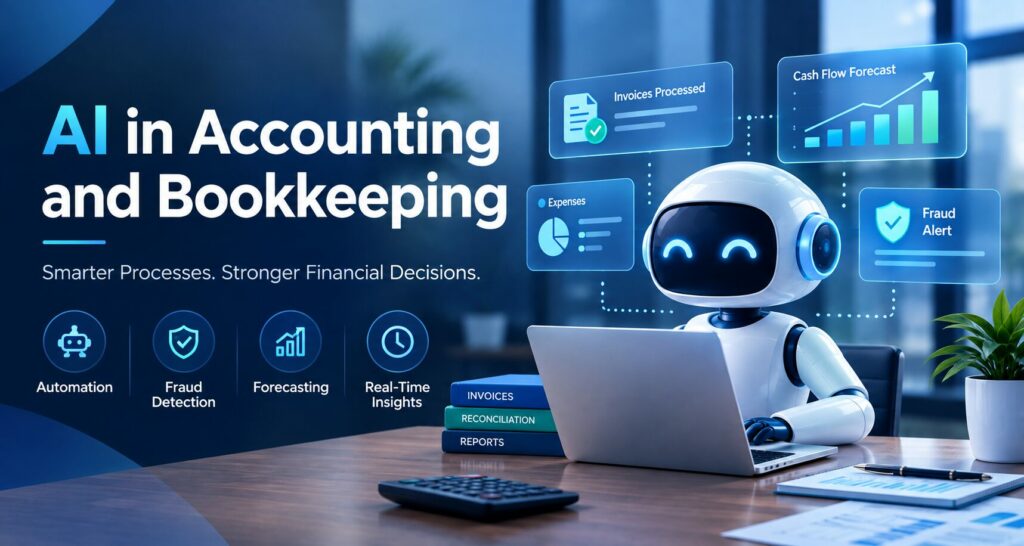
AI in Accounting and Bookkeeping
TL;DR
• AI automates repetitive accounting and bookkeeping tasks.
• AI helps process invoices and financial documents faster.
• Machine learning supports fraud and anomaly detection.
• AI enables predictive financial forecasting.
• Real-time reporting improves financial visibility.
• AI can reduce manual administrative work.
Accounting and bookkeeping have traditionally relied on repetitive processes such as manual data entry, spreadsheets, financial software, reconciliations, invoice processing, and periodic reporting. Today, artificial intelligence is changing how these activities are performed. From automated bookkeeping and invoice processing to fraud detection, financial forecasting, and real-time reporting, AI in accounting is becoming an important part of modern finance operations.
The transformation is not simply about making accounting tasks faster. Artificial intelligence is changing how financial information is collected, processed, analyzed, and used for business decisions. As businesses generate increasing amounts of financial data, intelligent systems can help organizations identify patterns, automate repetitive workflows, and gain faster access to useful insights.
Recent developments in the accounting technology market also demonstrate the growing interest in AI-native bookkeeping platforms. New solutions are being designed to provide real-time financial information, automate bookkeeping workflows, and reduce the amount of manual work involved in traditional accounting processes.
The Growing Role of AI in Accounting
Traditional accounting systems are effective at recording financial transactions, but many processes still require significant human intervention. Accountants may spend hours processing invoices, matching transactions, checking documents, preparing reports, and reconciling accounts.
AI introduces automation into these workflows.
Modern AI systems can process large volumes of structured and unstructured financial information, recognize patterns, classify transactions, identify anomalies, and generate useful insights. Machine learning models can also improve their ability to recognize patterns as they process more relevant data.
Businesses exploring AI development can use these capabilities to automate repetitive financial workflows while giving finance teams faster access to information.
For organizations looking to build customized intelligent solutions, AI development for financial services can support applications ranging from document processing to financial analytics and workflow automation.
How AI Is Transforming Bookkeeping
Bookkeeping is one of the areas experiencing significant automation.
AI-powered systems can extract information from invoices, receipts, bank statements, purchase orders, and other financial documents. Instead of manually entering every transaction, software can identify important fields and organize the information automatically.
Automated Data Entry
AI can extract:
- Invoice numbers
- Vendor information
- Transaction dates
- Tax amounts
- Payment amounts
- Customer information
- Expense categories
This reduces repetitive data-entry work and allows accounting professionals to spend more time reviewing and interpreting financial information.
For businesses looking for AI automation for accounting and bookkeeping, automated document processing can be an important starting point.
Automated Bank Reconciliation
Bank reconciliation involves comparing financial records with bank transactions and identifying differences.
AI can automatically match transactions and highlight exceptions that require human attention. This allows accountants to spend less time searching through individual transactions and more time investigating unusual activity.
This is one practical example of how AI-powered accounting software development can improve financial workflows.
Intelligent Invoice Processing
AI can support accounts payable workflows by reading invoices, identifying duplicate documents, extracting relevant information, matching invoices with purchase orders, and routing transactions for approval.
This combination of AI automation and accounting software can help businesses streamline financial operations while reducing repetitive administrative tasks.
AI-Powered Fraud Detection
Fraud detection is another important application of artificial intelligence in finance.
Traditional financial monitoring often depends on predefined rules and periodic reviews. AI can analyze transaction patterns and identify unusual behavior across large datasets.
For example, an AI system could flag:
- Duplicate payments
- Unusually large transactions
- Unexpected changes in spending
- Unusual transaction timing
- Abnormal vendor activity
- Suspicious account behavior
Instead of replacing financial professionals, these systems can provide an additional layer of monitoring.
This makes AI fraud detection software development an increasingly relevant application for organizations handling large volumes of financial transactions.
Machine learning models can analyze historical patterns and help identify transactions that differ significantly from normal business activity.
Predictive Analytics and Financial Forecasting
Traditional accounting is often focused on understanding what has already happened. AI can help businesses analyze historical information and identify potential future trends.
Predictive analytics can support:
- Cash-flow forecasting
- Revenue projections
- Expense forecasting
- Budget planning
- Customer payment predictions
- Risk analysis
- Scenario planning
For example, an organization could analyze historical payment patterns to identify customers who may be more likely to pay invoices late.
Businesses can also combine financial information with seasonal trends and operational data to create more informed forecasts.
This represents a shift from purely historical accounting toward machine learning for accounting and finance and predictive financial intelligence.
Organizations interested in developing these capabilities can explore custom machine learning solutions for finance to create models around their own datasets and business requirements.
Real-Time Financial Reporting
Another major change is the movement from periodic reporting toward real-time financial visibility.
Traditional financial reporting commonly follows monthly, quarterly, or annual cycles. By the time a report is prepared, the underlying financial situation may have changed.
AI-powered accounting platforms can continuously process incoming data and update financial dashboards.
Business leaders can potentially monitor:
- Revenue
- Expenses
- Cash position
- Profit margins
- Accounts receivable
- Accounts payable
- Financial anomalies
Real-time financial information can support faster operational decisions.
For growing companies, this can be particularly useful because management does not always need to wait until the end of the month to understand current financial performance.
This is also creating demand for real-time financial reporting with AI, particularly among businesses that need continuous visibility into cash flow and operational performance.
The Rise of AI Bookkeeping Platforms
The development of AI-native accounting products demonstrates how financial technology is evolving.
New bookkeeping platforms are increasingly focused on real-time financial information and automated workflows. Some platforms aim to connect directly with business financial accounts and continuously organize transactions, generate insights, and simplify bookkeeping activities.
One example discussed in recent industry coverage is Tabby, an AI-powered bookkeeping platform created by former accountant Ahad Ali. The platform is designed around real-time financial information and automated bookkeeping workflows for small businesses.
The broader trend is significant because it shows how AI accounting software development companies are moving beyond adding individual AI features to traditional accounting products.
Instead, some platforms are designing financial workflows around artificial intelligence from the beginning.
For businesses considering similar solutions, AI-powered financial forecasting solutions and automated bookkeeping systems can be developed around specific industry requirements.
Will AI Replace Accountants?
The question of whether AI will replace accountants is becoming increasingly common.
AI can automate many repetitive accounting activities, but accounting also involves judgment, interpretation, compliance considerations, communication, and business context.
A machine can identify an unusual transaction, for example, but understanding why the transaction occurred and determining what action should be taken may require human judgment.
The role of accountants may therefore evolve toward:
- Financial analysis
- Strategic advisory
- Business planning
- Risk management
- Client communication
- Regulatory interpretation
- Financial decision support
Rather than spending most of their time entering or organizing information, accounting professionals can increasingly focus on interpreting financial information and helping businesses make informed decisions.
AI and Natural Language Interfaces
Generative AI and natural language processing are adding another layer to financial technology.
Instead of navigating multiple reports, users can increasingly interact with financial systems using natural-language questions.
For example:
“What were our highest expenses last quarter?”
“Which customers have overdue invoices?”
“Show me the change in operating expenses this year.”
“Why did cash flow decrease last month?”
A conversational financial interface can make complex financial information more accessible to business owners and managers.
This broader movement toward AI agents and natural-language interfaces is also influencing enterprise software development.
Benefits of AI in Accounting and Bookkeeping
Businesses adopting AI-powered accounting workflows can potentially gain several advantages.
1. Greater Automation
Repetitive processes can be automated, reducing manual workload and allowing employees to focus on higher-value activities.
2. Faster Processing
AI systems can process large volumes of financial information much faster than manual workflows.
3. Improved Financial Visibility
Real-time dashboards can provide businesses with more current information about their financial position.
4. Better Anomaly Detection
Machine learning can identify unusual patterns that may require investigation.
5. More Efficient Auditing
AI can analyze large datasets and help auditors identify transactions that require additional review.
6. Better Forecasting
Predictive models can support cash-flow, revenue, and expense forecasting.
7. Reduced Administrative Work
Accounting professionals can spend less time on repetitive data-processing activities.
For organizations looking to implement these capabilities, AI solutions for financial businesses can be customized according to business processes, data requirements, and existing software infrastructure.
Challenges of AI in Accounting
Despite its potential, AI adoption in accounting requires careful planning.
Data Quality
AI systems depend heavily on the quality of the data they process. Incorrect, incomplete, or inconsistent financial data can produce unreliable results.
Security and Privacy
Financial information is highly sensitive. Businesses need strong cybersecurity, access controls, encryption, and governance when implementing AI systems.
Accuracy and Human Oversight
AI systems can make mistakes. Financial workflows should include appropriate validation and human review, particularly for high-impact financial decisions.
Regulatory Compliance
Accounting and tax requirements can vary by country and jurisdiction. AI systems must be designed to operate within applicable regulatory requirements.
Integration
Businesses may already rely on ERP systems, accounting platforms, payment systems, CRM platforms, and banking infrastructure. Integrating AI into these environments can require substantial technical planning.
The Future of AI in Accounting
The future of accounting is likely to involve increasing collaboration between humans and intelligent software.
AI will continue to automate repetitive activities while accountants and financial professionals focus on analysis, judgment, strategy, and relationships.
The next generation of accounting platforms may move beyond traditional dashboards toward intelligent financial assistants and AI agents capable of monitoring transactions, preparing reports, identifying anomalies, answering questions, and supporting financial workflows.
This does not mean every accounting function will become fully autonomous. Different levels of automation will likely coexist depending on the complexity, risk, and regulatory requirements of each financial process.
Businesses exploring custom AI development for finance can create solutions that combine automation, machine learning, natural language processing, predictive analytics, and financial data integration.
Conclusion
AI is transforming accounting and bookkeeping by automating repetitive processes, improving financial visibility, supporting fraud detection, enabling predictive analytics, and creating new ways to interact with financial information.
The emergence of AI-native bookkeeping platforms demonstrates that the transformation is moving beyond simple automation features. New solutions are attempting to make bookkeeping more real-time, intelligent, and automated.
However, successful adoption requires more than simply adding AI to an accounting workflow. Businesses need reliable data, strong security, appropriate human oversight, regulatory awareness, and thoughtful integration.
The future of finance will likely combine artificial intelligence with human financial expertise. AI can handle much of the repetitive work, while accounting professionals can focus on interpreting information, managing risk, advising businesses, and supporting strategic decisions.
As AI capabilities continue to advance, accounting is becoming less about manually processing financial information and increasingly about turning financial data into timely, actionable intelligence.
Frequently Asked Questions
How is AI transforming accounting and bookkeeping?
AI automates data entry, invoice processing, reconciliation, reporting, fraud detection, and financial forecasting.
Can AI replace accountants?
AI can automate repetitive accounting activities, while accountants continue to provide judgment, analysis, compliance expertise, and strategic guidance.
What are the benefits of AI in accounting?
Key benefits include faster processing, improved financial visibility, anomaly detection, better forecasting, and reduced administrative work.
How does AI help with financial forecasting?
AI analyzes historical financial data, trends, and operational information to support cash-flow, revenue, expense, and risk forecasting.
What is the future of AI in accounting?
Accounting is likely to combine AI-powered automation with human expertise, including intelligent financial assistants, predictive analytics, and real-time financial workflows.