
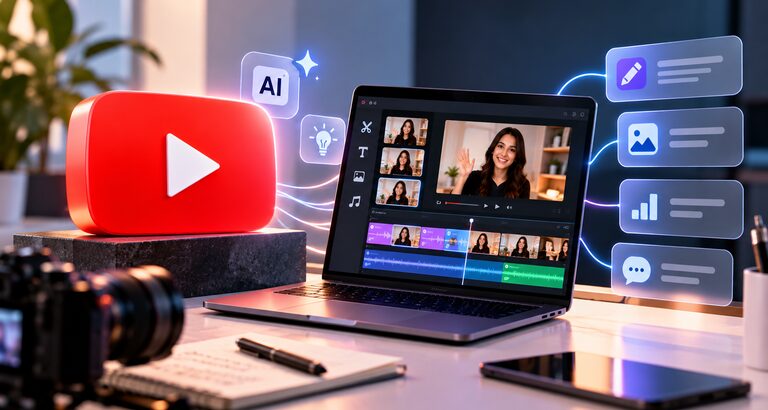
YouTube AI tools
TL;DR
• YouTube is adding new AI tools for creators.
• AI can assist with video editing and thumbnails.
• YouTube Studio is adding AI-powered feedback.
• AI can help with comment moderation.
• New tools aim to protect creator likeness.
• AI can reduce repetitive creator tasks.
YouTube is doubling down on AI, but its latest creator tools are designed to assist humans rather than take them out of the creative process. Here’s what the new features mean for creators and the future of online video.
Artificial intelligence is rapidly becoming part of the everyday creator workflow, and YouTube is making that shift even more visible.
At its Made on YouTube 2026 event, YouTube announced a new generation of AI-powered tools designed to help creators with everything from video editing and thumbnails to content strategy, audience engagement, and community management. The company says these tools are intended to reduce repetitive work while keeping creators in control of the creative process.
The timing is significant. AI-generated video, automated editing and synthetic media have already changed how content is produced. YouTube’s latest approach suggests the next phase may not be about AI replacing creators but about AI becoming a creative partner inside the creator’s workflow.
As Amjad Hanif, who leads YouTube’s creator products team, told Bloomberg, AI tools can make parts of the process easier, but they do not automatically create better content or stronger connections with an audience.
So, what exactly is YouTube building?
YouTube Is Turning AI Into a Creator’s Assistant
Running a successful YouTube channel involves much more than recording a video.
Creators need to research topics, develop ideas, write scripts, record footage, edit videos, create thumbnails, analyze performance, manage comments and maintain relationships with their audiences.
YouTube’s new AI tools are designed to assist across many of these stages.
The company’s latest updates include:
- AI-assisted conversational video editing
- Personalized feedback inside YouTube Studio
- AI-generated and channel-matched thumbnails
- Video A/B testing
- AI-powered comment moderation
- Expanded face and voice likeness protection
- AI assistance for content research and strategy
Rather than asking creators to hand over the entire production process to AI, YouTube is integrating AI into individual parts of the workflow.
That distinction could become increasingly important as generative AI becomes more capable.
1. Conversational AI Could Change How Creators Edit Videos
One of YouTube’s most interesting announcements is its new conversational editing assistant for Shorts and the YouTube Create app.
Instead of manually performing every editing task, creators can interact with the tool through prompts. YouTube says creators can use it to create a first draft and then continue refining the video through conversational instructions.
The assistant can help with tasks such as
- Trimming unnecessary pauses
- Reordering footage
- Improving pacing
- Synchronizing music with the video
- Making iterative edits
Creators can still switch back to manual editing whenever they want.
This represents an important shift in AI-assisted software.
Instead of learning where every editing function is located, creators can increasingly describe what they want the software to do.
For example, a creator could potentially move from:
“I need to find the right editing function.”
to:
“Remove the long pauses, make the opening faster and sync the transitions with the music.”
The software handles more of the mechanical work while the creator remains responsible for the creative direction.
2. YouTube Studio Is Becoming More AI-Powered
YouTube is also expanding AI capabilities inside YouTube Studio, its central platform for managing channels.
The new features are designed to help creators understand content performance and make decisions before and after publishing.
YouTube says creators will receive personalized feedback on early drafts, including guidance around areas such as pacing, structure, and storytelling.
The platform is also introducing channel-matched thumbnail generation and expanded testing capabilities. Creators will be able to test up to three different video cuts to understand which version holds audience attention better.
This could make AI useful not only for content production, but also for content optimization.
That is a major distinction.
A creator doesn’t simply need an AI system that can produce a video. They need tools that can help answer questions such as:
- Is the opening engaging enough?
- Where does the video lose momentum?
- Which thumbnail fits the channel?
- Which version performs better?
- What topics could the audience respond to next?
AI is increasingly moving into these decision-support roles.
3. AI Could Reduce the Editing Burden for Small Creators
Large media organizations can afford editors, designers, researchers and social media managers.
Individual creators often cannot.
This creates an interesting opportunity for AI.
A solo creator who previously needed several tools and hours of manual work may now be able to handle more of the workflow independently.
YouTube says its AI-powered tools are intended to take care of some of the heavy lifting so creators can spend more time on storytelling and connecting with their audiences.
The impact could be particularly relevant to:
- Solo YouTubers
- Small creator teams
- Educators
- Podcasters
- Short-form video creators
- Small businesses
- Independent media publishers
The technology doesn’t eliminate the need for creative judgment. Instead, it can lower the amount of technical effort required to turn an idea into a finished piece of content.
4. AI Is Also Coming to YouTube’s Comment Sections
Content creation doesn’t stop after a video is published.
Large channels can receive thousands of comments, making moderation increasingly difficult.
YouTube is testing opt-in AI-powered comment moderation that can learn a creator’s moderation preferences and apply them to future conversations.
This is another example of AI being used behind the scenes.
The AI isn’t necessarily creating the content itself. Instead, it handles a repetitive operational task that can consume significant creator time.
For growing channels, this type of automation could become just as important as AI video generation.
5. YouTube Is Strengthening AI Protection for Creators
The expansion of AI-generated media also creates a major problem for creators: likeness misuse.
A creator’s face or voice can potentially be reproduced or manipulated using generative AI.
YouTube is expanding its likeness detection technology to help creators identify uses of their visual likeness. The company also plans to integrate speaking voice detection with facial detection to improve matching accuracy.
YouTube says likeness detection will also become accessible through its mobile app, allowing creators to manage and respond to potential matches while away from their computers.
This is an important part of the AI conversation.
As generative AI becomes better at producing realistic faces and voices, platforms will need to develop equally sophisticated systems for identity protection, detection and enforcement.
6. AI Adoption Among Creators Is Already Growing
YouTube’s latest AI push isn’t happening in isolation.
According to YouTube’s first GenAI trends report, 72% of U.S. video posters aged 14–44 said they had used AI to help create or edit video content during the previous year. YouTube also said that hundreds of thousands of channels used its Gemini-powered creation capabilities each day in August 2026.
These figures indicate that AI-assisted creation is already becoming part of mainstream creator workflows.
The question is therefore shifting.
It is no longer simply
“Will creators use AI?”
Instead, it is becoming:
“How much of the creator workflow should AI handle?”
That is where the next stage of the industry battle could take place.
AI Can Automate Production, But It Cannot Automatically Build an Audience
One of the most important points in YouTube’s announcement is the distinction between producing content and building an audience.
AI can help with:
- Editing
- Research
- Drafting
- Thumbnail creation
- Content analysis
- Moderation
- Testing
But audience relationships are more complicated.
A successful creator often develops a recognizable voice, personality, perspective and relationship with viewers.
An AI system can help optimize the packaging of that content, but optimization alone doesn’t guarantee that viewers will care.
This is why YouTube’s strategy is notable.
Rather than positioning AI as an autonomous creator, the company is increasingly presenting it as infrastructure around the creator.
The Bigger Shift: From AI Tools to AI-Powered Workflows
YouTube’s announcement reflects a broader trend across the technology industry.
AI is moving from standalone chatbots and image generators into existing software products.
Instead of opening a separate AI application and manually transferring outputs between tools, users increasingly interact with AI directly inside the software they already use.
For creators, this could mean:
Idea → AI assistance → Editing → Optimization → Publishing → Audience management
all within one connected ecosystem.
This is similar to the broader movement toward AI agents and AI-powered software workflows, where AI doesn’t simply generate an answer but assists with multiple steps of a task.
For businesses and technology teams exploring this shift, our coverage of AI infrastructure and enterprise AI can provide additional context on how organizations are building the systems needed to support increasingly AI-driven workflows.
What This Means for the Future of YouTube
YouTube’s AI strategy could influence the creator economy in several ways.
- Faster production
Creators may be able to turn ideas into publishable videos faster because repetitive editing and production tasks can be automated.
- Lower barriers to entry
People without advanced editing skills may find it easier to produce polished content.
- More experimentation
When production becomes cheaper and faster, creators can test more concepts, hooks, formats, and thumbnails.
- Greater competition
The same technology that helps creators produce content faster can also increase the overall amount of content competing for viewers’ attention.
- Greater importance of originality
As AI makes production easier, human perspective may become even more important as a differentiator.
If everyone has access to similar AI tools, the advantage may increasingly come from what creators choose to say, how they say it, and how well they understand their audience.
The Creator Is Still the Creative Director
YouTube’s latest AI features point toward an important evolution in digital content creation.
AI is becoming better at handling the repetitive parts of production, but YouTube is still placing the creator at the center of the process.
That could be the more sustainable model for AI-powered creativity.
Instead of:
- AI creates. Humans publish.
The emerging model looks more like
Humans decide. AI assists. Humans refine. Audiences respond.
YouTube’s new tools show how quickly that model is becoming part of mainstream creator platforms. With conversational editing, intelligent studio recommendations, automated moderation, and stronger likeness protection, AI is moving deeper into almost every stage of the video lifecycle.
The real question isn’t whether AI will change YouTube.
It already is.
The more interesting question is what creators will do with the extra time and creative capacity AI gives them.
And that may ultimately determine whether AI becomes a threat to the creator economy or one of its most powerful tools.
Related Reading
Frequently Asked Questions
What are YouTube AI tools?
YouTube AI tools help creators with editing, thumbnails, content strategy, moderation and audience management.
Can YouTube AI tools edit videos?
Yes. YouTube's conversational editing tools can help with trimming, reordering, pacing, music synchronization and iterative edits.
Can AI replace YouTube creators?
The blog explains that AI is being positioned as an assistant rather than a replacement for creators.
How can AI help small YouTubers?
AI can reduce repetitive production work, making it easier for solo creators and small teams to produce and manage content.
How does YouTube protect creators from AI misuse?
YouTube is expanding likeness detection for faces and voices to help creators identify potential misuse of their identity.