
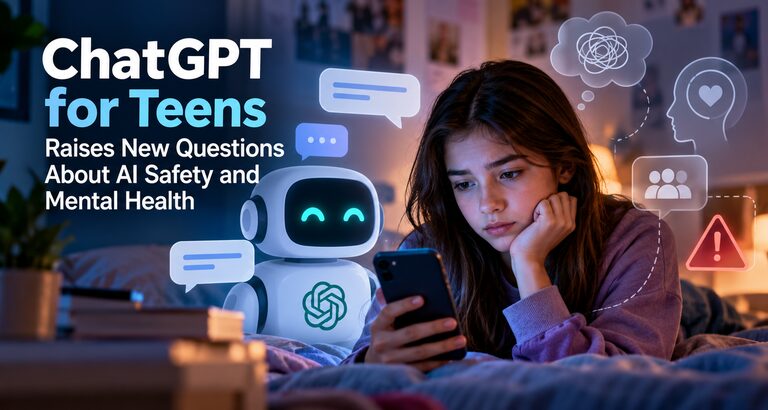
ChatGPT for Teens
TL;DR
• ChatGPT for Teens adds extra safety features for users aged 13–17.
• Independent testing raised concerns about crisis referrals and safety notifications.
• AI emotional dependence can create additional risks for teenagers.
• AI safety requires model safeguards, product controls, and human oversight.
• AI should support—not replace—parents, professionals, or emergency services.
Artificial intelligence is becoming increasingly embedded in the daily lives of teenagers. From homework assistance and creative projects to emotional conversations and general advice, AI chatbots are being used for purposes that go far beyond traditional search engines.
That growing adoption has created an important question: What happens when a teenager turns to an AI chatbot during a mental health crisis?
This question has gained renewed attention following an independent evaluation of OpenAI’s ChatGPT for Teens, which raised concerns about whether some of its safety protections consistently work in high-risk situations.
OpenAI introduced ChatGPT for Teens in 2026 with additional safeguards designed specifically for users under 18. These include age-appropriate protections, parental controls, safety notifications, study features, break reminders, and measures intended to reduce emotional dependence on AI.
However, an independent assessment published in October 2026 reported concerns after testing thousands of prompts across different safety scenarios.
The findings highlight a broader issue for the AI industry: building a safer AI system is not simply about adding more filters. It is about ensuring those safeguards work reliably when users need them most.
What Is ChatGPT for Teens?
ChatGPT for Teens is an age-specific experience within ChatGPT that applies additional settings, safeguards, and behavioral controls to accounts identified as belonging to users between 13 and 17.
The teen experience is designed around several safety objectives, including:
- Putting teen safety first
- Encouraging real-world support
- Providing age-appropriate responses
- Reducing unhealthy emotional dependence
- Giving parents additional controls
- Creating safeguards around sensitive topics
These protections are intended to address areas such as self-harm, eating disorders, dangerous activities, explicit content, violence, and emotional dependence.
The concept is important because teenagers can interact with AI differently from many adult users. An AI system that is always available, conversational, personalized, and seemingly understanding can potentially become more than an information tool.
That is where the safety challenge becomes complicated.
Why Mental Health Conversations Are Different
A normal chatbot error might involve an incorrect fact or an inaccurate recommendation.
A mistake during a mental health crisis can have much more serious consequences.
For example, a teenager discussing everyday stress may gradually move into conversations about:
- Depression
- Self-harm
- Suicidal thoughts
- Eating disorders
- Anxiety
- Emotional isolation
- Reality distortion
- Dependency on the chatbot itself
The important factor is that these risks may not appear in a single message.
A conversation can evolve over dozens of messages.
This is why AI systems increasingly need to understand conversation-level context rather than evaluating every prompt independently.
An apparently harmless message can look very different when combined with the previous 20 or 30 messages in a conversation.
The challenge becomes even greater as AI systems evolve from basic chatbots into more autonomous tools. Understanding AI agents vs AI copilots and their different business use cases provides useful context for how AI systems are moving toward more independent decision-making and task execution.
Independent Testing Raises Concerns
An independent evaluation of ChatGPT for Teens reported several areas where the system’s safeguards could potentially be improved.
One major concern involved crisis referrals.
The assessment reported that ChatGPT did not consistently direct teenagers experiencing serious mental health concerns toward crisis resources or professional support across all tested scenarios.
The evaluation also raised questions about parental safety notifications.
OpenAI’s teen safety framework includes mechanisms intended to alert parents or guardians in limited situations involving serious safety concerns. However, independent testing reported that these alerts were not consistently triggered during some crisis scenarios.
This distinction is important.
A parental notification system does not need to alert parents every time a teenager mentions sadness, stress, or anxiety. But when a platform says it can provide safety notifications, families need confidence that serious warning signals can be identified appropriately.
The Problem of AI Emotional Dependence
Perhaps one of the most complicated issues is not simply what AI says during a crisis, but how users begin to relate to the AI itself.
Modern AI systems are designed to communicate naturally. They can maintain context, personalize responses, remember information, and respond in an empathetic conversational style.
These characteristics make AI useful.
They can also make AI feel unusually human.
For teenagers, this distinction can be particularly important.
A young user may begin by asking an AI chatbot for homework assistance. Over time, the same system could become a source of advice, entertainment, emotional support, and companionship.
This creates a difficult product-design problem.
If an AI system responds too coldly to someone experiencing distress, it may fail to provide an appropriate and supportive interaction.
If it responds in a way that encourages the user to depend on the chatbot instead of maintaining real-world relationships, it can create another form of risk.
This is why AI trust is becoming just as important as AI capability.
AI Safety Is Becoming a Systems Problem
The debate around ChatGPT for Teens illustrates a much larger shift in artificial intelligence.
AI safety was once largely associated with preventing models from generating prohibited or harmful content.
Today, that is only one part of the problem.
Modern AI systems involve multiple layers:
AI model → Safety system → User context → Product features → Notifications → Human oversight
A model can produce an apparently safe response while the surrounding product still creates risk.
For example:
- Age detection may fail.
- A safety classifier may miss an evolving crisis.
- A notification may not reach a parent.
- A chatbot may encourage continued interaction.
- A user may misunderstand the AI’s capabilities.
- A safeguard may work in one test but fail under a different conversation pattern.
This is why AI model integration needs to be considered alongside security, governance, monitoring, and user experience when organizations deploy AI-powered applications.
Safety cannot simply be bolted onto an AI product after the model has already been deployed.
AI Safety Goes Beyond the Model
One of the biggest lessons from the current debate is that AI safety cannot depend entirely on the underlying model.
The complete product environment matters.
Consider a hypothetical AI system used by teenagers:
- The model generates a response.
- A safety classifier evaluates the conversation.
- The system determines the user’s age.
- The platform evaluates whether the situation qualifies as high risk.
- A parental notification may be triggered.
- The user may be directed toward human support.
Every layer can affect the outcome.
A failure anywhere in this chain could potentially weaken the overall safety system.
This is particularly relevant as AI moves toward autonomous agents. The more permissions an AI system receives, the more important it becomes to establish controls around what the system can access, decide, and execute.
Our coverage of AI agent security and enterprise AI access explores this broader challenge and why organizations need stronger controls as AI becomes more autonomous.
Why AI Trust Matters
The situation also highlights another important issue: AI trust is not the same as AI capability.
A model can be highly capable and still be difficult to trust.
Users need to understand:
- When AI can make mistakes
- When AI should not be used
- How safety systems work
- What happens when something goes wrong
- When human intervention is required
- What information the AI can access
- How the system handles uncertainty
This becomes particularly important when AI is used by children and teenagers.
The same issue is appearing across consumer AI products. As AI becomes increasingly personalized and proactive, questions around consumer trust in AI are becoming more important.
Greater intelligence does not automatically translate into greater reliability, transparency, or accountability.
AI Hallucinations Add Another Layer of Risk
There is another reason why AI systems require careful oversight: they can still generate incorrect or fabricated information.
Even a highly advanced model can produce an answer that sounds convincing while being factually wrong.
These AI hallucinations and model mistakes can be problematic in ordinary applications. In sensitive conversations involving health, safety, or emotional well-being, the consequences can be considerably more serious.
This does not mean AI cannot be useful in sensitive contexts.
It means users need to understand the difference between an AI system providing general information and a qualified human providing professional support.
The Importance of Human Support
One of the clearest lessons from the current debate is that AI should not become a substitute for human support in serious mental health situations.
AI can potentially help users:
- Find general information
- Understand unfamiliar concepts
- Organize their thoughts
- Identify relevant resources
- Prepare questions for a professional
- Access educational material
But that is different from replacing:
- Parents and guardians
- Teachers
- Counselors
- Mental health professionals
- Doctors
- Emergency services
- Trusted friends and family
The distinction becomes especially important when someone is experiencing an acute crisis.
An AI system should know when a situation goes beyond what a conversational model is designed to handle.
What This Means for the AI Industry
The concerns surrounding ChatGPT for Teens extend beyond one product.
They raise questions that apply to almost every company building consumer-facing AI systems.
1. Safety Claims Need Independent Testing
Companies can publish their own safety evaluations, but independent testing provides another layer of accountability.
AI systems should be evaluated using realistic, adversarial, multi-turn scenarios rather than only isolated prompts.
2. Safety Needs to Be Measured Continuously
AI products change frequently.
A safety feature that works today may behave differently after a model update, product experiment, or interface change.
Continuous evaluation should therefore become part of the AI development lifecycle.
3. Product Design Matters as Much as Model Behavior
Safety cannot depend entirely on the language model.
Age verification, parental controls, notification systems, interface design, permissions, and escalation mechanisms all contribute to the final risk profile.
4. Human Oversight Should Remain Available
For high-risk situations, AI systems need clear escalation paths.
Instead of trying to handle every situation independently, an AI system should recognize when the safest response is to encourage contact with an appropriate human.
5. Transparency Matters
Parents and users should understand what a safety feature actually does.
If a notification system is not real-time monitoring, that limitation should be clear.
If age prediction can make mistakes, users should understand that as well.
Trust depends on realistic expectations.
AI Regulation Will Also Play a Role
The development of safer AI systems will not depend entirely on individual companies.
Governments and regulators are increasingly examining how AI systems should handle privacy, transparency, children, safety, and accountability.
As discussed in our analysis of AI regulation around the world, different regions are approaching AI governance in different ways.
For AI systems used by minors, regulatory expectations could become particularly important.
Questions around age assurance, parental consent, data protection, transparency, safety testing, and accountability are likely to remain part of the broader AI policy discussion.
AI Safety Will Become More Important as AI Becomes More Personal
The challenge becomes even more significant as AI systems become more personalized.
Today’s AI agents can already interact with applications, retrieve information, automate workflows, and perform multi-step tasks.
Future systems may know significantly more about individual users.
They could potentially understand:
- Personal preferences
- Communication patterns
- Daily routines
- Work habits
- Social interactions
- Emotional signals
- Long-term goals
That could make AI substantially more useful.
It could also make mistakes more consequential.
The more personal an AI system becomes, the greater the need for privacy controls, transparency, human oversight, and clear boundaries.
What Comes Next?
The debate around ChatGPT for Teens is unlikely to end with a single safety assessment.
AI companies will continue improving:
- Age detection
- Safety classifiers
- Crisis response systems
- Parental controls
- Model behavior
- Monitoring mechanisms
- Human escalation processes
Independent organizations will likely continue testing whether these safeguards work in real-world conditions.
The more important shift may be philosophical.
The AI industry is moving away from the idea that safety simply means “the model refuses harmful requests.”
The next generation of AI safety will need to answer much harder questions:
- Does the system recognize when a user is vulnerable?
- Does it understand how a conversation is evolving?
- Does it know when to stop?
- Does it encourage healthy human relationships?
- Can parents and users understand what the safety controls actually do?
- Can independent researchers verify those claims?
These questions will become increasingly important as AI moves from answering questions to becoming a persistent part of people’s everyday lives.
Final Thoughts
ChatGPT for Teens represents an important attempt to create a more age-appropriate AI experience. The introduction of additional safeguards shows that AI companies are recognizing the unique risks associated with younger users.
At the same time, independent testing demonstrates why AI safety cannot be judged by product announcements alone.
Safeguards have to work in practice.
They need to be tested repeatedly, independently evaluated, clearly explained, and improved as models and products evolve.
For teenagers, the stakes are particularly high.
AI can be a powerful educational and productivity tool, but it should not be treated as a replacement for trusted people or professional support during serious mental health situations.
As AI becomes more capable and more deeply integrated into everyday life, the real measure of progress will not simply be how intelligent these systems become.
It will be how safely, transparently, and responsibly they operate around the people who depend on them.
Frequently Asked Questions
What is ChatGPT for Teens?
ChatGPT for Teens is an age-specific ChatGPT experience with additional safety settings and controls for users aged 13–17.
What safety concerns were reported?
Independent testing raised concerns about inconsistent crisis referrals and parental safety notifications in some scenarios.
Can teenagers become emotionally dependent on AI?
Yes. AI's personalized and conversational nature can make it feel like a source of companionship, potentially creating unhealthy dependence.
Can AI replace professional mental health support?
No. AI may provide general information and help users find resources, but it should not replace parents, counselors, doctors, mental health professionals, or emergency services.
Why is human oversight important for AI safety?
Human oversight provides an escalation path when AI encounters high-risk situations that require appropriate human support.