
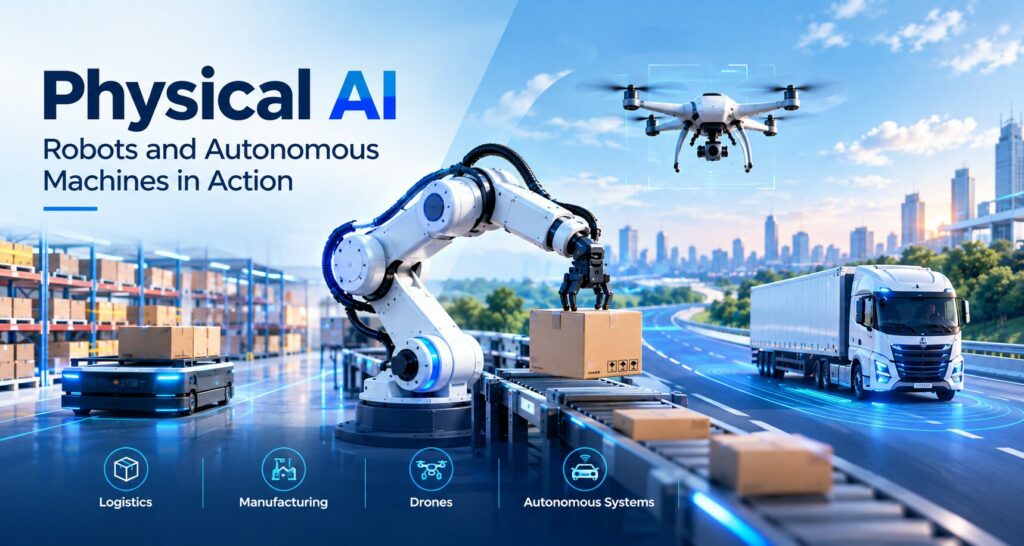
Physical AI
TL;DR
• Physical AI brings AI into the real world.
• Robots are transforming logistics and manufacturing.
• AI-powered drones enable autonomous inspection and monitoring.
• Autonomous vehicles are advancing freight transportation.
• Specialized robots may be more practical than humanoids.
• Edge AI enables faster machine decisions.
Artificial intelligence is no longer limited to chatbots, search engines, recommendation systems, and software applications. A new phase of AI is emerging in which intelligent systems can perceive their surroundings, make decisions, and physically interact with the world.
This shift is often described as Physical AI or embodied AI.
While humanoid robots receive much of the public attention, the more important story is happening in less glamorous environments: warehouses, factories, ports, farms, roads, skies, and industrial facilities. Autonomous mobile robots are moving inventory, computer-vision systems are inspecting products, drones are monitoring infrastructure, and autonomous vehicles are increasingly handling transportation tasks.
The distinction matters because many of these technologies are already solving specific business problems. They do not need to look human to be useful.Recent investment activity also suggests that the market is moving from AI experimentation toward physical deployment. Robotics startups, autonomous systems, and industrial AI are receiving increasing attention as businesses explore practical applications of intelligent machines.
What Is Physical AI?
Physical AI refers to artificial intelligence systems that operate in and interact with the physical environment.
Traditional AI primarily processes digital information. A language model receives text and produces text. A recommendation engine analyzes user behavior and suggests content.
Physical AI adds another layer.
A physical AI system can:
- Sense its environment using cameras, radar, lidar, microphones, and other sensors
- Interpret what it sees
- Make decisions based on changing conditions
- Plan actions
- Control machines or robotic hardware
- Learn from operational data
- Respond to physical events in real time
This combination of perception, reasoning, and action is what makes robotics increasingly different from traditional automation.
Instead of simply following a fixed sequence of instructions, intelligent machines can potentially adapt to changing environments.
However, that does not mean today’s robots are universally capable. In many cases, the most successful systems are still highly specialized.
Logistics: Robots Are Already Moving Things
Warehouses are among the clearest examples of practical AI automation.
Modern fulfillment centers can contain thousands of products and millions of individual movements. Moving inventory manually is expensive, repetitive, and physically demanding.
Autonomous mobile robots can help transport goods between storage areas, picking stations, packing areas, and loading zones.
These robots can use cameras, sensors, maps, and AI-powered autonomous systems to understand their surroundings and avoid obstacles.
The important point is that they do not need human-like bodies.
A wheeled robot designed specifically for warehouse movement may be far more efficient than a humanoid robot attempting to perform the same task.
AI can also improve warehouse operations beyond physical movement. Computer vision can identify packages, monitor inventory, detect damaged goods, and support quality-control processes.
This creates a broader category of AI solutions for logistics and supply chain, where software intelligence and physical machines work together.
For businesses exploring this transition, an experienced AI development company can help design AI systems that connect intelligence with real-world business processes.
Manufacturing: From Automation to Adaptive Machines
Manufacturing has used robots for decades, but traditional industrial robots usually operate in controlled environments and perform predetermined movements.
Industrial AI is gradually changing that model.
AI-powered robotic systems can use computer vision and sensor data to inspect components, identify defects, optimize production processes, and assist with material handling.
The biggest opportunity may not be replacing every conventional machine with a humanoid robot. Instead, it may be making existing industrial equipment more intelligent.
For example, AI can help a production system recognize when a component is incorrectly positioned, identify an unusual machine condition, or adjust a process based on real-time data.
This approach is particularly relevant for older factories.
AI development therefore becomes an important part of industrial transformation. Businesses need software capable of connecting machine data, computer vision AI development services, predictive analytics, automation workflows, and operational systems.
Companies can also explore custom AI development for manufacturing when standard automation tools are not sufficient for their production environment.
Drones: AI Takes Machines Beyond Human Reach
Drones are another important part of Physical AI applications.
Traditional drones can be remotely controlled by human operators. Increasingly, AI allows drones to perform more tasks autonomously.
AI-powered autonomous drones can potentially:
- Navigate predefined routes
- Detect objects
- Track moving targets
- Inspect infrastructure
- Monitor agricultural fields
- Survey construction sites
- Analyze aerial imagery
- Assist with emergency response
- Operate in environments that are difficult or dangerous for humans
The key development is not simply that drones can fly automatically.
The bigger change is that drones can increasingly interpret what they see and make decisions based on that information.
For example, an inspection drone could identify a potential structural problem rather than simply recording video. A warehouse drone could scan inventory and compare observations with digital records.
Autonomous drone systems are therefore becoming an intersection of computer vision, edge computing, robotics, navigation, and AI decision-making.
Autonomous Vehicles and Freight
Transportation may become one of the largest real-world applications of autonomous vehicle technology.
Self-driving technology has been under development for years, but autonomous freight represents a particularly important opportunity because commercial vehicles spend significant amounts of time performing repetitive transportation tasks.
Autonomous systems can potentially operate trucks, yard vehicles, delivery machines, and other transportation equipment with less direct human intervention.
The challenge is substantial.
Road environments are unpredictable. Vehicles need to understand pedestrians, traffic signals, road conditions, weather, construction zones, and unexpected behavior from other drivers.
That is why autonomous transportation depends on multiple technologies working together:
Sensors + computer vision + mapping + AI models + planning + vehicle control + edge AI
The same architecture applies to other autonomous machines.
A robot does not become useful simply because it has an AI model. It needs reliable perception, low-latency decision-making, physical control, safety mechanisms, and a way to operate consistently in the real world.
Humanoid Robots: Interesting, But Not the Whole Story
Humanoid robots remain one of the most visible areas of robotics technology.
Their human-like form makes them easy to imagine in homes, factories, warehouses, and offices. Investors are also paying significant attention to the sector.
But the current reality is more complicated.
Humanoid robots still face challenges involving battery life, dexterity, reliability, cost, speed, safety, and the ability to perform unfamiliar tasks without extensive training.
Recent developments demonstrate the gap between impressive demonstrations and dependable factory work. Robots may perform choreographed activities successfully while still struggling with the flexibility and reliability required for unpredictable industrial environments.
That does not mean humanoid robots will fail.
It means their commercial value should be evaluated based on the problem they solve rather than how impressive a demonstration looks.
A specialized robot may outperform a humanoid system when the task is repetitive and predictable.
The winning AI robotics systems may therefore include many different forms of machines rather than one universal humanoid robot.
The Real Opportunity Is the AI Layer
Hardware is only one part of physical AI.
The bigger long-term opportunity may be the software intelligence connecting machines, sensors, data, and business systems.
Consider a warehouse.
A robot can move a box.
But an intelligent system could determine:
- Which box should move first
- Where it should go
- Which route is most efficient
- Whether inventory levels are changing
- Whether a machine needs maintenance
- Whether demand requires a different warehouse configuration
This turns robotics into a broader intelligent operations platform.
The same principle applies to factories, transportation networks, agriculture, energy infrastructure, and construction.
This is why physical AI increasingly overlaps with AI agents, computer vision, machine learning, edge computing, digital twins, and predictive analytics.
AI agents can potentially decide what actions need to happen, while robotic systems provide the physical mechanism for executing those actions.
Businesses looking to build these systems can explore AI development services for intelligent systems that combine AI models, automation, data, and business workflows.
Why Edge AI Matters
Physical AI cannot always depend on a remote cloud server.
A robot operating inside a factory or a vehicle traveling on a highway may need to make decisions in milliseconds.
Sending every sensor reading to a distant data center can introduce latency, consume bandwidth, and create reliability challenges.
This is where edge AI for autonomous systems becomes important.
Edge computing allows some AI processing to happen closer to the machine itself.
A camera-equipped robot, for example, can analyze video locally and respond immediately when it detects an obstacle.
The future will likely involve a combination of cloud and edge computing:
Cloud AI for training, coordination, analytics, and large-scale processing
Edge AI for real-time perception, control, and decision-making
This architecture can make autonomous systems faster and more resilient.
What Businesses Should Actually Invest In
Businesses should avoid adopting physical AI simply because robotics is fashionable.
The better approach is to identify operational problems where intelligent machines can generate measurable value.
Good starting points include:
- Repetitive material handling
- Inventory monitoring
- Industrial inspection
- Predictive maintenance
- Warehouse navigation
- Infrastructure inspection
- Quality control
- Autonomous transportation
- Dangerous or hazardous environments
- High-volume data collection
The most successful implementations are likely to begin with narrow, measurable tasks.
For example, instead of asking, “How can we replace workers with robots?”, a company could ask:
“Which repetitive process costs us the most time, and can an intelligent machine perform it more safely and efficiently?”
That shift in thinking makes intelligent automation software development much more practical.
The Biggest Challenges Ahead
Despite rapid progress, physical AI faces several major obstacles.
Reliability
A software error may produce an incorrect answer. A physical AI error can cause equipment damage, product loss, or injury.
Data
Robots need large amounts of real-world data to learn how objects, environments, and humans behave.
Safety
Autonomous machines must operate safely around people and other machines.
Cost
Sensors, actuators, processors, batteries, robotics hardware, and maintenance can make deployment expensive.
Integration
Businesses often have legacy systems that were never designed to communicate with AI-powered machines.
Regulation
Autonomous vehicles, drones, industrial robots, and other physical AI systems operate under different regulatory requirements depending on the industry and location.
These challenges explain why the transition will probably happen gradually rather than overnight.
Physical AI Is Becoming a Business Technology
The most important change is that AI is moving from something businesses use on screens to something businesses use in physical operations.
Robots can move inventory.
Drones can inspect infrastructure.
AI-powered machines can monitor factories.
Autonomous vehicles can transport goods.
Computer vision can inspect products.
Intelligent systems can coordinate all of these activities.
That is a much bigger story than humanoid robots.
The latest physical AI developments show that the field is expanding across industrial automation, warehouse logistics, autonomous systems, drones, and general-purpose robot intelligence rather than being limited to humanoids.
The future of AI will therefore not exist exclusively inside data centers.
It will increasingly exist in warehouses, factories, vehicles, farms, roads, skies, and industrial facilities.
Final Thoughts
Physical AI is entering an important stage.
The technology is still developing, and many ambitious promises remain ahead of commercial reality. Humanoid robots may eventually become highly capable, but businesses do not need to wait for a general-purpose machine to transform their operations.
Specialized autonomous systems are already creating practical opportunities.
The immediate future is likely to be less about robots that can do everything and more about machines that can do one valuable thing extremely well.
That could mean a warehouse robot moving inventory, a drone inspecting equipment, a computer-vision system detecting manufacturing defects, or an autonomous vehicle transporting goods.
As AI becomes better at understanding the physical world, the boundary between software and machinery will continue to disappear.
The next phase of artificial intelligence may not simply answer our questions.
It may see, decide, move, inspect, transport, and act.
And that is what makes Physical AI one of the most important AI trends to watch.
Frequently Asked Questions
What is Physical AI?
Physical AI refers to AI systems that can perceive, understand, and interact with the physical world using robots, sensors, cameras, and autonomous machines.
How is Physical AI used in logistics?
Physical AI helps warehouses automate inventory movement, navigation, package handling, monitoring, and other repetitive logistics tasks.
How are AI-powered drones being used?
AI-powered drones can autonomously navigate, detect objects, inspect infrastructure, monitor farms, survey sites, and analyze aerial data.
Are humanoid robots the future of Physical AI?
Humanoid robots are an important area of development, but specialized robots may be more practical for specific industrial and commercial tasks.
Why is Edge AI important for autonomous machines?
Edge AI allows machines to process data locally, enabling faster decisions and real-time responses without relying entirely on cloud servers.