
TL;DR
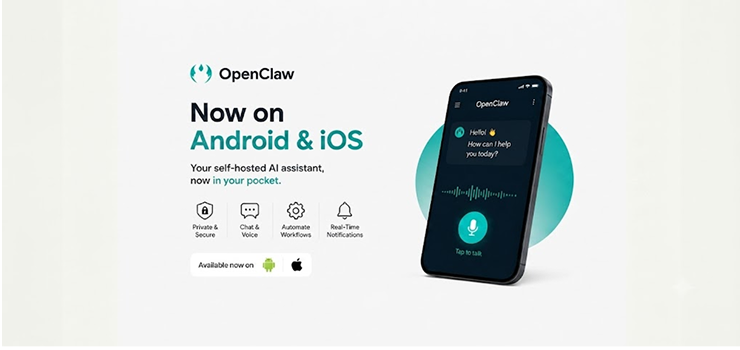
• OpenClaw is now available on Android and iOS.
• Users can access self-hosted AI from anywhere.
• Mobile apps support chat, voice, and automation.
• Early users reported bugs and setup issues.
• The launch reflects the rise of Agentic AI.
Open-source AI assistant OpenClaw has officially arrived on Android and iOS, marking a significant milestone for the growing agentic AI ecosystem. The new mobile apps allow users to securely connect to their self-hosted OpenClaw Gateway and interact with AI agents from virtually anywhere.
Unlike traditional AI chatbots that rely entirely on cloud services, OpenClaw follows a local-first approach. Users retain control over their AI assistant, data, permissions, and connected devices while extending those capabilities to their smartphones.
Although the launch has generated excitement among developers and AI enthusiasts, early feedback suggests that the mobile experience still has room for improvement.
What Is OpenClaw?
OpenClaw is an open-source AI agent platform designed to help users automate tasks using large language models while keeping control of their own infrastructure. Instead of depending on centralized AI services, users run an OpenClaw Gateway on their computer or server and connect companion devices such as smartphones.
This architecture provides several benefits:
- Greater privacy and data ownership
- Full control over AI configurations
- Secure device permissions
- Support for autonomous workflows
- Integration with multiple AI models
The newly launched Android and iOS applications extend these capabilities to mobile devices, making AI assistants more accessible on the go.
What Can Mobile Apps Do?
The official apps function as companion nodes that communicate with an existing OpenClaw Gateway. Once paired, users can manage their AI assistant directly from their smartphones.
Key capabilities include:
- Chat with your AI assistant from anywhere
- Real-time voice conversations using Talk Mode
- Push-to-talk functionality
- Approve AI-requested actions
- Receive workflow notifications
- Enable permissions for camera, microphone, location, screen, and notifications
- Monitor connected automations
Because OpenClaw is local-first, users choose exactly which device permissions are granted, offering more transparency than many cloud-based AI assistants.
Early User Reactions
While the release has been welcomed by the AI community, first impressions have been mixed.
Several early users reported issues such as:
- Gateway pairing challenges
- Basic user interface design
- Bugs affecting setup
- Limited onboarding guidance
Reviewers appreciated the functionality and long-term vision but noted that the apps currently feel more like early developer tools than polished consumer products.
These challenges are not unusual for rapidly evolving open-source projects, and future updates are expected to improve usability and stability.
Why This Launch Matters
The mobile release represents a larger shift occurring across the AI industry.
Modern AI assistants are evolving from conversational chatbots into AI agents capable of performing actions, accessing tools, and automating workflows with minimal human intervention.
Instead of simply answering questions, these systems can:
- Execute multi-step tasks
- Interact with connected applications
- Manage notifications
- Request approvals before taking actions
- Use contextual information from mobile devices
This growing trend is commonly known as Agentic AI, and it is expected to play a major role in enterprise software, productivity tools, and consumer applications over the next few years.
If you’d like to understand this technology in greater depth, check out our guide on Agentic AI in Enterprises: The Rise of Autonomous Workflows, where we explain how AI agents are transforming modern businesses.
What This Means for Businesses
As organizations increasingly adopt AI-driven automation, platforms like OpenClaw demonstrate how intelligent agents can move beyond desktop environments and become available across multiple devices.
Businesses exploring AI-powered applications should also focus on building secure, scalable mobile experiences that support intelligent workflows.
If you’re planning to build an AI-enabled application, our guide on AI App Development Services from Promatics Technologies explains how businesses can develop scalable, enterprise-grade AI solutions tailored to their specific use cases.
The Future of Self-Hosted AI
OpenClaw’s mobile apps are still in their early stages, but they highlight an important trend: users increasingly want AI assistants that are private, customizable, and capable of working across devices.
As autonomous AI continues to mature, self-hosted platforms could become an attractive alternative to cloud-only assistants, especially for developers, enterprises, and privacy-conscious users.
Future updates are expected to improve the user experience while expanding the platform’s automation capabilities.
Final Thoughts
The launch of OpenClaw’s Android and iOS apps is an important step toward making autonomous AI assistants more practical for everyday use. While early versions still have some rough edges, the release showcases how quickly agentic AI is moving from desktop systems to mobile devices.
For developers, businesses, and AI enthusiasts, OpenClaw offers an exciting glimpse into a future where intelligent assistants don’t just answer questions, they actively help users complete real-world tasks while keeping control firmly in the user’s hands.
Frequently Asked Questions
What is OpenClaw?
OpenClaw is an open-source AI agent platform that lets users run AI assistants on their own infrastructure instead of relying on cloud-based AI services.
Is OpenClaw available on Android and iOS?
Yes. OpenClaw has officially launched companion apps for both Android and iOS, allowing users to access their self-hosted AI assistants from mobile devices.
What can the OpenClaw mobile app do?
The app supports AI chat, voice interactions, workflow notifications, automation management, and approval requests while connecting securely to an OpenClaw Gateway.
How is OpenClaw different from cloud AI assistants?
OpenClaw follows a local-first approach, giving users greater control over their data, privacy, device permissions, and AI configurations.
Does OpenClaw require an OpenClaw Gateway?
Yes. The mobile apps work by connecting to an existing OpenClaw Gateway running on your computer or server.
Is OpenClaw suitable for businesses?
Yes. Businesses can use OpenClaw to build secure, self-hosted AI workflows, automate repetitive tasks, and maintain greater control over sensitive data.
What issues have early users reported?
Some early users have experienced gateway pairing issues, UI bugs, and a challenging setup process. Future updates are expected to improve stability and usability.
Why is OpenClaw important for the future of AI?
OpenClaw reflects the growing shift toward Agentic AI, where intelligent assistants can perform tasks, automate workflows, and interact with multiple tools instead of only responding to prompts.