
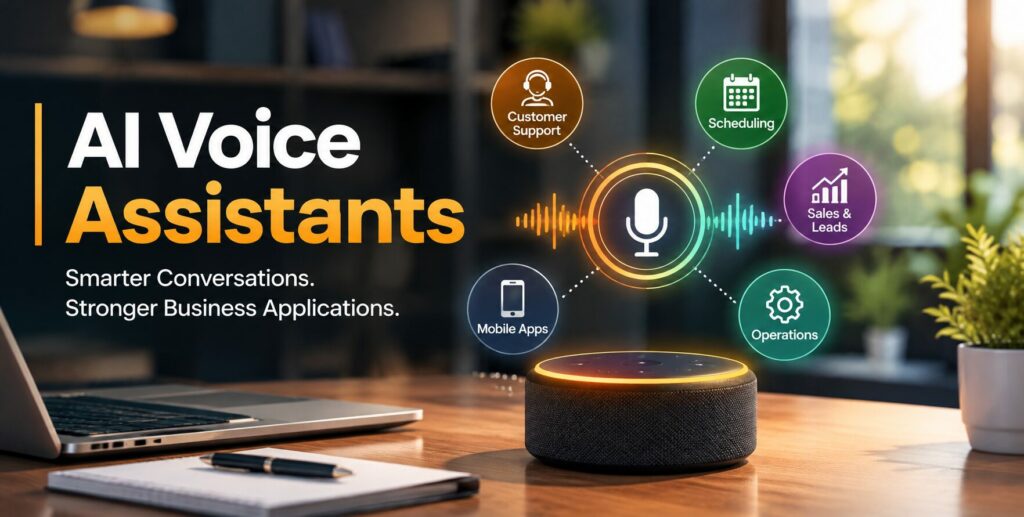
AI Voice Assistants
TL;DR
• AI Voice Assistants help businesses automate customer interactions and routine tasks.
• Voice AI improves customer support with faster, more convenient responses.
• Voice agents support appointment scheduling, sales, and lead qualification.
• Conversational AI enables natural communication with business applications.
• Secure integrations and human oversight are essential for successful voice AI adoption.
The way people interact with businesses is changing as artificial intelligence becomes more accessible. Customers increasingly expect quick answers, personalized assistance, and convenient ways to access services without navigating complicated menus or waiting for a customer support representative. AI Voice Assistants are helping businesses meet these expectations by turning spoken conversations into practical digital experiences.
With modern AI-powered software development solutions, businesses can explore voice-enabled applications that understand customer requests, automate routine tasks, and connect conversations with existing business systems. Unlike traditional voice response systems, modern voice AI can interpret natural language, maintain conversational context, and provide more flexible responses.
From customer service and appointment scheduling to sales support and internal operations, AI Voice Assistants are becoming an important part of business automation. They combine speech recognition, natural language processing, and conversational AI to help users interact with software through everyday speech.
This article explores how voice AI works, its business applications, major benefits, implementation challenges, and the future of voice-powered business applications.
What Are AI Voice Assistants?
AI Voice Assistants are software systems that use artificial intelligence to understand spoken language and respond to users through speech. Depending on their capabilities, they can answer questions, retrieve information, perform specific tasks, and interact with connected applications.
Traditional voice assistants often rely on predefined commands or limited conversational flows. Modern AI voice assistants can handle more flexible requests and use context to determine what a user needs.
For example, a customer might say, “Can you reschedule my appointment for Friday afternoon?”
A capable AI voice assistant can interpret the request, check available appointments through an integrated scheduling system, confirm the preferred time, and update the booking.
Businesses can use voice AI in mobile applications, websites, contact centers, enterprise software, and telephone-based customer support.
How Voice AI Works
A business AI voice assistant generally follows several steps:
- Speech recognition: Converts spoken words into text that the system can process.
- Language understanding: Identifies the user’s intent and relevant details.
- Context processing: Uses the conversation history and available business information to understand the request.
- Task execution: Retrieves information or triggers an authorized action through connected software.
- Speech generation: Produces a spoken response that communicates the result.
These components work together to create a conversational experience. More advanced voice agents can also connect with customer relationship management (CRM) platforms, calendars, databases, and support systems to complete tasks instead of simply answering questions.
How AI Voice Assistants Are Changing Business Applications
Voice technology is moving beyond simple commands and becoming a practical interface for business software. Several applications demonstrate how this change can improve everyday operations.
1. Smarter Customer Support
Customer service is one of the most promising applications of AI Voice Assistants. Businesses receive repetitive questions about orders, billing, product availability, account access, and service appointments.
Voice AI can handle many routine requests by retrieving approved information and providing immediate answers. Customers can explain their problems naturally instead of navigating multiple phone menus.
For example, an online retailer could use a voice agent to provide order updates, explain return policies, or direct customers to the correct support department.
When a request involves a complicated complaint, a sensitive decision, or an issue the assistant cannot resolve, the system should transfer the conversation to a human representative.
This approach allows customer service teams to focus on complex issues while automated systems manage suitable routine interactions.
2. Automated Appointment Scheduling
Businesses in healthcare, education, consulting, hospitality, and professional services often spend considerable time managing appointments.
An AI voice assistant can answer scheduling calls, check available time slots, confirm bookings, send reminders, and process cancellations when connected to the relevant systems.
For example, a customer could call a service provider and request the earliest available appointment. The assistant could check the scheduling application and offer suitable options without requiring staff to handle every step manually.
Automated scheduling can reduce administrative work, improve response times, and help businesses manage appointments outside normal working hours.
However, organizations operating in regulated sectors should ensure that the assistant follows applicable privacy rules and handles confidential information appropriately.
3. Sales and Lead Qualification
Sales teams often receive enquiries that require initial screening before a representative becomes involved. Voice agents can ask predefined qualifying questions, collect contact details with appropriate consent, and identify the reason for a customer’s enquiry.
For instance, a software company could use an AI voice assistant to ask prospective customers about their business needs, preferred features, and project timelines.
The system can then record the responses in a CRM and route qualified leads to the appropriate salesperson.
This process can help sales teams respond faster and reduce repetitive administrative work. It also allows representatives to spend more time on meaningful conversations and opportunities that require human judgment.
AI-powered calling should remain transparent, respect customer preferences, and comply with relevant telemarketing and consent requirements.
4. Voice-Enabled Mobile Applications
Mobile applications traditionally depend on buttons, forms, menus, and text input. Integrating voice AI gives users another way to interact with these features.
For example, a banking application could allow users to ask about recent transactions, while a travel application could help users search for bookings or retrieve itinerary information.
Voice interfaces can also support hands-free interaction in situations where typing is inconvenient. Field employees may use voice commands to record updates, search operational information, or create reports while performing their work.
Businesses exploring these capabilities can learn more about AI model integration in existing business applications, particularly when planning how AI features can work alongside established software and workflows.
The key is to design voice interactions around specific user needs rather than adding voice commands simply because the technology is available.
5. Internal Business Operations
AI Voice Assistants can support employees as well as customers. In enterprise environments, voice interfaces can help teams retrieve information, update records, summarize conversations, and access internal knowledge.
A warehouse employee, for example, might ask for inventory information without stopping to type a search query. A field technician could dictate maintenance notes that are converted into structured records.
Meeting assistants can also transcribe discussions, identify action items, and prepare summaries for participants.
These applications can reduce manual data entry and make business information easier to access. Their usefulness depends on reliable integrations, accurate transcription, appropriate permissions, and clear processes for reviewing important records.
Key Benefits of AI Voice Assistants for Businesses
Adopting voice AI can offer several operational and customer experience benefits when the technology is implemented around genuine business needs.
Faster Responses and Extended Availability
AI voice assistants can respond to routine enquiries outside standard business hours. This helps businesses provide continuous access to basic information and capture enquiries when employees are unavailable.
Improved Operational Efficiency
Automating repetitive conversations can reduce the amount of time employees spend on scheduling, information retrieval, call routing, and routine follow-ups.
More Consistent Customer Experiences
A voice assistant connected to an approved knowledge base can deliver consistent answers to common questions. Regular monitoring and content updates are still necessary to maintain accuracy.
Better Application Accessibility
Voice interfaces can give users another way to navigate digital services. They may be particularly useful for hands-free tasks and for people who find certain text-based interfaces difficult to use.
Accessibility benefits depend on implementation quality, language support, speech recognition accuracy, and the availability of alternative interaction methods.
Scalable Customer Interactions
A well-designed voice AI system can handle multiple routine interactions without requiring a proportional increase in human staffing. Businesses must still plan for peak demand, system availability, and human escalation.
Voice AI vs. Traditional Voice Assistants
Although the terms are sometimes used interchangeably, traditional voice systems and modern AI voice assistants can differ significantly.
| Feature | Traditional voice systems | Modern AI voice assistants |
| Interaction | Fixed commands and menus | Natural-language conversations |
| Understanding | Limited predefined inputs | Context-aware intent recognition |
| Responses | Scripted options | Flexible, AI-generated responses |
| Integrations | Often focused on call routing | Can connect to business applications |
| Task completion | Usually limited to predefined flows | Can perform authorized workflows |
| Adaptability | Requires manual flow updates | Can handle varied phrasing, within system limits |
Modern systems are not automatically more reliable in every situation. Traditional interactive voice response (IVR) systems can remain effective for predictable tasks, while AI voice assistants are useful when customers need more flexible conversations.
Businesses should select the approach that best matches their workflows, risk tolerance, and customer expectations.
Challenges of Implementing AI Voice Assistants
Despite their potential, AI Voice Assistants require careful planning. A successful implementation involves more than choosing a natural-sounding voice.
Speech Recognition and Language Accuracy
Background noise, accents, pronunciation differences, and regional languages can affect recognition accuracy. Businesses serving diverse audiences should test their systems with representative speakers and real-world conditions.
Privacy and Data Security
Voice interactions may contain personal, financial, or confidential business information. Organizations should establish clear data-retention policies, protect stored recordings, restrict access, and communicate when calls are recorded or processed by AI.
Integration With Existing Systems
A voice assistant may need access to calendars, customer records, order management platforms, or internal databases. Poor integration can result in outdated answers, duplicate records, or incomplete tasks.
Businesses evaluating AI integration solutions should consider data compatibility, authentication, workflow design, and system reliability before deployment.
Incorrect Responses and Limited Context
AI systems can misunderstand a request or generate inaccurate information. Important actions should include validation, confirmation, and suitable approval steps. High-risk decisions should not rely solely on an unverified AI response.
Customer Trust and Human Escalation
Some customers prefer speaking with a person, particularly when resolving complaints or discussing sensitive matters. Businesses should clearly identify AI interactions where appropriate and provide a straightforward path to human support.
How Businesses Can Implement Voice AI Successfully
A practical implementation strategy can help businesses control costs and identify useful applications before expanding deployment.
- Identify a specific problem: Start with a repetitive, well-defined workflow such as appointment reminders or order-status enquiries.
- Choose the right technology: Evaluate speech recognition, conversational capabilities, supported languages, response speed, and integration options.
- Connect business systems securely: Give the assistant only the access needed to perform its assigned tasks.
- Test real-world conversations: Evaluate different accents, noisy environments, unexpected questions, and failed requests.
- Establish human oversight: Define when the system should request confirmation, stop an action, or transfer a conversation.
- Measure performance: Track task completion, response accuracy, customer satisfaction, escalation rates, and operating costs.
- Improve gradually: Use feedback and performance data to refine the system before expanding into more complex workflows.
Businesses can also explore AI technology insights and application trends to understand how emerging AI capabilities are influencing enterprise software and automation.
The Future of AI Voice Assistants
The future of AI Voice Assistants is likely to involve more natural conversations, stronger multilingual support, improved contextual understanding, and deeper integration with business applications.
As conversational AI develops, voice agents may become better at coordinating tasks across multiple systems, remembering relevant context within permitted boundaries, and switching between voice and other communication channels.
Businesses may also combine voice agents with other AI agents to manage workflows that involve customer support, sales operations, scheduling, and information retrieval. However, the quality of these experiences will depend on reliable data, secure integrations, transparent policies, and appropriate human supervision.
For organizations serving multilingual markets, including India, support for regional languages and varied speech patterns could make voice interfaces more useful to a wider range of customers.
The most successful implementations will not necessarily be the most advanced. They will be the ones that solve real problems, protect customer information, and make everyday interactions easier.
Conclusion
AI Voice Assistants are changing business applications by making software more conversational, accessible, and capable of completing routine tasks. From customer support and appointment scheduling to sales qualification and internal operations, voice AI can help organizations improve responsiveness and reduce repetitive work.
However, successful adoption requires accurate speech recognition, secure data handling, dependable integrations, and clear escalation paths. Businesses should begin with practical use cases, measure the results, and expand only when the technology demonstrates value.
As conversational AI and voice agents continue to evolve, voice will become an increasingly useful interface for interacting with digital services. Companies that adopt it thoughtfully can create more convenient customer experiences while helping employees focus on work that requires human expertise and judgment.
Frequently Asked Questions
What are AI Voice Assistants?
AI Voice Assistants are AI-powered systems that understand spoken language and respond to users, answer questions, and perform tasks through voice interactions.
How do AI Voice Assistants help businesses?
They automate customer support, appointment scheduling, lead qualification, and routine tasks, helping businesses improve efficiency and customer experience.
What is the difference between voice AI and traditional voice assistants?
Traditional voice systems rely on predefined commands and menus, while modern voice AI can understand natural language and handle more flexible conversations.
What are the common business applications of voice AI?
Voice AI is used in customer service, sales, healthcare scheduling, mobile applications, contact centers, and internal business operations.
Are AI Voice Assistants secure for business use?
They can be secure when businesses implement data encryption, access controls, privacy policies, and appropriate safeguards for sensitive information.
What is the future of AI Voice Assistants?
AI Voice Assistants are expected to offer more natural conversations, better multilingual support, improved contextual understanding, and deeper integration with business applications.